The Daily Hum of Occupation
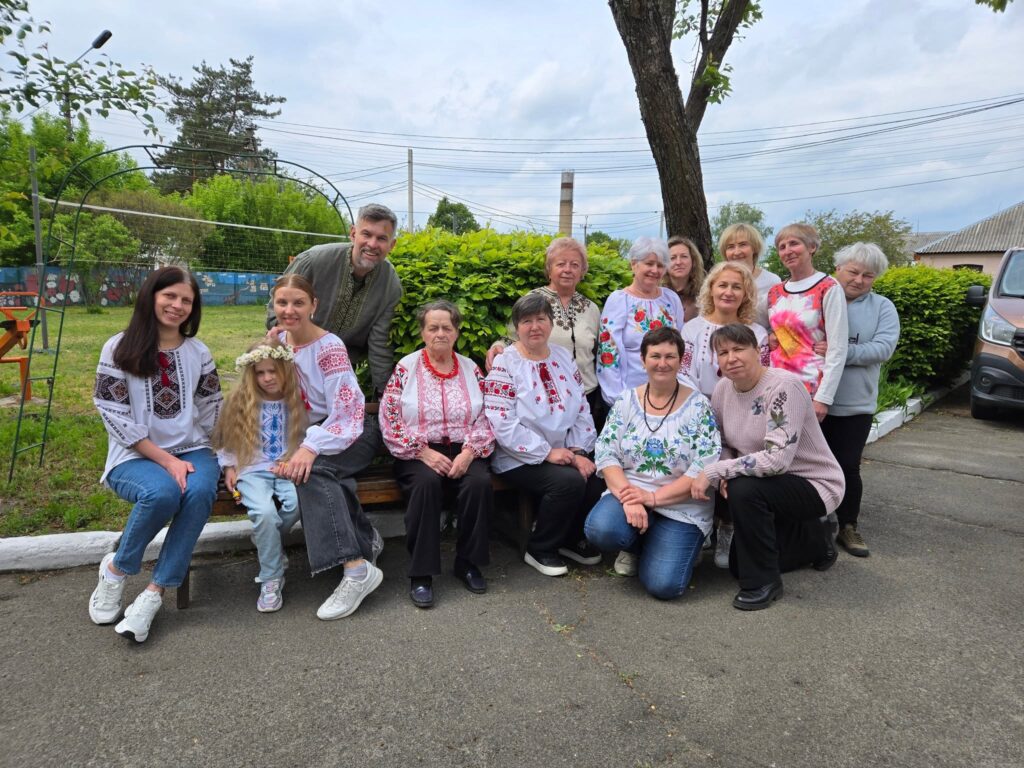
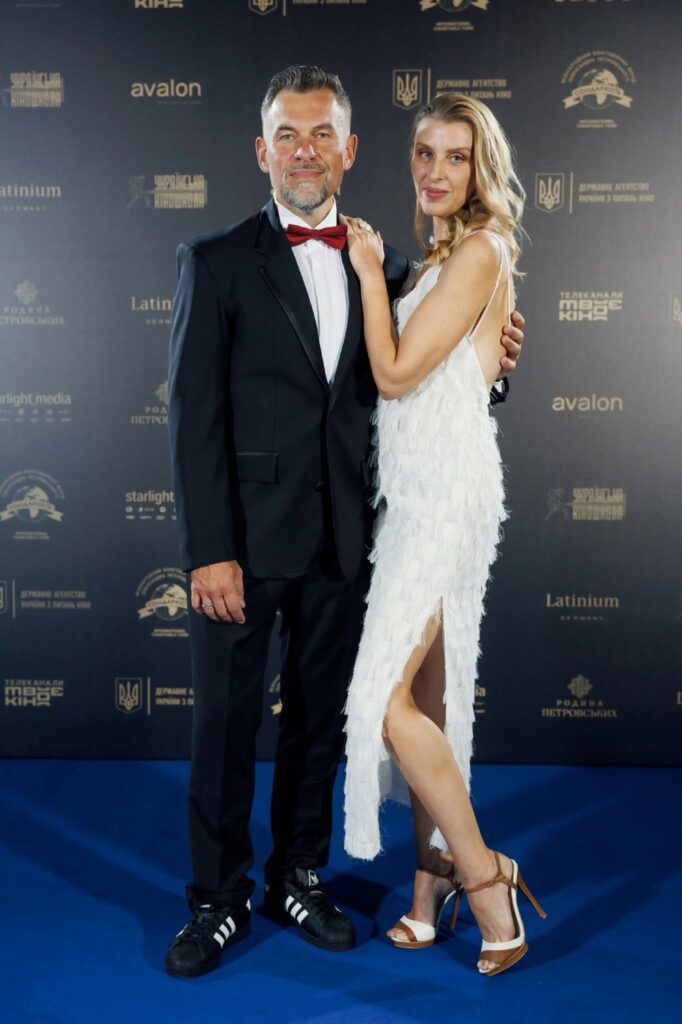
I am from Polissia, from the town of Ivankiv in Vyshhorod district, Kyiv region. After finishing school, I lived in Kyiv all the time. At one point, I ran a modeling business, and my husband, Hennadii Popenko, and I organized creative events together. If someone had told me back then that my experience organizing large events for several thousand people would one day help me manage the work of 200 people during a war, I never would have believed them.
I didn’t follow the news. We didn’t have a television or radio at home, and as a happy mother, I devoted all my time to my daughters — two-year-old Sviatoslava and nine-year-old Bohdana. My husband tried to shield me from worry so that my breast milk wouldn’t dry up. But I don’t know how right that was, because when Russia launched its full-scale invasion on February 24, 2022, I was completely lost. We left our home wearing whatever we had on, taking just one change of clothes for our younger daughter. My husband grabbed some documents, but in the rush, he forgot all our passports.
We went to Ivankiv to stay with my parents, hoping everything would be over quickly — and, in fact, we headed straight into the advancing invasion. By the time we were thinking about what to do next, it was already too late to leave. The area had come under occupation. It was the most frightening period of my life. God forbid anyone should ever have to go through something like that. It was a complete sense of helplessness and powerlessness, not knowing what tomorrow would bring, or even what would happen a minute from then.
The occupiers had established a helicopter route over our town, and almost every night they flew over to bomb Kyiv. One sunny morning in March, I decided to spend at least a little time outside with the children. Suddenly, a helicopter hovered right between our house and an outbuilding. It was flying so low that, despite my poor eyesight, I could see the pilot’s glasses, his hair, and even the numbers on the bomb. I didn’t know whether he was about to drop it, but I could think of only one thing: please, just not in our yard.
Fortunately, we were spared that time, and throughout the entire occupation as well — Russian soldiers never physically reached us. Our street is a dead end leading down to the river, and they were afraid of streets like that.
There was a constant rumble near the bridge not far from our house — long columns of Russian military equipment were moving toward Kyiv. While we still had a connection, my husband and son-in-law would quietly launch a drone and send information about their movements to Kyiv. One day, we heard the columns coming back and thought it was a redeployment. Then an unusual silence fell. We went down to the river and saw a box from some kind of ammunition being carried away by the current. About half an hour later, there was a huge explosion — the blast lifted us about ten centimeters off the ground. Later, we learned that the occupiers had blown up the bridge. And what we had thought was a redeployment turned out to be a retreat.
The next day, we learned that Ivankiv had been liberated. We could hardly believe it — it was April 1, April Fools’ Day. It was a day of incredible joy! We tried to find a phone connection so we could call our relatives and tell them that we were alive and well, because no one knew what had happened to us.
How the Volunteer Effort Began
Just one day after the town was liberated, my husband and I realized that the bridge had been destroyed, there was no food left in the shops, the pharmacies were closed, and bank cards were not working. Since Hena worked in the media, he managed to arrange humanitarian aid. After seeing how disorganized the distribution of other humanitarian supplies was, we decided to set up our own volunteer center, where we would collect, sort, and distribute aid, prioritizing those who needed it most.
A month later, once the situation with food and essential goods had improved, my husband, who had volunteered to join the army, suggested that we start making camouflage nets. He knew the military needed them, while at the time I simply saw them as pieces of cloth and wasn’t particularly enthusiastic about the idea.
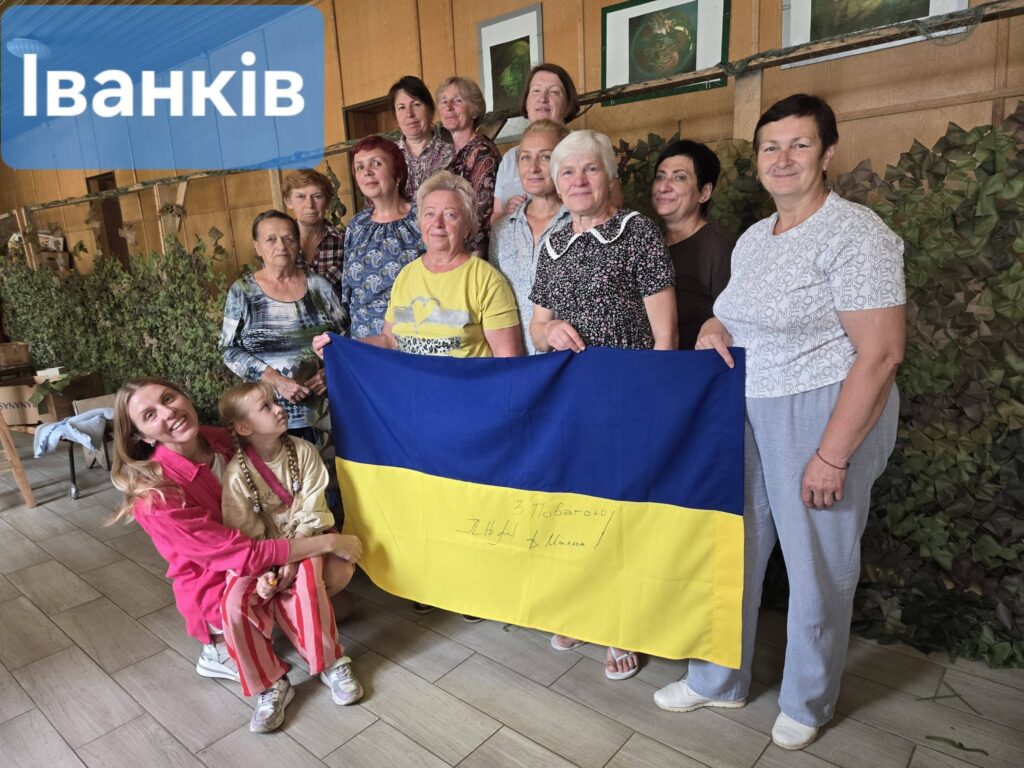
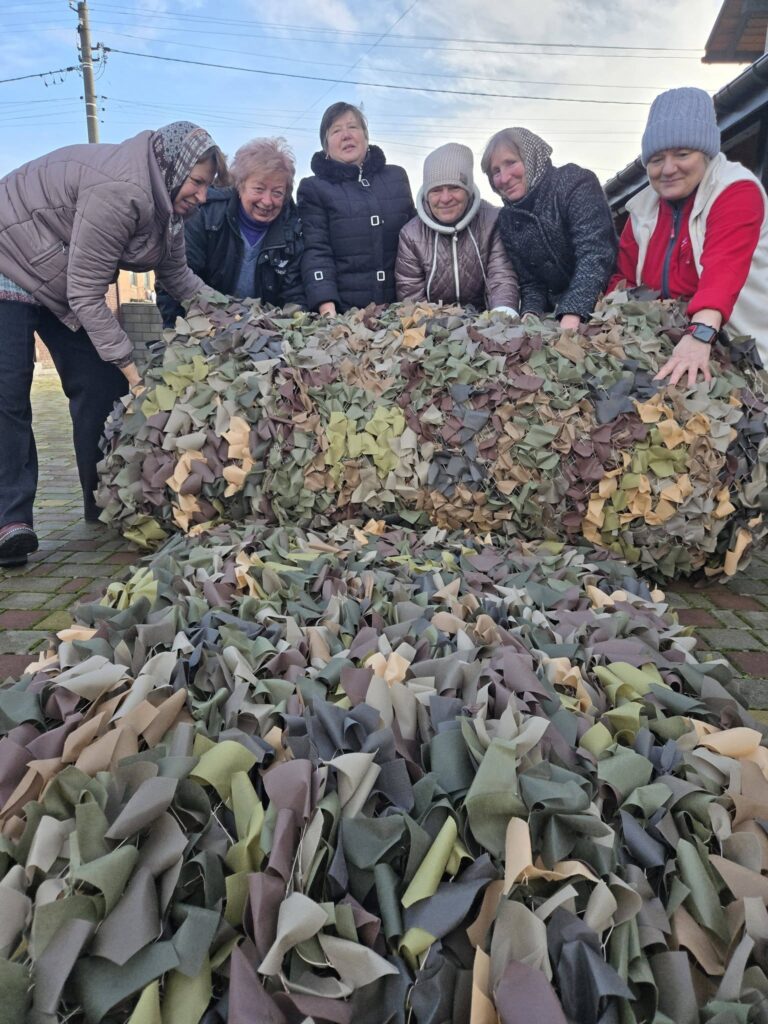
Today, you can buy a special netting base and choose the necessary colors of spunbond fabric. Back in the spring of 2022, nothing like that was available. Together with the local women who had been with me from the very first day of our volunteer center — which we named 4.5.0, a military phrase meaning, “Everything is fine, the situation is under control” — I started posting appeals on social media asking people to bring fabric and old clothes. People responded. We sorted through the clothes for the right colors, bought thread, and made the netting base ourselves.
Later, we found a warehouse filled with old military clothing dating back to the 1980s. It was damp, moldy, and had an unbearable smell. After unloading an entire KamAZ truckload, we put out a call on Facebook asking people to help wash it. Employees from kindergartens, libraries, the local House of Culture, and other residents of the town joined in. In the end, even clothing left behind by the occupiers became part of the camouflage used by Ukrainian soldiers. We also found clothes belonging to people who had fled at abandoned positions in the forest, washed them in the river, dried them, and wove them into the nets.
Our first nets were 3×4 or 4×6 meters in size — today, those are the smallest formats we make. They were also heavy and the colors were not particularly well suited to camouflage.
Every Position Has Its Own “Formula”: From First Attempts to Our Own Weaving Technique
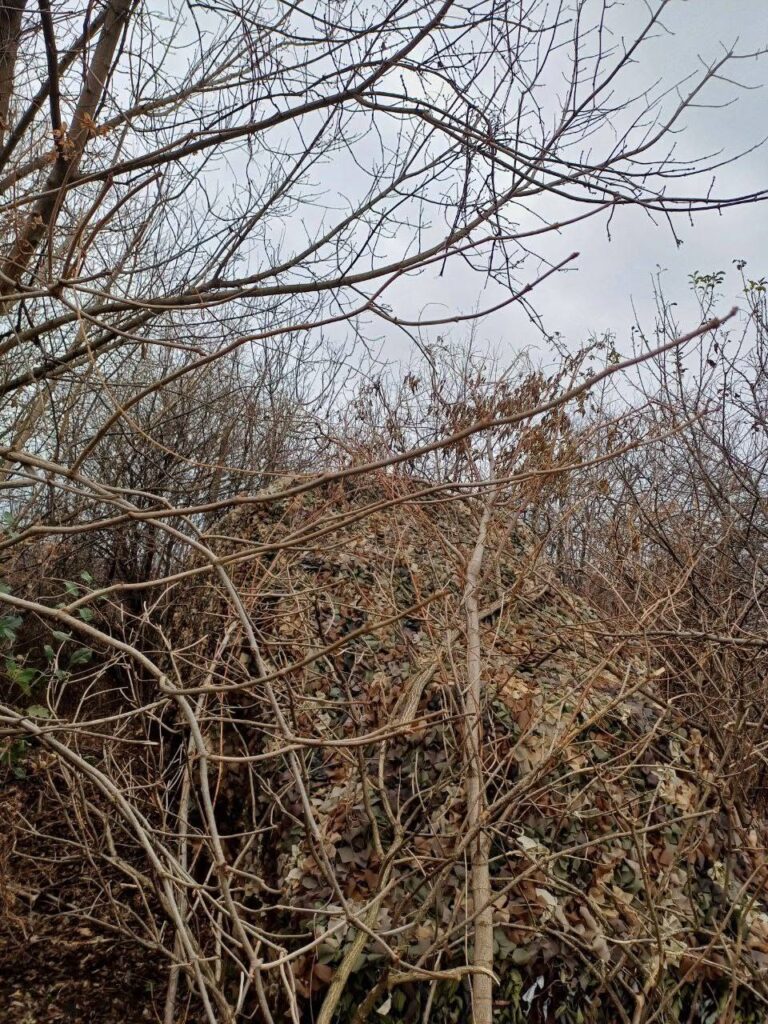
Over time, I realized that if a net has fewer than four colors, it becomes what we call an “anti-net” — instead of protecting the soldiers, it actually gives them away. That’s why we try to reproduce the natural palette as closely as possible: we use four to six different shades of green and beige, as well as black, gray, and brown.
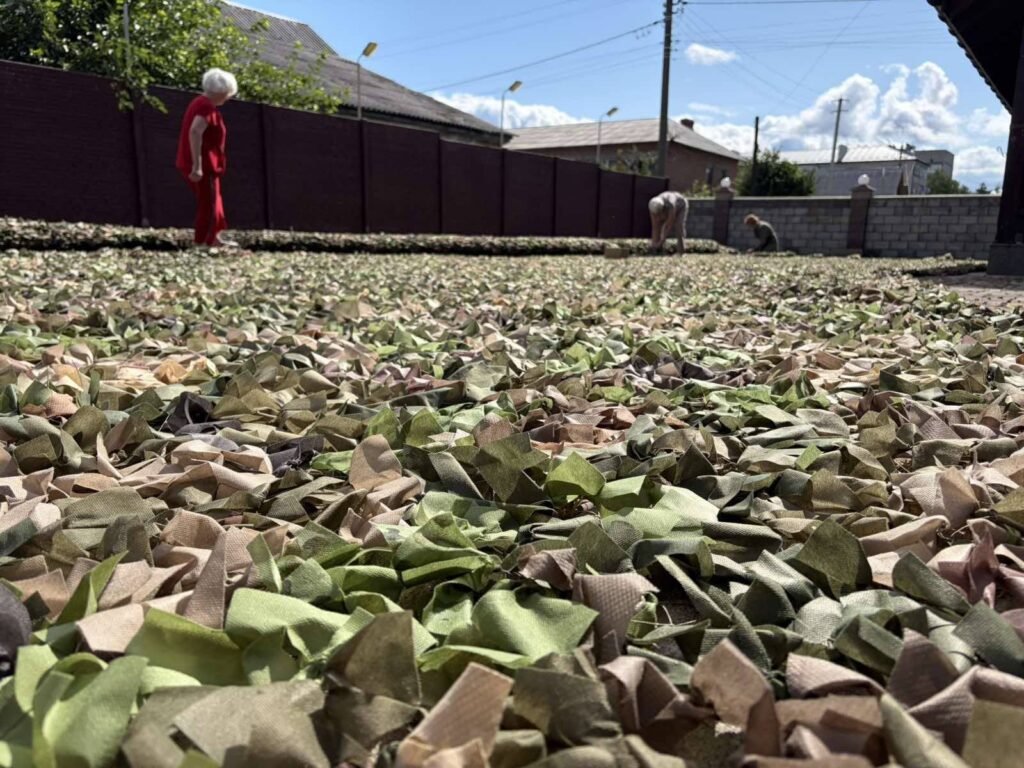
For this, I ask the soldiers to send me photos of the area that needs to be camouflaged, and then I choose the fabric accordingly. It’s not just the shades that matter, but also the size and placement of the larger and smaller pieces, which need to create a natural pattern without straight geometric lines. Every position is different.
When the guys tell me, “I’m in the forest,” I ask what kind of forest it is: deciduous, pine, or mixed; whether the foliage is dark or light; whether there are ferns or pine branches on the ground. It’s just as important to know whether it’s a field, a road, a river, reeds, sand, or dark soil, and which region it is in — Kherson, Zaporizhzhia, Kharkiv, or Polissia.
That’s why I develop a separate color “formula” for every net. The soldiers tell us that our nets are top-notch.
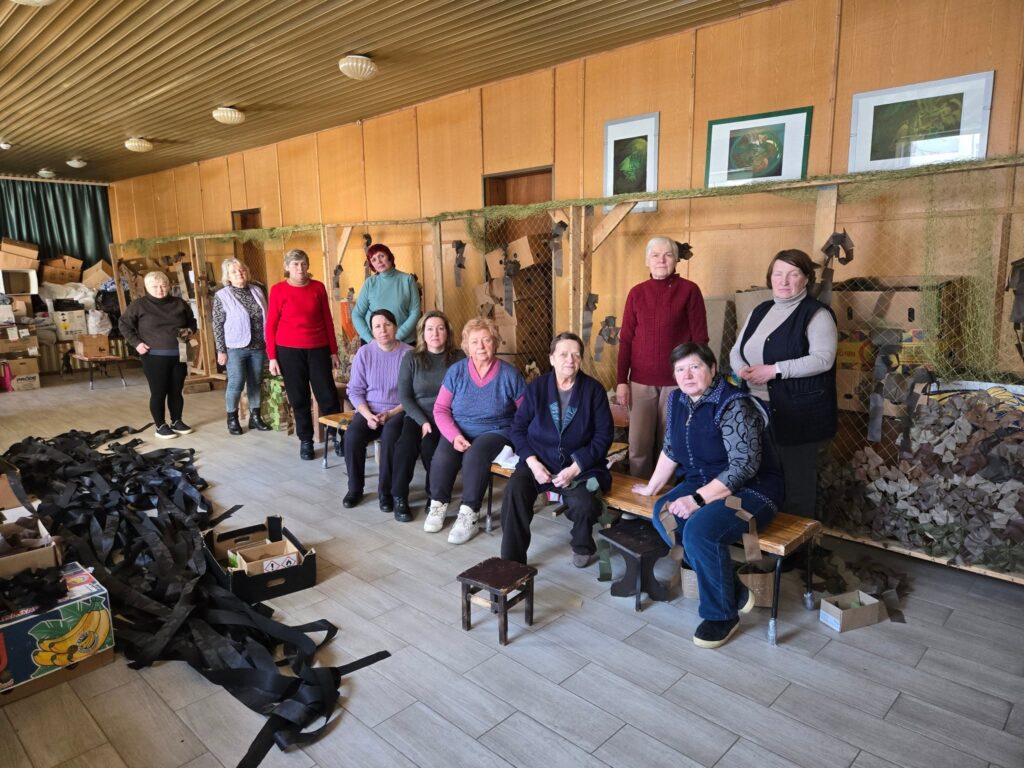
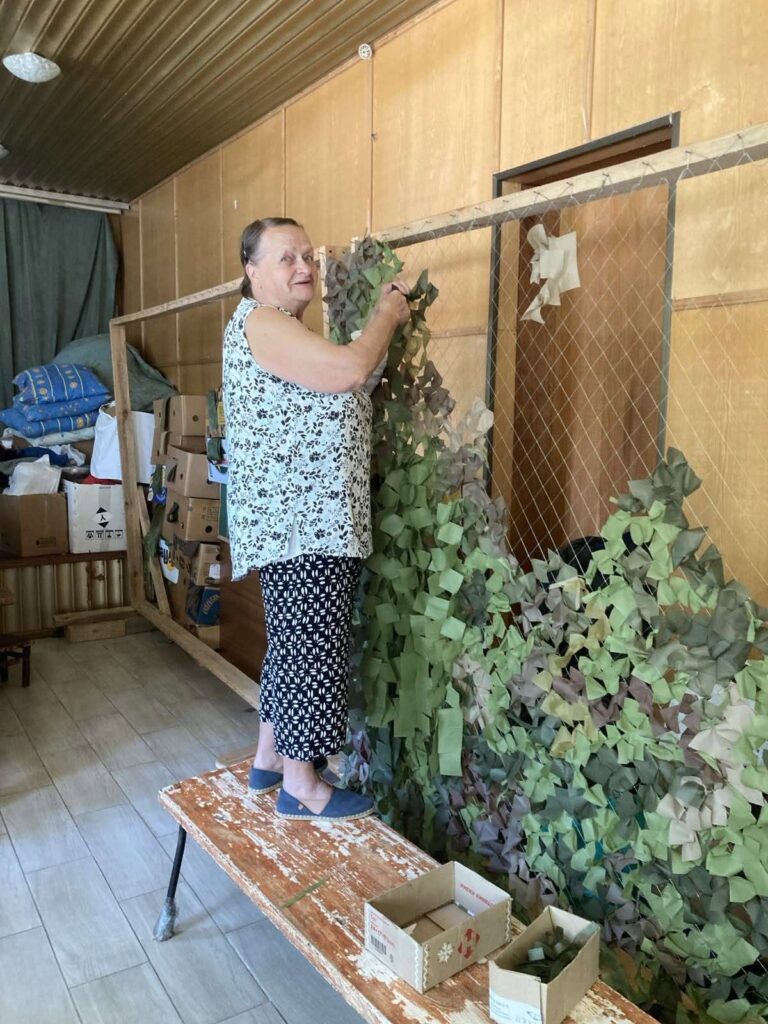
At first, we made the nets only in Ivankiv. When the number of orders became greater than we could handle, women from other villages in the hromada began joining us. Today, we have nine villages that participate on a regular basis, and in winter, when there is less work in the fields and gardens, several more join in. At that time, the total number of volunteers exceeds 200; during the rest of the year, around 150 people are consistently involved in weaving the nets.
Most of them are women, but there are also men — drivers, because making the nets also involves logistics. We practically never have days off. Some of our women even work until seven or eight in the evening on New Year’s Day.
One of our volunteers is 92 years old. She finds it difficult to walk now, but at home she sorts and cuts the strips of fabric. Another woman, from Ivankiv, is 82. Every day, from eight in the morning until noon, she stands and weaves.
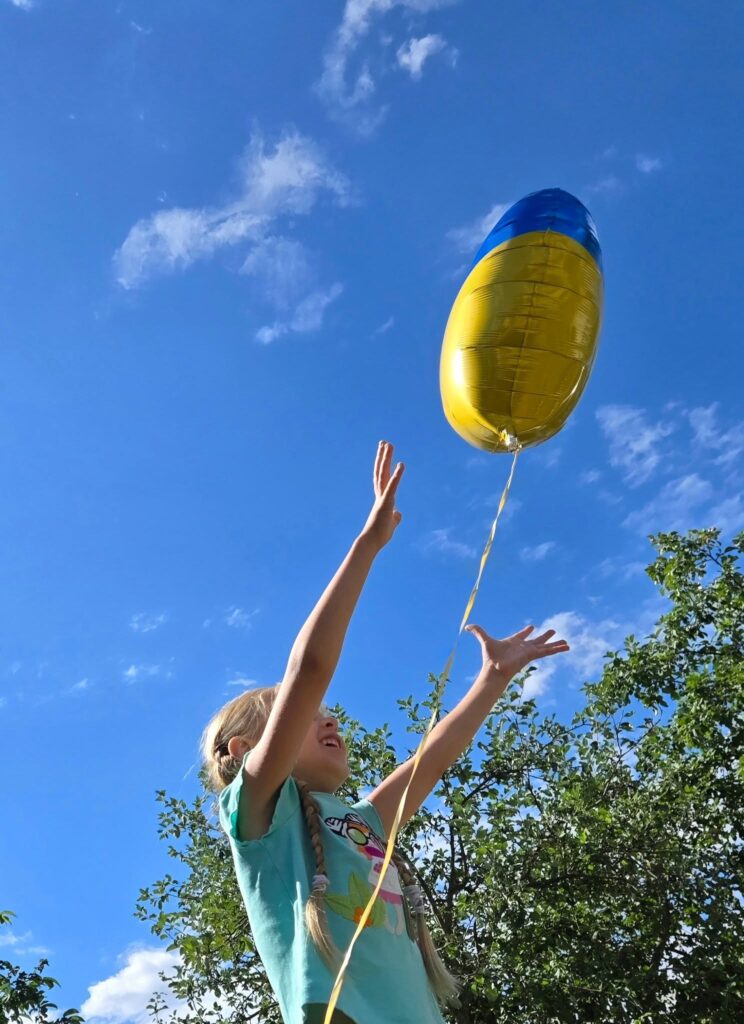
And our youngest volunteer is my daughter, Sviatoslava. She started out by sweeping the floor, then began drawing pictures for the soldiers, and now she helps me cut the netting base. Almost every weekend, we prepare 200–400 meters of it.
Of course, she would rather be playing, but she has never once refused to help. Just imagine how much she wants Ukraine to win: she saves her pocket money for… a tank.
On average, we need 20 rolls of fabric a month. As of today, one roll costs 4,000 hryvnias, and the price keeps rising. We managed to find a partner — a Ukrainian agricultural holding company. The company provides enough funding to cover the cost of the fabric, while we raise the money for the netting base ourselves.
By my estimates, our center has made nearly 100,000 square meters of camouflage nets for the military so far. That is especially significant given the complex weaving technique, which considerably slows down the process. As a result, we consistently have a waiting list of one to one and a half months.
We also look for refrigerators, dishes, bed linens, pillows, mattresses, beds, microwaves, and clothing for the military. People are constantly getting involved and helping, and this ongoing flow of donated goods never stops.
When Nets Become Stories — and Why We Have to Keep Going
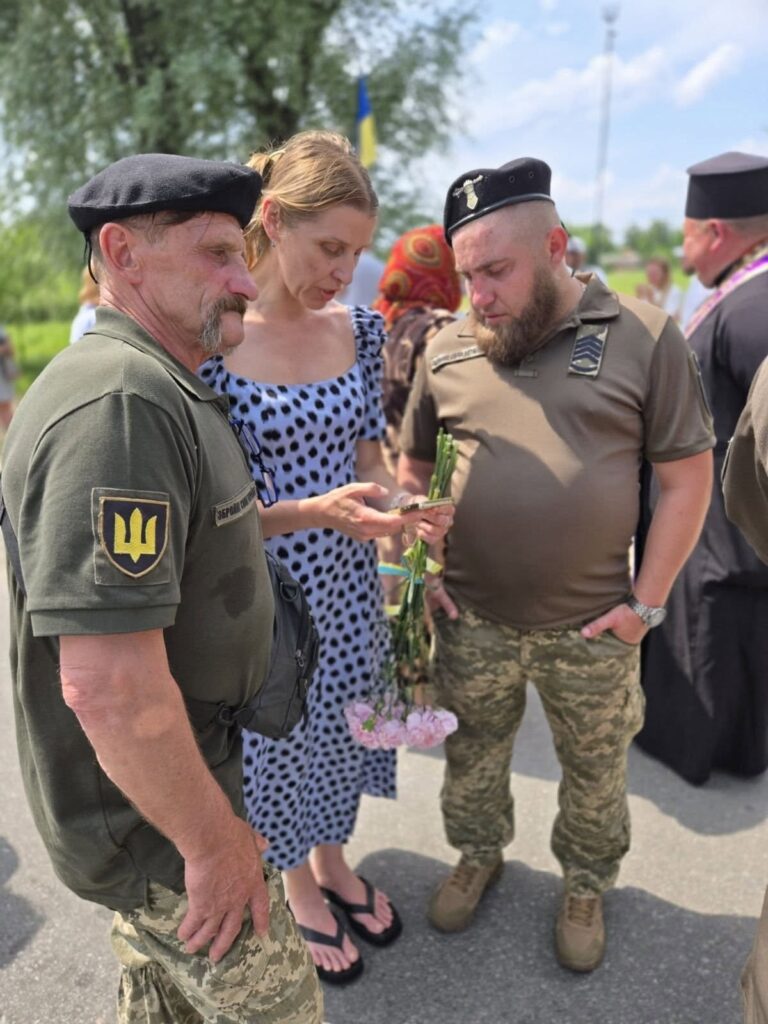
The guys call us and thank us for lives that have been saved. There have been several remarkable stories, and my husband and I want to make a film about them. Hennadii, who, after three and a half years of military service, moved into a role as a spokesperson for the Ministry of Veterans due to an injury, has already written the screenplay.
Here is one of the stories that actually happened. Three crews set out to carry out a mission. When enemy drones appeared overhead, one crew managed to take cover under a camouflage net. The men from the second vehicle ran over to join them, and that saved their lives — their vehicle was destroyed. Unfortunately, the third crew was killed. In total, the camouflage helped save seven people that day.
There have even been cases when soldiers “took” our net from other soldiers. They went into a shop, and when they came back out, the net that had been covering a pickup truck carrying essential supplies had already been used to cover another vehicle. That’s recognition (laughs).
Lately, there are times when we feel like giving up: the needs are not getting any smaller, while our resources are becoming more limited. But after a few days, the women volunteers lift our spirits, or the soldiers call and say, “It fit perfectly — a top-notch net! We’re kissing your hands.” And we keep going.