The beginning of the story is in the first part of the article.
You have worked extensively with people with disabilities. What has this experience given you personally? Has it changed the way you see the lives of people with disabilities? And what, in your view, does Ukrainian society still not fully understand about their everyday needs and lives?
Perhaps the most valuable thing my friendships with people with disabilities have given me is genuine mutual affection and unconditional love. The kind of acceptance I feel around my friends is difficult to find anywhere else.
It makes me sad that people with disabilities are still isolated from society in so many ways. We may be moving toward greater inclusion, but stereotypes and stigma still often prevail.
I remember that one Easter, Liusia, a small team, and I went to the Novobilychi Psychoneurological Boarding Facility for Men. One of the volunteers turned back halfway there because she had heard that the men living there were supposedly very aggressive. In the end, we wished the residents a happy Palm Sunday, and they were so kind and grateful that I felt terribly saddened by the stigma surrounding them. They are genuinely wonderful and creative people.
Our dream is to organize traveling workshops for them.
Novobilychi provides fairly comfortable conditions for its residents: it has wonderful administrators, doctors, and caregivers. But in many such institutions—boarding facilities, residential institutions, and hospitals—people spend years living behind closed doors, without the freedom to leave the facility without special permission.
It is difficult to imagine how a life like that could improve their physical or mental well-being.
After traveling to Poland, Italy, Germany, and the Netherlands, I became especially aware of how far Ukraine still has to go—psychologically, technologically, and, to some extent, bureaucratically. In the Netherlands, I was struck by how comfortable and inclusive even small towns could be. People who use wheelchairs moved around the city independently, used public transportation without additional assistance, and visited parks and galleries. In Ukraine, it is still difficult to imagine such a picture even in the capital.
In Rome, I also saw co-housing communities run by the Community of Sant’Egidio, where people with disabilities live together as groups of friends, have their own personal space and much greater freedom, pursue their interests, and go to exhibitions, for walks, or to the cinema.
The Community has established a similar home in Ivano-Frankivsk, and our friends there have become much more independent and confident. They started going out around the city freely, going to the cinema and attending workshops. We would very much like to create a similar co-housing community in Kyiv as well.
Another important realization for me is that people with disabilities, especially those with intellectual disabilities, are often mistakenly treated as children. But they are adults. Their way of thinking may be different, but that doesn’t make them “childlike.” They expect to be treated as equals. When our stigma makes them feel helpless, they may eventually begin to conform to that image.
I would like us to have more shared spaces built around equality, where everyone is taken seriously and mutual respect is the foundation of communication.
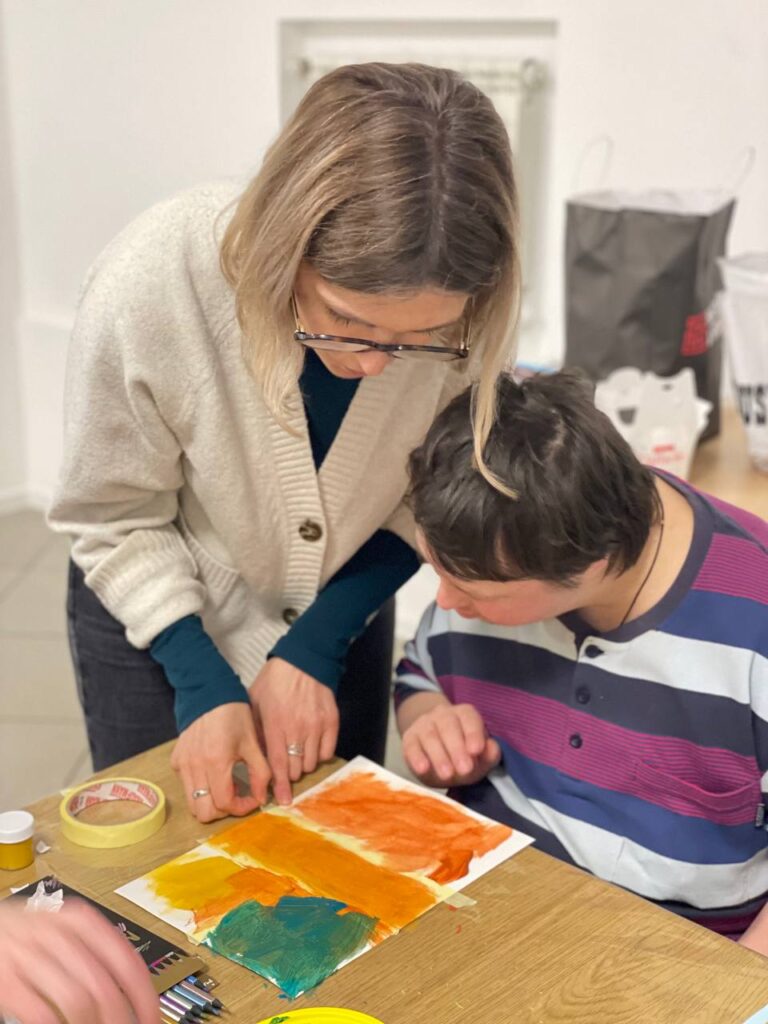
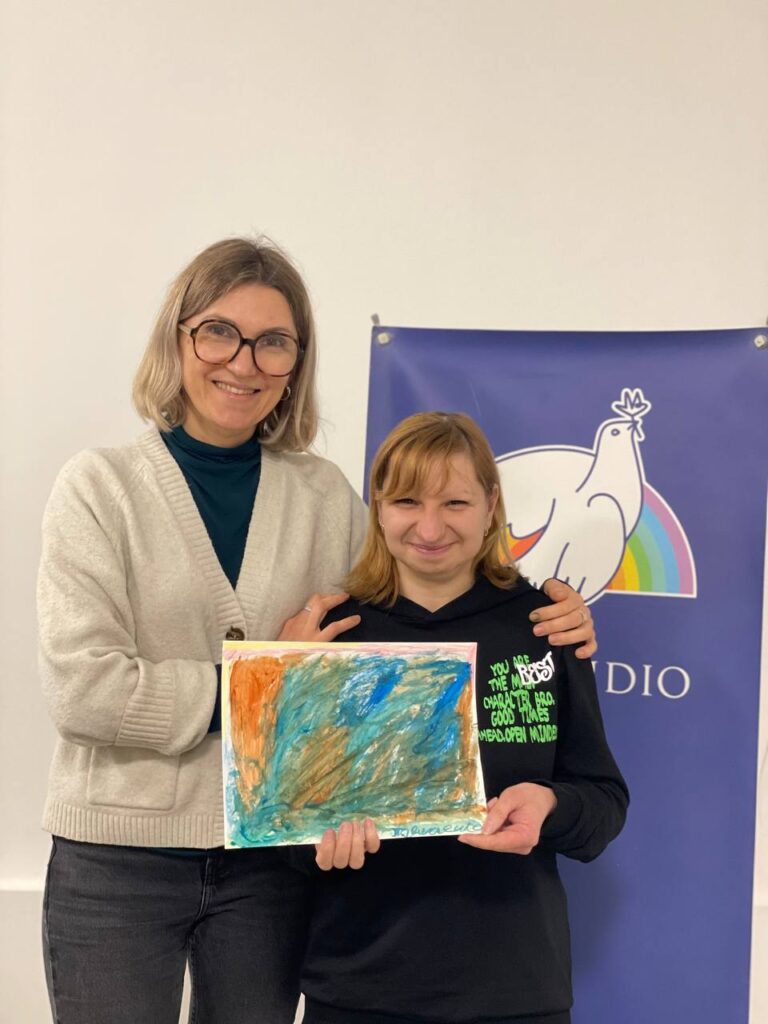
Every Wednesday after the Workshop, we gather around one table: we drink tea, talk, play games, joke around, celebrate birthdays, and discuss the news. I would like to see more volunteers around that table—people who want to help and are not afraid of people with disabilities.
Over the course of your volunteer work, you have met many people with difficult life stories. Is there a person or story that has stayed with you in a particularly powerful way and reminds you, time and again, why you continue volunteering?
Oh, this is probably the most emotionally difficult question. I have heard so many difficult stories, but what hurts me most is what children have been through.
Perhaps my “special” story happened in Lviv, when I was visiting one of the Community’s mobile humanitarian centers in a modular settlement.
There I met a 10-year-old girl who asked me to buy her a jar of olives. We spent a lot of time together that day, and while we were walking, she told me about their evacuation from Donbas: how they had spent a long time living in a basement, how people had tried to separate her from her father during the evacuation, and how frightened she had been.
Later, her family lived abroad, but they were unable to adapt there and eventually returned to Ukraine. They now live in a modular settlement in Lviv. The girl has diabetes, while her younger brother has a musculoskeletal condition, so their father constantly monitors their health.
Later, we went with the other children to the “School of Peace” to draw postcards. I noticed that the girl kept asking me to write things for her instead. It turned out that because of their constant moves, she had missed a lot of school. She was still in the second grade and had only just begun catching up with the curriculum. She also found it difficult to adapt to a new school and learn Ukrainian, and both she and her brother were bullied because they spoke Russian.
But by that point, she was already essentially fluent in Ukrainian. I realize what an enormous journey she had been through.
That day, we played, talked, and hugged a lot. She dreamed of a nice makeup bag, cool clothes, a better phone, and, more than anything, a cat.
I wanted so badly to give her everything she dreamed of and take her away from that cramped modular settlement.
Later, my mother bought clothes for the children, and I sent the girl some children’s cosmetics. But I still feel that perhaps I should have stayed in touch with her more. For some reason, it was psychologically very difficult for me to maintain that connection.
I know that people are still in touch with this family and that quite a few young people have become friends with her, but I still think of her often whenever other children come to our centers.
She is an incredible girl. I would really like to tell her how proud I am of her—for being so cheerful and active, and for continuing to look at this not-always-friendly world with such curiosity.
Perhaps I really should go visit my little friend.
Volunteering is not only about helping others; it also comes with a constant emotional burden. After more than four years of war, many volunteers talk about fatigue, exhaustion, and burnout. Have there been moments in your life when things felt particularly difficult? What helps you maintain your motivation and continue helping others?
Yes, of course. From time to time, I find myself lacking the energy to go either to the center or to the Workshop.
The exhaustion of war, the constant stream of sad news, and a growing sense of hopelessness can really take their toll. In those moments, it is easy to start thinking that my small actions will not change anything on a larger scale, and even to feel guilty, as if I am not doing enough.
When that happens, I try to take care of myself: I limit my time on social media and in the news, and do something repetitive or creative. The support of my husband, family, and friends helps enormously, as do conversations with my therapist. I am learning to allow myself to take breaks because I know that otherwise, my body and mind may suffer in the long run. So it is important to listen to yourself.
There is an important rule in the Community: never act alone, but always work together, in groups. Otherwise, the risk of burnout becomes very high within the first few months.
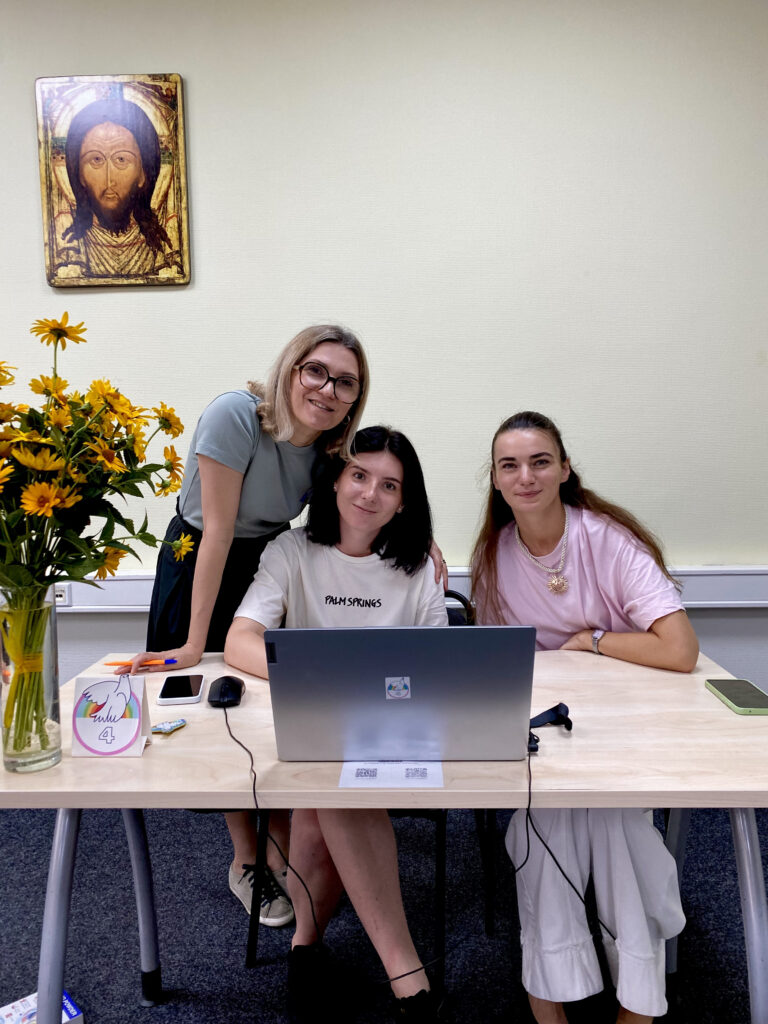
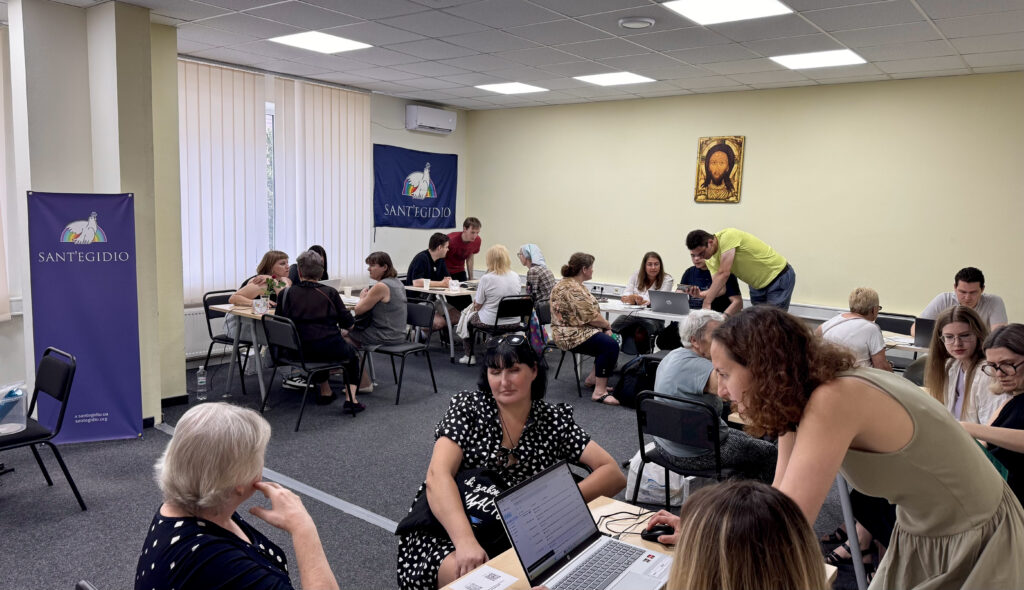
So working together, as a true community, is one of the core principles of what we do. That is why it is so important for as many like-minded people as possible to join us.
Conversations with coordinators and friends who have extensive volunteering experience also help me enormously. Simply sharing your thoughts, feelings, and fears can be incredibly supportive.
If you compare yourself before the full-scale invasion with who you are today, what do you think has changed the most? What has this journey taught you, and what lessons have you taken from it?
I think I have become more fearless and more active.
Before, I was afraid to talk about my volunteering, almost as if I was ashamed of it. I worried that people would try to discourage me or look at me with suspicion.
Now it is much easier for me to talk about what I do, what is needed, and the work we are doing. And, surprisingly, when I started sharing these stories on social media, many of my friends supported me—they began donating items for older people, children, and the military.
It is as if, when I became more open to the world, the people around me responded in kind.
That gives me a very special sense of working toward the common good. And ultimately, I learned this openness from my friends with disabilities, from children, and from older people.
My mother also told me that she was very proud of me, and those words of support meant an enormous amount to me.
I have become more resilient and started to understand my own values better. Concepts such as humanity and equality have taken on a special meaning for me. I would not want them to remain empty words for any of us.
That is why I attend rallies and respond differently to social and political issues. I feel more active, and I feel that my voice matters.
Volunteering helps you develop your own understanding of the world, your sense of purpose, your vision of the kind of country you want to live in, and the kind of treatment you expect, including the way you expect to be treated yourself.
After all, our lives are very fragile, uncertain, and changeable right now. You never know when you might be the one who needs to ask for help.
Finally, I’d like to ask a question that lies at the heart of our project. In your view, what makes Ukraine’s volunteer movement such a phenomenon? What allows it to remain so strong even after so many years of full-scale war?
I now teach Ukrainian to foreigners, and I have repeatedly heard my students express admiration for our courage and resilience. When they ask me how we manage to keep our spirits up, not give up, and not fall into despair, I always find myself at a loss for words.
Sometimes it feels to me as though we have entered a state of perpetual motion, because we simply cannot afford to stop.
For our own survival, it is crucial that we change, become more compassionate, and help one another. That is what keeps our “perpetual-motion machine” running.
We have to do whatever is within our power, even if it seems insignificant—but we have to do it together and with as much dedication as possible.
And yes, I am proud of my wonderful students, who also support Ukraine in so many ways—they take part in humanitarian initiatives and support the military. My work has become a tremendous source of strength for me, and my students inspire me enormously.
Translator: Ivan Chepaykin


