Telling the stories of Ukrainians who were victims of Russian aggression, honouring the civilians and military who gave their lives for our freedom — all this is of great value today, when Ukraine has been defending its independence from the Russian army for more than 10 years. These are people with their own history, with different dreams and goals, and we need to know about them. That is why it is so important that the project that preserves the memory of our heroes and tells their stories, the Memorial Platform:Victims of Russia, was recognised as the best social project of 2024 in the annual award organised by the Ukrayinska Pravda media outlet.
We were delighted to have the opportunity to speak with Yulia Lozynska, the editor-in-chief of the platform.
In today’s fast-moving world, publications that specialise in identifying and debunking fake news play a particularly important role. Their work helps ordinary citizens to better navigate the information overload that now surrounds us, and to avoid the spread of various kinds of manipulation and lies. We decided to look at the methods and tools used by fact-checking platforms StopFake, Behind the News and Washington Post Fact Checker to debunk fakes and provide their audiences with only true information.
In the modern world, information wars have become an integral part of conflicts between states. Ukraine, which has been suffering from Russian aggression for more than 10 years, is also fighting on the information front to spread only true information about what is happening on its territory. At the same time, Russian and pro-Russian propaganda media, telegram sources and YouTube channels are actively and daily spreading fakes aimed at manipulating public opinion, sowing discord within Ukrainian society and undermining trust in Ukrainian institutions.
The war in Ukraine. The biggest armed conflict the world has seen since the Second World War. The most devastating invasion in the heart of Europe since the days of the Nazis and Hitler, one that has created millions of refugees, destroyed homes and raised the threat of all-out nuclear war to unimaginable levels. I think it has never been greater, especially since the end of the Cold War between the Soviet Union and the United States.
As a society, we often look at various countries we admire and strive to achieve the same level of development. And this is justified. In my opinion, in order to develop and become better, we need to have great examples to look up to (especially when it comes to countries that started with almost nothing but managed to create a cool and successful nation of happy people in a relatively short period of time).
Austin Malloy joined Radio Free Europe/Radio Liberty as multimedia editor in June 2022. Previously, he was the head of multimedia at The Kyiv Post in Ukraine. For Truthful Reporting, Austin Malloy shares his insights, advice and years of experience.
We are always very happy to communicate with talented and ambitious Ukrainian youth who, despite all the difficulties and challenges of today, continue to create, do cool things, work on various projects, establish their own NGOs, student publications and report on the lives and experiences of Ukrainians during full-scale war. I had the opportunity to talk to Oleksandra Gotsuliak. Oleksandra is an activist and a member of the language NGO RVN (Making You Nervous), which works to de-Russify Odesa. She works as a scriptwriter in the video team, where she is involved in creating materials that help rethink the linguistic and cultural environment of the city. She is also editor-in-chief of the student publication DeFacto.
Today I had the opportunity to talk to one of Ukraine’s young ambitious people, Sofiia Yevchenko. Despite her young age, she has already completed internships in various institutions and organisations, is actively involved in the development of the European Youth Ambassadors (YEAs) initiative in Ukraine, is a member of the Academy of Youth Diplomacy “United Youth”, the Women’s League and the Coordination Platform of Ukrainians Abroad, and has completed internships at the Verkhovna Rada of Ukraine and the Ministry of Youth and Sports of Ukraine. Sofiia is currently interning at the IFES Ukraine office.
Playwright, screenwriter, journalist and war correspondent Oksana Grytsenko is sharing her years of professional experience, advice and valuable insights from working in the media with our students. Oksana has long worked in English language journalism, travelling to and reporting from war zones. In recent years, she has been writing plays, which have been performed in various cities in Ukraine and abroad. And her play Don Juan of Zhashkiv became the basis for the script of a feature film of the same name, to be produced by Kristi Films in 2021.
Today we got to talk with Oleksandra Panyak, Head of Media Relations at Truman, who has been working in media relations for 10 years. Last year, she and her team placed hundreds of articles in the media, including The Guardian, The Wall Street Journal, The Times, etc. Their high-profile investigations into international business in Russia have attracted worldwide publicity and millions of views.
This story about a young mother on maternity leave who finds her own unique way to help and be useful. Roksolana Myhovych-Kovbasniuk shares her valuable experience and emphasizes the importance of every contribution to the common goal. She does not stop at any obstacles and finds how to help and support Ukrainians on the way to our victory.
At first, no one believed that Nadiya Radchuk from Rivne had the right idea to visit the wounded in hospital. But the 24-year-old president of the Rivne Rotaract Club persevered, and was touched by the gratitude of the wounded. Now, more people are joining the initiative, and Nadiya is looking for ways to expand support for the wounded.
We continue our interview with Anna. Today we will learn more about her participation in various scholarship programmes and her interactions with European politicians. Finally, she will tell us what Ukraine’s victory in this war means to her and how she interprets this concept.
Stella Marchuk, 29, works in IT and devotes her free time to her art, creating souvenirs with her own illustrations. For her, this is the perfect balance, although it took some time to find. In the early days of the full-scale invasion, the artist did not understand how she could make art, but later she saw it as a tool to capture memories and emotions and to volunteer. Now she sends her postcards to military hospitals to express words of support and gratitude for our defence through art, and donates part of the proceeds to the Ukrainian army.
Today we talk with Anna Husenytsia. She is currently developing her own project to support young leaders in Ukraine, working in the field of youth diplomacy and has already had the opportunity to visit the European Parliament and talk to European leaders. Read more in our interview below.
For Svitlana Pochepets, a resident of Kyiv, the first two weeks of the occupation were the most terrifying in almost two years of large-scale Russian-Ukrainian war. Although the occupiers did not enter the village of the dacha where she lived with her family because of its good geographical location, it was unbearable to leave through a Russian checkpoint, to see the destroyed buildings, the foreign flag and to hear the enemy language.
The history of the modern Donetsk region has deep roots intertwined with the history of the Ukrainian people. Russian occupiers faced resistance from the pro-Ukrainian movement in Donetsk.
Війна, непередбачувана і лячна, завдає страждань та руйнує життя тисяч людей. Наразі вона перебуває в центрі уваги кожного українця, має величезний вплив на нашу країну та суспільство. Кожен з нас внаслідок цієї війни в певний період мав зіштовхнутись зі складним вибором, який вирішує подальшу долю.
Steve Parker is 54 years old. He is an ex-serviceman who, before the war in Ukraine, was a owner of Boxers Barbers in Wickford, lived with his girlfriend and her daughter, had a dog and lived a happy, peaceful life. He became a volunteer in March 2022.
Today we want to show you the letters of a mother who stayed in Mariupol with her husband to her son living in Kharkiv. They describe in detail the whole disaster happening in Mariupol.
The morning of February 24, it’s 6:07 a.m. A muffled phone call. I pick up the phone and hear a confused but surprisingly calm voice: «Wake up! Iro! Putin invaded Ukraine! War!».
Колишні студенти журналістики діляться своєю історією створення подкасту про молодих українців, які змінюють світ і надихають.


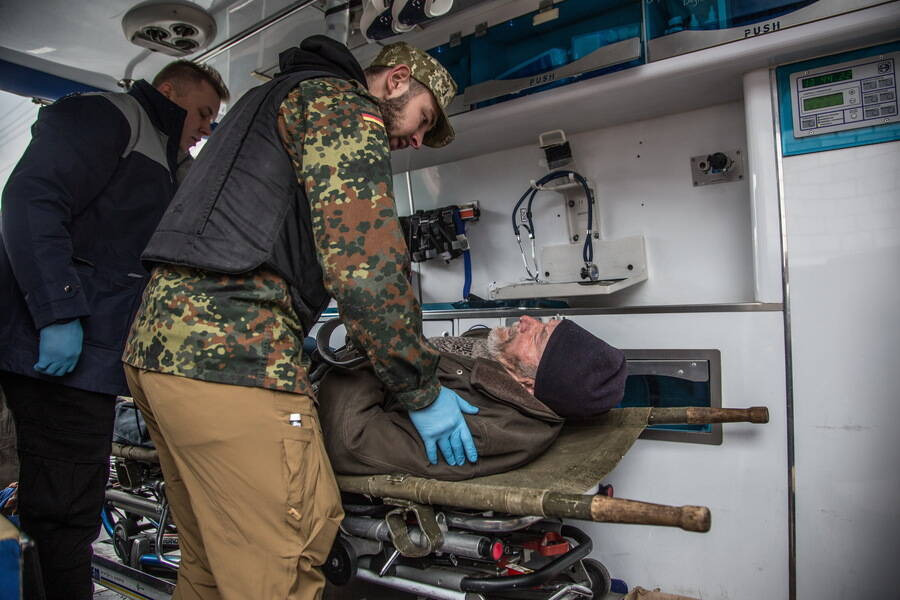 Elderly man in an ambulance. Irpen. Photo: UNIAN