StopFake was founded in 2014 as one of the first platforms dedicated to exposing fakes against Ukraine. The main goal of the project is to refute disinformation spread by Russian media and other propaganda sources.
The initiative was born at the Mohyla School of Journalism. Teachers, students and alumni of the university created a platform to clear the information space of Russian media fakes and to inform Ukrainian society about the dangers of such disinformation. Over the past nine years, the project has collected and documented numerous examples of fakes from Russian sources, becoming a significant archive of evidence of Kremlin propaganda. In 2022, StopFake was added to the archives of the Library of Congress as “a unique historical source that thoroughly covers the evolution and threats of Russian propaganda and disinformation”.
As mentioned above, the original aim of the initiative was to refute fake news and Kremlin propaganda. Today, however, the project has become an information hub that analyses in detail the phenomenon of ‘Russian propaganda’ in all its forms and aspects.
In the first few months of the Russian invasion of Ukraine, StopFake became a sort of veritable citizens’ advice bureau. The readers sent in reports of enemy troop movements, asked for advice on how to respond to social media posts, and even asked for advice on how to communicate with loved ones in Russia. This demonstrated the confusion many people felt at the start of the war, but also their trust in StopFake led them to seek support here. It is therefore not surprising that, according to the USAID/Internews Ukraine Media Consumption Survey, 18% of Ukrainians regularly visit StopFake to check information. In other words, one in six Ukrainians trusts this source, confirming its high level of credibility.
Engaging the public and finding ways to communicate effectively with them has been an important part of StopFake’s policy since its inception. The site has introduced an option for users to send a link to something they think might be fake. You can see what this looks like in the screenshots below:
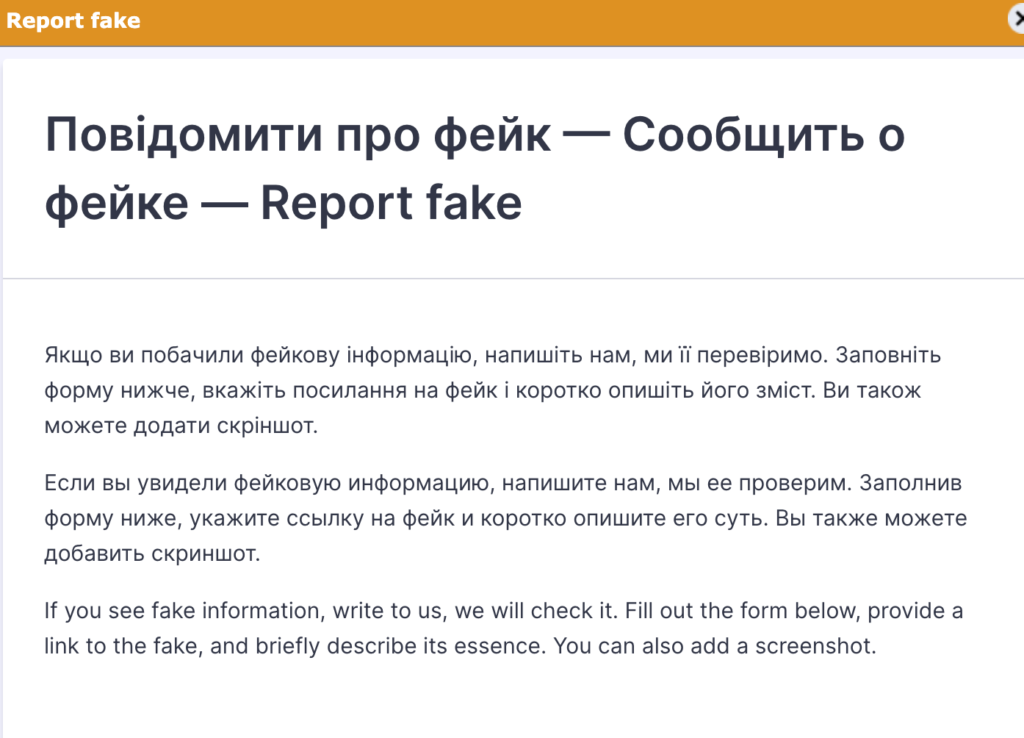
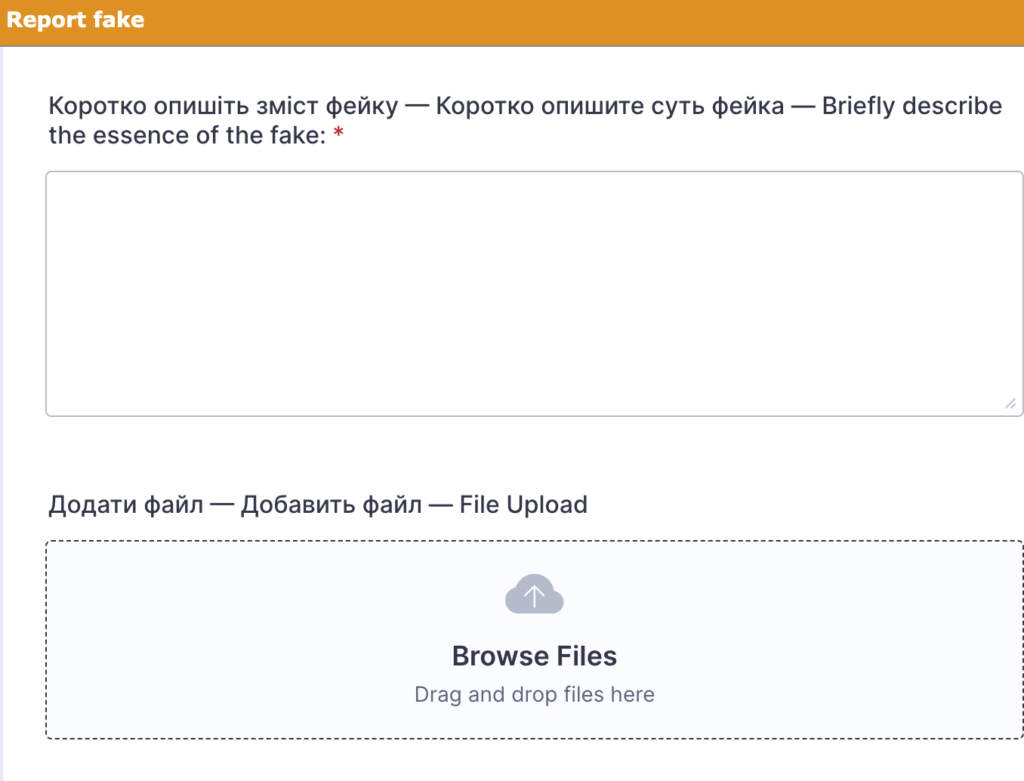
Social media is also actively used to communicate with the public. To go beyond digital platforms and reach a wider audience, StopFake has started working with television and radio. The multimedia team produces videos in Ukrainian, Russian and English. These materials are broadcast not only online but also on television channels, ensuring that the content is accessible to different audiences.
The StopFake project only publishes factual conclusions based on verified data. Funding for it comes from charitable foundations, non-profit organisations and grants, as well as government agencies (in particular, it has received funding from the Czech Ministry of Foreign Affairs and the British Embassy in Ukraine). To ensure objectivity and honesty in its assessments and analysis of information material, the organisation adheres to the principles of impartiality, transparency of sources, openness of funding, clear research methodology and a policy of correction.
For fact-checking, StopFake journalists use material from a variety of sources, including: television and radio reports; publications in the media or on websites; social media posts, both by well-known bloggers and experts, as well as ordinary users.
StopFake also reports on various trends in Russia’s information warfare, analyses its fakes and fake news in a special section called Context, and provides tips and tools for fact-checking. The aim is to promote the culture of fact-checking and encourage users to check information themselves.
How do the StopFake journalists go about debunking misinformation?
At the beginning of the article, they briefly describe the nature of the fake: who spread it and when. A screenshot or other visual evidence is needed, as fakes are often deleted after being debunked. Photographs are used, statistics are presented, information is gathered from official sources that can be trusted, data from scientific studies are provided, as well as comments from experts who have been working on a particular topic for many years. If the refutation concerns a video, a link to it is included, with the exact time at which the falsification begins. In the absence of obvious evidence, then refutation is carried out through logical analysis, demonstrating that the information contradicts all the facts we already know about a particular event, as well as common sense. It is also a common practice in their materials to point out various logical errors made by fake news makers, which any of us can spot if we read the information more carefully.
Let’s talk a little more about how StopFake works:
1. Source monitoring and analysis: StopFake regularly analyses news sites, social media, Telegram channels, as well as official statements and media platforms that spread fake news. The publication monitors popular narratives that often contain false information related to the war in Ukraine, the Ukrainian government, European partners and international organisations.
2. Fact-checking based on verified sources: StopFake uses trusted official sources, analytical reports and comments from renowned experts to verify information. By comparing different sources, the team identifies manipulation and provides detailed explanations.
3. Using technology to verify images and videos: StopFake actively uses technology to analyse media content, including reverse image searches to identify the original source. This allows them to identify cases where old or doctored photos and videos are being used in fake posts.
4. Publishing detailed explanations: Each debunked fake is published with an explanation of how the false information was found. StopFake also provides recommendations on how to spot fakes yourself. There is a separate section called “Tools” that lists media literacy tools that ordinary newsreaders can use.
Behind the news
Behind the News is a project that aims to refute fake news and manipulation, especially those that are actively spread on social media. Thanks to its format and approach to presenting information, the project has gained a large audience, including young people who actively use social media. According to the founder of Behind the News, Alyona Romaniuk, the motivation for creating the project was the desire to debunk popular household myths (including health myths), manipulations and stereotypes in simple and accessible language.

How journalists at “Behind the News” work with information:
1. Rapid analysis of news on social media: Behind the News team regularly monitors information on social media and messengers such as Facebook, Instagram and Telegram, where fake news often spreads fastest, and monitors the news feed. This allows them to respond to false news in a timely manner.
2. The types of information that the publication’s fact-checkers work with the most are gossip, rumours, scare stories, domestic fakes and political statements. The publication’s fact-checkers select statements from the material that need to be verified, choosing the most efficient way to do so.
3. An interactive format for presenting information: “Behind the News” often uses images, short videos (reels) and infographics to demonstrate and explain fake news, making the information understandable to a wide audience.
4. Identify manipulative headlines: Fake news is often spread through manipulative headlines that immediately grab the audience’s attention. Therefore, the publication analyses headlines in text and video material for manipulation and identifies the features that can help identify manipulation on their own.
5. Using different tools to find and verify information. Fact-checkers use a wide range of tools to help them analyse images and videos and check information for accuracy. In particular, these are tools for checking images: TinEye — reverse image search to find where else a photo has been used or modified; Google Reverse Image Search — upload an image or paste a link to find its original source. Video verification tools are also used: InVID is a specialised tool for verifying videos, including frames, metadata and the context of publication; YouTube DataViewer allows you to get the exact date a video was uploaded to YouTube and verify its originality. To check the text, the publication’s journalists use Google Advanced Search — a search for specific words, dates or domains, for metadata checks — ExifTool (checks image and video metadata), also FotoForensics (analyses images for edits).
6. Explanatory articles: “Behind the News” sometimes publishes explanatory materials that detail the mechanisms of fake news creation, provide various examples and explain how to prevent oneself from spreading various types of manipulation.
Social media users also have the opportunity to send examples of what they believe to be fake news to the project’s Facebook page for further refutation by the editors. A significant portion of debunked information comes from such letters from subscribers. For example, a person sends in a post with suspicious information to check its veracity, and in the vast majority of cases it turns out to be fake.
It is also worth mentioning that Alyona Romaniuk, the founder of the “Behind the News” project, a journalist and communications expert, has created another project called “NotaYenota“.
“NotaYenota” is designed to teach people the basics of information hygiene. Its aim is to develop and improve the skills of correct information consumption and analysis. According to the founder of NotaYenota, the project is based on anti-fake intellectual games that allow you to learn the basics of information hygiene, understand the mechanisms of manipulation and stay aware of trends in the modern information space.

Washington Post Fact Checker
The Washington Post Fact Checker is one of the leading English-language publications specialising in debunking fakes and manipulations in the US media and beyond. The project has high standards of fact-checking and is an authoritative source for many Americans as well as international audiences.
How the Washington Post Fact Checker works:
One of the Washington Post’s debunking pieces concerns the war in Ukraine. The article refers to a video by pro-Russian blogger Tucker Carlson in which he questions the democratic regime in Ukraine. Carlson essentially repeats many of Russian President Vladimir Putin’s arguments in favour of invading Ukraine, in particular that Ukraine is not a democratic state. In particular, he throws in another Putin thesis, that Ukraine is an alleged “client state” of the United States.
“Ukraine, to be technical, is not a democracy,” Carlson said. “Democracies don’t arrest political opponents, and they don’t shut down opposition media, both of which Ukraine has done. And by the way, Ukraine is a pure client state of the United States State Department — again, that’s fine. We are not mad about that, go ahead and run Ukraine if you want, if you think you can do a better job than Ukrainians. Just don’t tell us it’s a democracy.”
The publication’s fact-checkers categorically denied Carlson’s statements in their article, assuring readers that Ukraine is a young democracy facing significant difficulties, largely due to Russian agression and interference in its affairs. They also noted that Ukraine is certainly not a “tyranny”.
In support of this thesis, several important aspects of Ukraine’s functioning as a democratic state were listed: the President of Ukraine, who is the head of state and the Supreme Commander-in-chief of the Armed Forces of Ukraine, is elected in national elections; the legislative branch of power in Ukraine is formed by people’s deputies elected by the citizens of Ukraine; the Prime Minister is appointed by the Verkhovna Rada and is the head of the government, the executive branch of power; the Supreme Court is appointed by the President on the proposal of the High Council of Justice.
From this analysis we can conclude that Ukraine has many aspects of democracy and shares the values of the civilised world, but unfortunately it has to tirelessly defend those Western values every second, it has to defend its own freedom and independence on the battlefield.
So we have been able to show how the Ukrainian and foreign media use a variety of methods in their crucial work to refute fakes. We have described the work of the fact-checking platforms StopFake, Behind the News and Washington Post Fact Checker. These platforms are all united by rapid response to fake news, sharing verified information with their subscribers, and constant feedback and suggestions from their readers. It is important to note that there are currently quite powerful fact-checking platforms operating in Ukraine that verify various statements, share only the truth and expose lies, and also engage the public in developing critical thinking and media literacy skills. These media platforms give great hope and confidence that Ukraine has a bright future as a free democratic state with a preserved identity and a society of people who know the truth.


