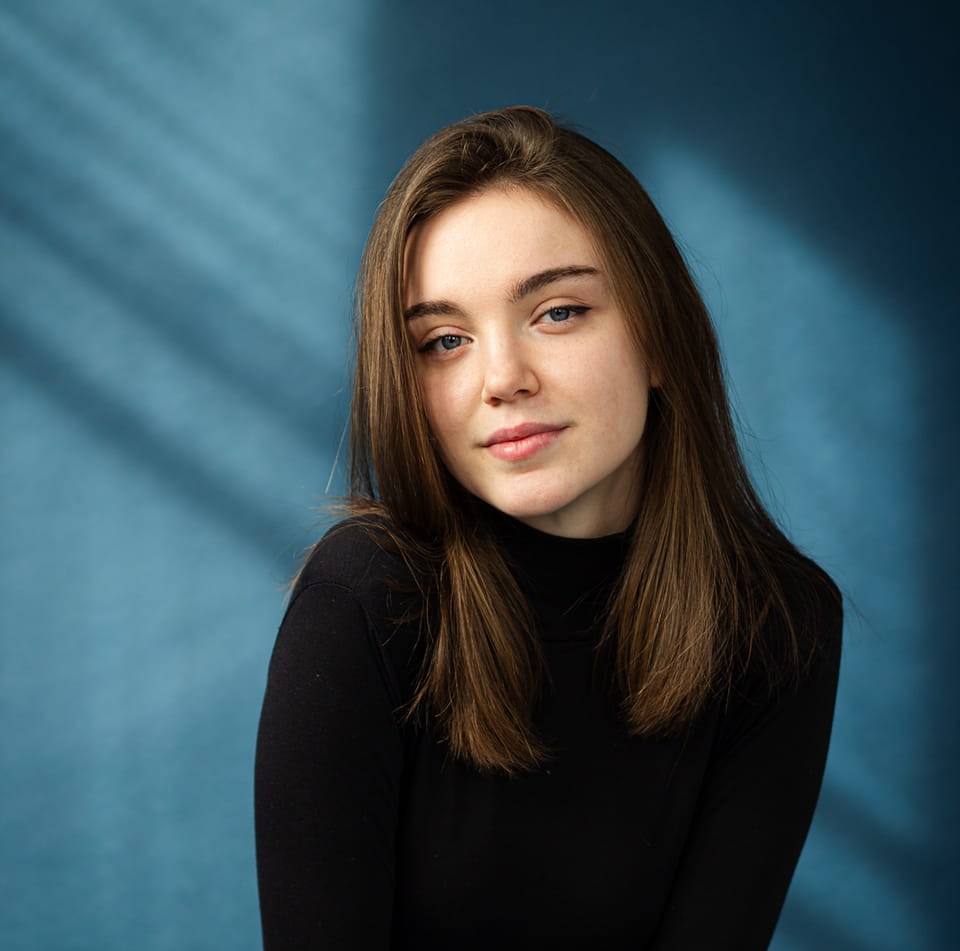
First, please tell our readers a little bit about yourself, describe in a few sentences what you do today.
I strive for change and believe that through such initiatives as the NGO “Making you nervous” we can build a new consciousness of Odesa that preserves and develops the Ukrainian identity. At the moment, I spend most of my time studying. I am convinced that a deep understanding of the media and the power of words are the keys to real change in society. This field opens up new horizons for me: from researching and gathering facts to analysing and creating meaningful stories that can influence public opinion. I believe that every story, whether through text or video, can help people see their city, language, and culture from a new perspective.
You are the editor-in-chief of DeFacto, a student newspaper founded at the Mechnikov National University in Odessa. Could you please tell us how you came up with the name of your newspaper?
The name DeFacto came from the idea of emphasising the newspaper’s commitment to truth and objectivity. This Latin expression means ‘in fact’ or ‘in reality’, which symbolises our desire to present facts and real events as they are, without embellishment or distortion. We chose the name together, discussing with the team how best to express our journalistic position. Everyone offered their own options, and in the end we all agreed that De Facto successfully reflects the values and principles of our newsroom.
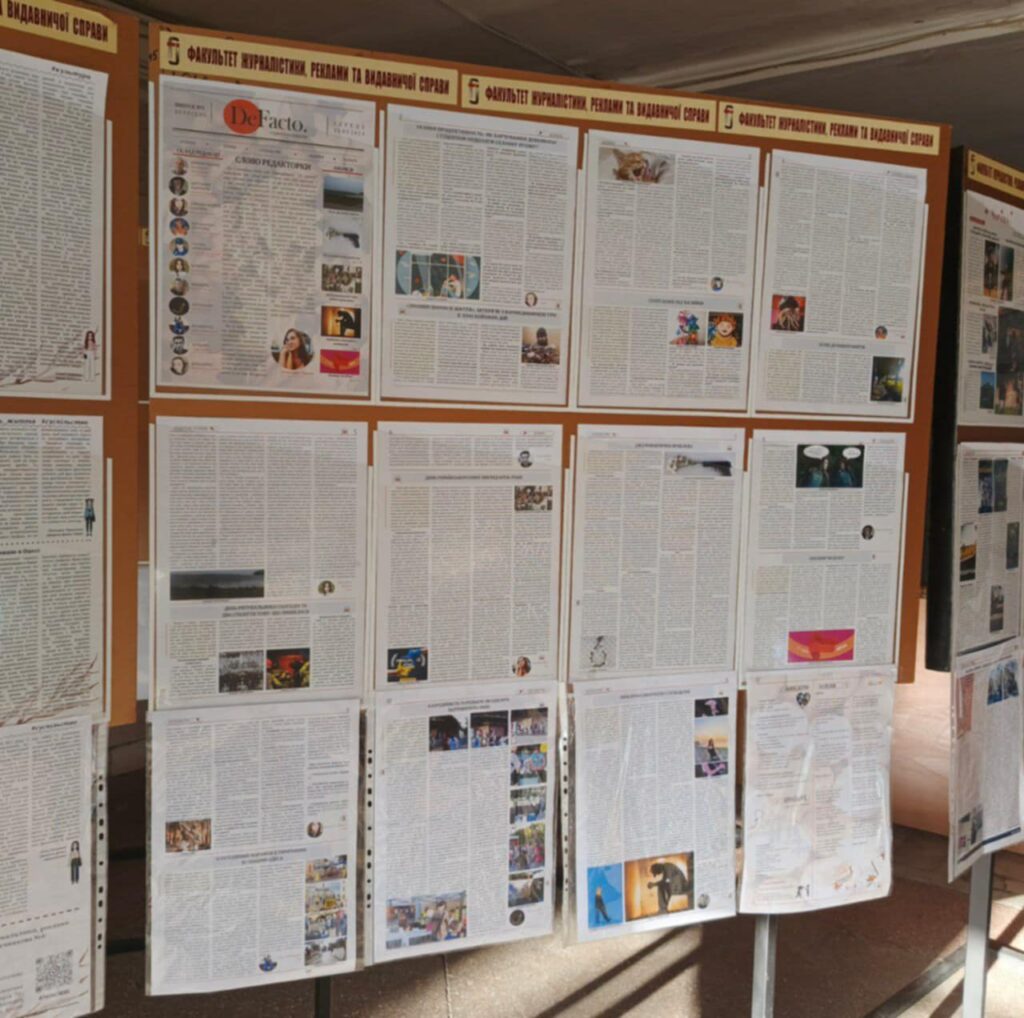
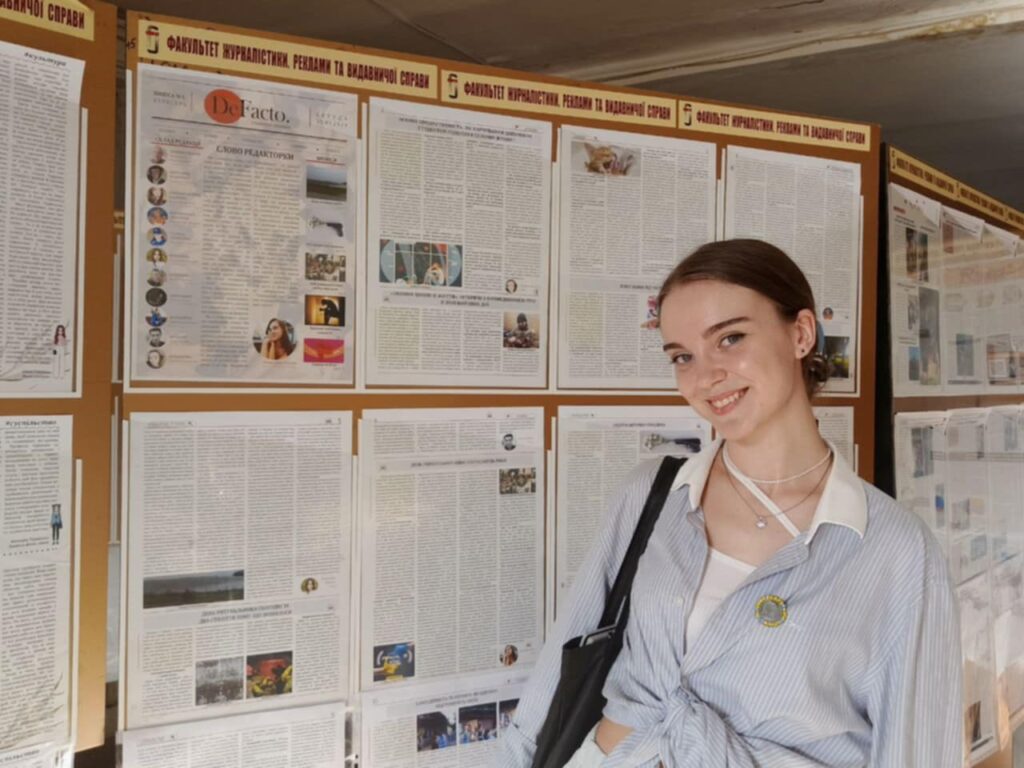
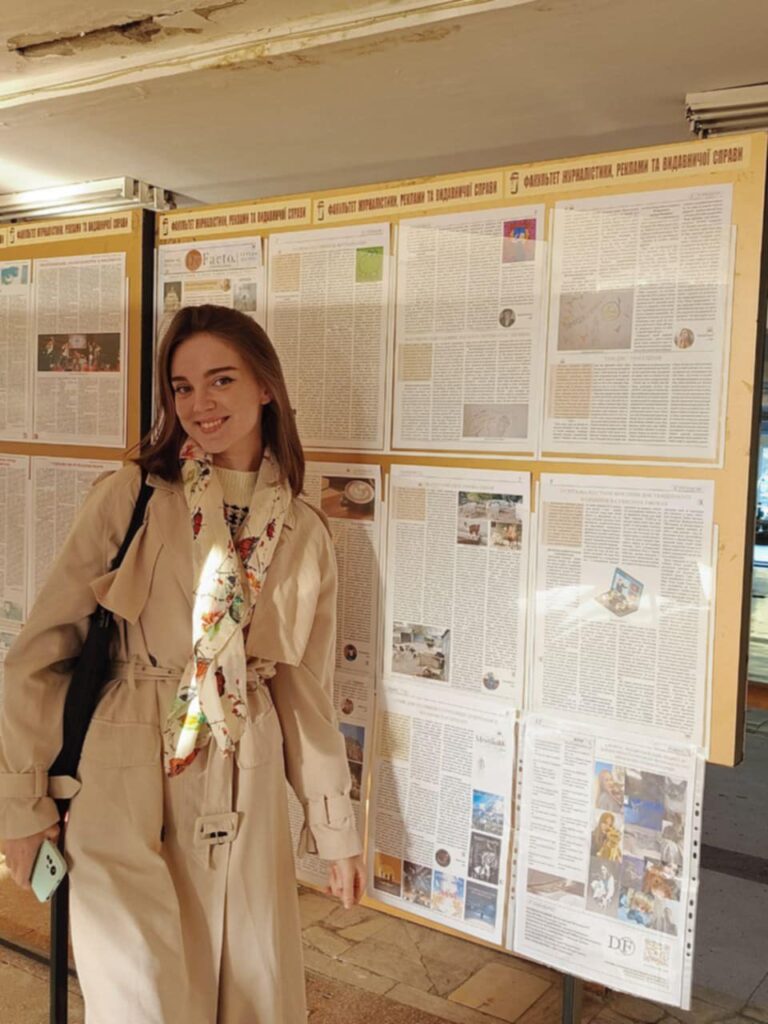
I really like the way your student newspaper looks, it has a very good design and content with a very wide range of topics. You’ve really done a wonderful job with it.
What is the main idea of your publication, how would you describe it in a few words? Do you have a theme that you would describe as the main theme that appears in every issue? What topics are particularly difficult for your journalists to work on?
I am very happy to hear that you like our student newspaper. We really put a lot of effort into creating a high quality and informative product. The main idea behind our publication is that we are a student newspaper working within the journalism discipline. This is our practical component, which allows students to delve deeper into journalism. In each issue, we try to cover current events and socially important questions that need to be discussed. The topics vary, but we always focus on issues that affect students and society as a whole. Of course, some topics are quite painful and difficult emotionally for our authors, especially those related to war and mental health. For example, interviews with the military force our journalists to go through really difficult moments with the person that’s being interviewed.
What do you enjoy most about working with the team? Perhaps organizing some informal meetings with journalists,editors, where you can discuss some ideas for new material, new design, etc. in a friendly format?
I really enjoy working with the publication team, each of us is unique. We try to create a friendly atmosphere where everyone can freely express their thoughts. This is difficult, of course. But as editor, I try to create a tandem. We have informal meetings, of course. I think this is our way of getting to know each other, discussing new issues and spending time together. During these meetings we share our thoughts on new materials, discuss the design and concept of the next issues. I believe that these moments of informal communication contribute to the development of our publication and make it better and more interesting for the readers.
What is your most memorable material for De Facto? Maybe it was an issue or a person, a particular interview, that has left a lot of memories? Or perhaps a piece of work you are personally most proud of?
Every piece we work on for De Facto is special to me. We put a lot of effort and emotion into it. Every topic and every interviewee leaves its mark on our memories. I believe that this process of creating content shapes our team and allows us to understand the importance of each story. That’s why I’m proud of each piece, because each one opens up new perspectives and emotions.
What motivates you to work, to run your own publication, to participate in various programs? What inspires you to do so in these very difficult times for our country, times of great uncertainty, when it seems that young people, who are prone to emotional swings at this age, might simply give up and when it is easy to become depressed? What gives you the impetus and motivation not to be disappointed by the surrounding events, by the constant news of the deaths of our citizens, by new explosions and shelling, but to work hard on yourself, to improve your professional skills and try to build your future?
First of all, it is an awareness of the importance of our role in reporting the truth and the surrounding events. In such difficult times as these, our newspaper becomes not only a source of information, but also a platform for support, exchange of opinions and ideas. At the same time, I am inspired by a team of like-minded people with whom we work together to create quality content.
I am also motivated not to be disappointed and to keep working by the knowledge that every piece of content we publish can be useful and valuable to someone. This is an opportunity to be the voice of those who cannot express their thoughts and to support society in difficult times. I believe that through journalism we can help people find hope and understand that even in the darkest times there is room for light. This understanding and the desire to make a difference is what drives me to improve my skills and work on myself.
Do you sometimes think about the fact that the country has been at war for half your life? Yes, if we go back to 2014 and the annexation of Crimea by the russians, and even before that there was the bloody Maidan with the tears of parents who lost their children. This is a huge period of time; we have been at war as a country for more than 10 years. Moreover, the war has become such an everyday part of our lives, no matter how horrible it may sound, that nowadays you can often hear opinions about the Ukrainians’ fatigue with it, for example, video reports about the events in the occupied territories get much fewer views compared to the first months of the full-scale invasion.
Do you feel this fatigue? Could you please describe your experience of perceiving the war as a representative of our youth, whose conscious life was essentially formed in a country under fire, and in recent years this situation has only worsened significantly?
Yes, I often think about how the war has become an integral part of our lives. Since 2014, starting with the annexation of Crimea, we as a society have gone through a huge number of challenges. It has been a difficult period that has affected our perception of the world and the country. The war has become such an everyday reality that, even when we try to detach ourselves from it a bit, it looks like a defence mechanism that allows us to cope with the emotional burden. As for the tiredness, I feel it. Sometimes it’s really hard to watch or read about the war because it’s full of painful memories and a sense of hopelessness. But at the same time I understand that it is important to stay informed in order to be aware of the reality that surrounds us. It can be difficult, but it is necessary.
I believe that our generation, which grew up in conditions of constant anxiety, is particularly sensitive to such topics. However, we have learned to cope with emotions and support each other in difficult times. The war certainly leaves its mark on our consciousness and shapes our vision of the future. It is important not to lose this hope and to continue to act, even if it is difficult.
What are your goals for the next few years, what would you like to achieve? Do you want to tie your future to Ukraine, or do you plan to live abroad?
In the next few years, I would like to develop my journalistic skills and deepen my knowledge in this field. I would like to continue working in Ukraine, because I believe that this is where I can make the greatest contribution to the development of society and journalism in the face of current challenges.
Imagine waking up one morning, picking up the phone and reading the long-awaited news that the war is finally over, Putin and other members of his gangster regime are all dead, and Ukraine is free after all these terrible years. What would you do first on that day, and how would you spend it?
Oh, if only it could come true! I can imagine that morning: I wake up not to the sound of a siren, but to the sunlight coming through the curtains. I pick up the phone and see the cherished lines: ‘VICTORY’. My heart is pounding, tears are streaming down my face, but they are tears of joy, relief, and gratitude. First gratitude to my mum, then to my dad, and then to everyone else who is dear to me. I want to hear their voices, their joy and share their feelings. I would breathe in the fresh air, without the sound of sirens. Maybe I would hug the first stranger I met, just out of happiness. This day should have been a day of unity, a day of gratitude to all those who fought for our freedom. But at the same time it is a day of mourning and unbelievable pain… and it gives me goosebumps just thinking about how many people died… My heart breaks.
Do you feel that you have already found yourself, your purpose, or are you still searching for it? Can you say that today you are extremely passionate about journalism and want to tie your future to it?
Today I feel that I have found my purpose in journalism, but the process is never over. My studies in journalism really fuel me. I am passionate about the opportunity to tell a story that can change people’s perceptions about important issues and challenges facing our society. I am inspired by the idea that my work can affect other people’s lives, raise important issues and encourage change.
I feel satisfied with my work in the field, but I also strive to grow. I believe that development in journalism is a continuous process. Therefore, I want to continue improving my skills, discovering new topics and exploring different formats of presenting information. In this way, I hope to leave my mark on journalism and perhaps even influence society positively.
What gives your life meaning?
The meaning of life? (laughs) That’s such a deep question! I would say I look for it everywhere. Every walk gives me energy, every look out of the window inspires me, every compliment to someone cheers me up. I am surrounded by many small meanings. Speaking of more concrete things, my hobby is needlework. I have loved to create since I was a child: drawing, painting, embroidering… Recently, I have taken an interest in making bouquets of satin ribbons and felt toys. I also love to sing. It is a form of meditation for me.


