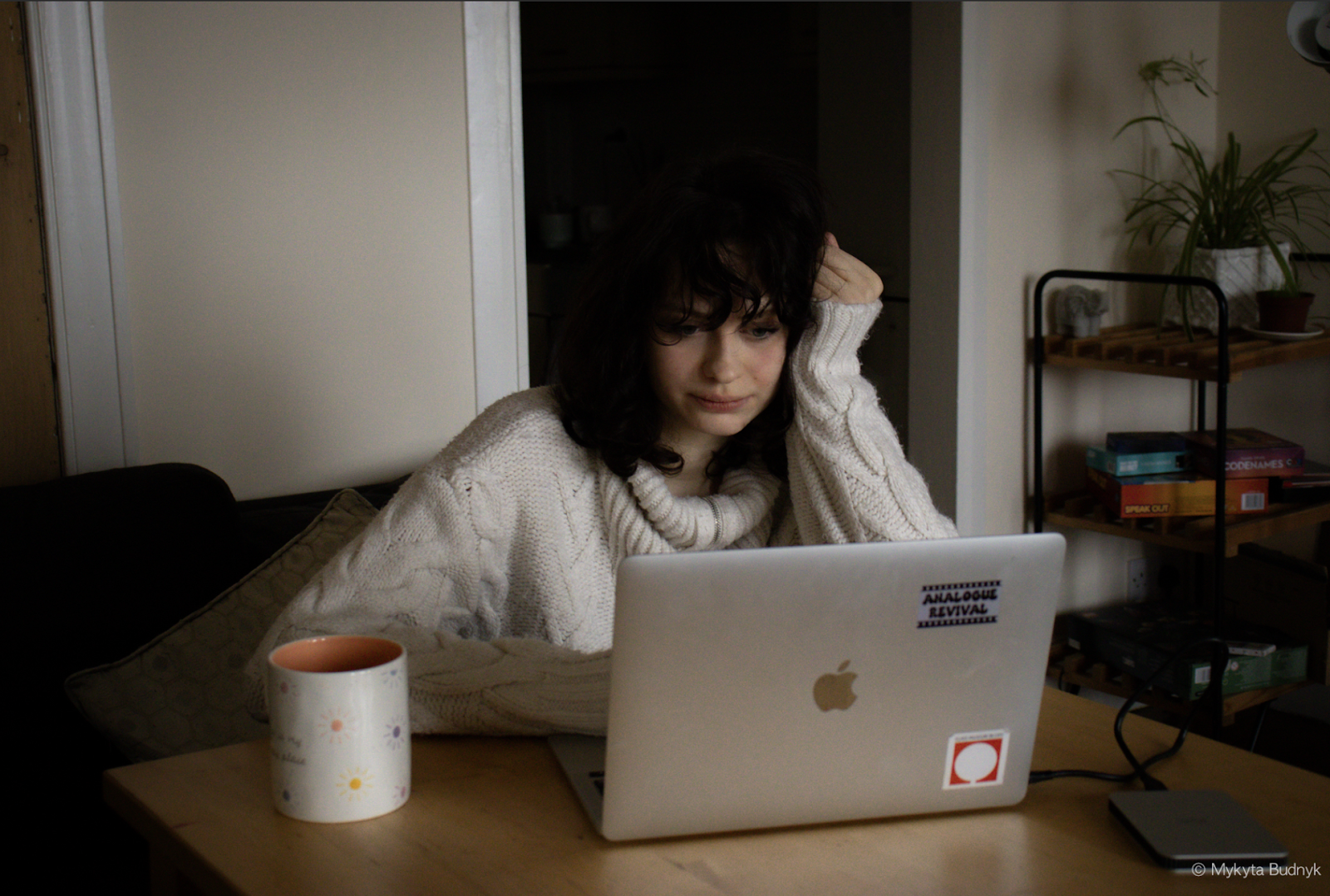
How did your morning start on February 24, 2022?
Starting from the morning of February 24, I was at home in Kyiv with my parents. Already two weeks before the invasion began, we had prepared our suitcases. Together with our relatives, we developed a plan: in the event of an unstable situation, we intended to go to the west of the country, where we could wait out the war. On the night of February 23-24, I talked to my relatives and informed them about the deterioration of the situation: Russia recognized the so-called “republics”, and we had to prepare for departure from the very morning. At 5 in the morning, my aunt called me and told me that she heard explosions. That’s how the war began.
Read more: Edinburgh Stands with Ukraine: Second Year of Russian Invasion, Over 500 Unite in Solidarity
What feelings came over you at that moment?
Analyzing and describing events at that time was extremely difficult. You never know how to react in such situations. Although we were taught in school how to act in a fire and how to protect ourselves, no one prepared us for what we would have to experience in war. At that moment, you lose your bearings. You start calling your relatives, following the news, collecting valuable things, but not to keep them, but perhaps to exchange them for food or fuel. On February 24, we went to the store, bought everything we needed – food, water, withdrew cash, prepared our suitcases, were in the subway and basements, and spent the night in the corridor.
My family and I left Kyiv, and on February 25, 2022, we departed for the Khmelnytskyi region, where we lived in a small town for several months. However, even there, we could not avoid shelling.
In May 2022, I moved to my friends in Ireland.
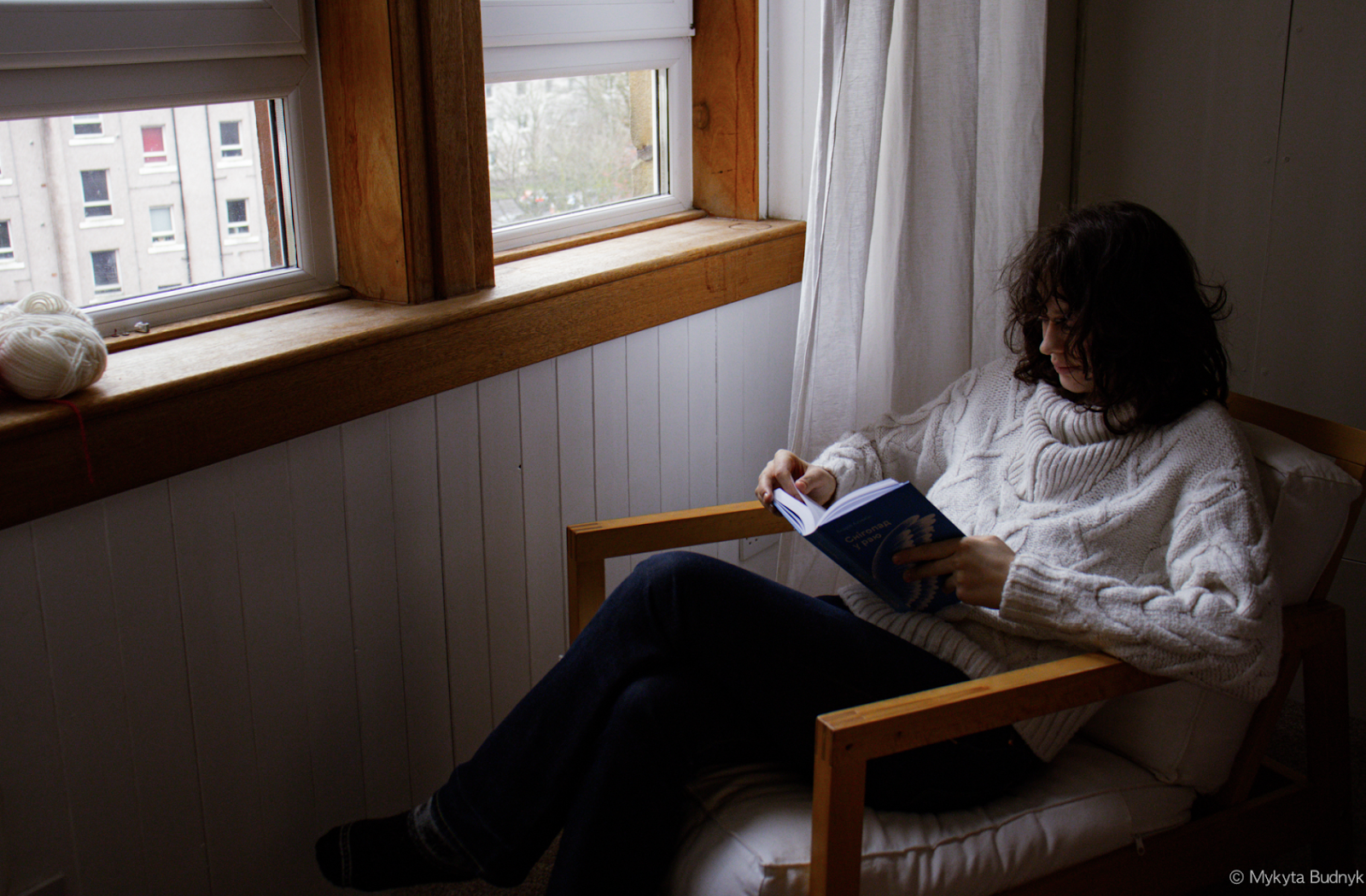
Was it difficult for you to make the decision to leave at a time when it seemed temporary?
Originally, I planned to go to Ireland only for a month. I wanted to stay in Ukraine, but when they started mentioning the possible use of nuclear weapons in May 2022, it became clear to me that it was necessary to leave the country. I agreed to leave for one month, and it turned out that I would continue to stay abroad.
How did your life in Scotland begin?
After arriving in Ireland, I realized that I needed to look for opportunities to study at a university abroad. I believed that this could provide me with useful experience that would be important for my future life in Ukraine. I understood that leaving the country at such a time, I should do something useful, support our defenders, gain knowledge, and experience. Therefore, in the summer of 2022, I entered the University of the West of Scotland to study journalism, and already in August, I moved to Scotland, to the town of Ayr, where I lived for 9 months, and then moved to Glasgow.

Why did you choose journalism?
It was a new field for me, but already during the first weeks of classes, I realized that I had found myself. It was something I had never experienced before. Especially during the Russian aggression in Ukraine, I feel a strong desire to tell people the truth, and this only strengthens my motivation to pursue journalism.
Read more: From Donetsk to Scotland: A Ukrainian Woman’s Journey of Support for Her Homeland Abroad
What were your first impressions of Scotland?
When I came to Scotland, I experienced an amazing level of help and support from the local people. Having no friends or acquaintances here and staying in the hostel, I got to know the administration, especially Alison and Elspeth, who helped me tremendously in adapting to my new life. They were supportive and made it feel like home.
How did you feel among other students in Scotland during the Russian invasion?
My professors at the university showed extraordinary support when they found out that I am from Ukraine, especially at the journalism faculty. They were always ready to help and support.
However, among other students, the initial reaction to the acquaintance was different, which prompted me to adopt a protective mechanism and keep my distance. I realized that making friends can be more difficult because many people feel uncomfortable talking to those who have gone through traumatic experiences. However, over time, I found true friends and people who continue to support me.
How do you maintain connect with Ukraine during the russian war?
In the fall of 2022, I joined the volunteer initiative “Scot Baby Box Appeal,” where we collected donations for newborn babies, humanitarian aid, and sent these trucks to Ukraine. I also helped out at a charity shop in Ayr, where I lived.
Regarding the community, there are several Ukrainians at our university with whom we have united. Initially, it was just communication between people with similar experiences and language. It was difficult for us Ukrainians to discuss missile attacks and war with foreigners because, for us, it became a part of everyday life, whereas, for them, it caused discomfort. Thus, shared experiences united us Ukrainians and allowed us to build friendly relations. It gave us a feeling of home, the sensation that we were among our own people.

How exactly do you cover the events in Ukraine for a foreign audience?
During the second year of the full-scale Russian invasion of Ukraine, I have been actively covering these events in Scotland. My experience includes regular posts on my university’s UWS Newsroom website, as well as collaboration with “The Borgen Project,” an American organization that fights poverty around the world. My articles reveal various aspects of the situation in Ukraine, including the role of Ukrainian women in ensuring economic growth during the war, the impact of the war on education, and the environmental situation in Ukraine. I am glad to have the opportunity to cover these topics on a platform with a large audience.
What is the role of journalism in the context of the Russian-Ukrainian war for people abroad?
In today’s conditions, journalism is becoming extremely important, especially in the context of the war in Ukraine. Currently, the country is facing an extremely unstable situation, not only militarily, but also in terms of politics and trust in power structures. It is clear that the government has its duties and tasks, but not always fully reveal the truth. At such moments, journalists, as individuals with the ability to convey information to society, are particularly important. Their function is to inform the public, and this information can be extremely crucial, especially when authorities are unable or unwilling to do so. Journalism is an essential tool for uncovering the truth and establishing an objective picture of events, helping people abroad to understand the situation in Ukraine.
What potential do you see in covering events in Ukraine specifically for a foreign audience?
One of the main tasks is to promote the correct and complete image of Ukraine to the global audience. For this, it is important that information about the country is provided by those who know the context, understand the situation on the ground, and can offer an objective portrayal of events. Therefore, writing for a foreign audience is a great responsibility, but also an opportunity to reveal the real Ukraine to the world. It is important that foreigners do not solely associate Ukraine with war but also understand the context and causes of the conflict. That’s why initiatives like The Kyiv Independent are extremely important because they convey the right message to audiences abroad.
However, my aspiration is to work in Ukraine. Currently, I am utilizing my time in Scotland to write about Ukraine for a foreign audience. However, my desire to return to Ukraine is fueled by the belief that the development of press freedom in Ukraine is extremely important, requiring motivated professionals ready to defend the values of journalism.
It is already the second year of the large-scale Russian invasion of Ukraine. What do you feel, and what can foreigners do?
It’s difficult for me to answer this question because, for me, it’s not just a date; it’s an ongoing reality. Here I am, still at that moment, February 24, 2022. I consider myself fortunate not to be under direct fire, although I frequently visit Ukraine and understand the feelings associated with the war. But time seems to have stopped for me then, and with each passing year of the invasion, I long for that day to end and for us to return home. Foreign audiences may have become desensitized to war, especially following events like those between Israel and Gaza, where people try to detach themselves. However, I can’t blame them. How can we encourage their support?
I believe that Ukrainians abroad should share their experiences of the Russian invasion with their friends, urging them to participate in protests, even if only for a brief period. Everyone should contribute in their own way. As the saying goes, change starts with you. I think this approach would be more effective than traditional campaigning, which foreign audiences often ignore. When the message comes from a real person, it has the potential to change attitudes or motivations. This is something I actively engage in as well.
What are your plans for the future?
As for my future plans, I have some ideas, though it’s challenging to plan too far ahead. I intend to return to Ukraine within the next two years at most. It’s a certainty. My entire family is there, and I visit them regularly; I essentially live between two countries. And I aspire to work in Ukraine.
In conclusion, I urge Ukrainian youth living abroad to consider returning to Ukraine. Even if you’re feeling restless now, gather experience abroad, but don’t lose sight of your future plans in the Motherland.
Support for war survivors and the rebuilding of our country will be more crucial than ever. Your skills, experience, and motivation can contribute to creating a better future for Ukraine. While it may be challenging, your active involvement in politics, journalism, business, and other fields can have a significant impact on the country’s future.
Those who have endured war for an extended period will require support and assistance, and your proactive participation in building a new Ukraine will be invaluable. Together, we can rebuild our country and secure its future.

How Scotland Supports Ukrainians
Scotland responded swiftly to the Russian invasion of Ukraine by implementing the “Warm Scottish Future” strategy. Under the Super Sponsor Scheme, the Scottish government has provided shelter to more than 25,500 Ukrainians, offering both temporary and long-term housing solutions. Hotel rooms and civilian vessels were utilized to address housing challenges. Additionally, a £50 million fund (over UAH 2.3 billion) supported the construction of 671 houses by August 2023, accommodating 948 displaced individuals. Despite the temporary pause in the Super Sponsor Scheme from July 2022, Scotland’s commitment to supporting and integrating Ukrainians remains one of the country’s government’s main priorities.
The material was produced with the support of the NGO «Institute of Mass Information» as part of a project of the international organisation Internews Network.


