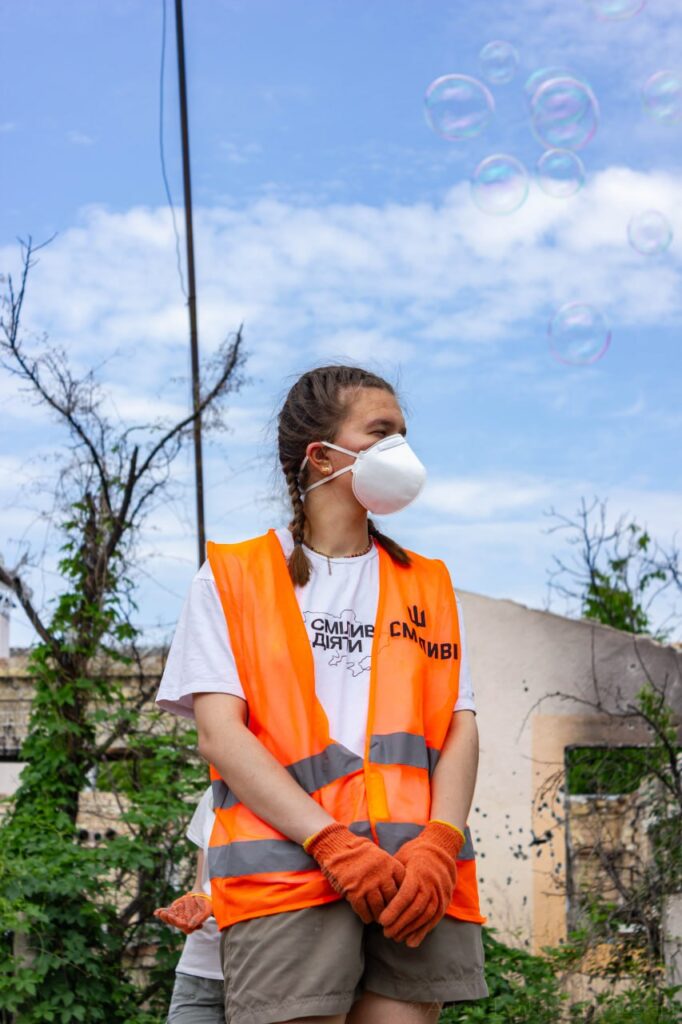
Please tell us how the “Brave” chat group has grown from 8 people to approximately two thousand participants.
Immediately after the de-occupation of Kyiv, we started to grow incredibly quickly because many people wanted to get involved. Yes, at the first gathering, there were eight people, and for the next one, they brought their friends, so there were about fifteen people, and the meeting lasted for two days, Saturday and Sunday. We even stayed overnight in Bucha. The subsequent gatherings included more of my friends and acquaintances, some of whom also became part of our team, and we began thinking about how to advance this.
I was appointed as the coordinator of volunteers because they needed someone to organize everyone onto the buses, and I agreed. My friend started managing our social media.
And that’s how we evolved. In the first few months, people were joining us very actively, and the number of participants and the number of locations we were helping increased with each meeting. At first, I was the sole coordinator, and I could only do Saturdays, so I kept going to coordinate and organize everything. Then, in August, I realized that doing everything on my own was challenging, so I posted the first job openings in the chat, and my favorite coordinators responded. They are still with us.
At some point, TikTok brought in a lot of people. Seeing the rapid growth in our audience, we understood that we needed to expand our team to handle more requests. From the very beginning, I also realized that we needed to build not only a volunteer organization but also a community of proactive individuals. That means we needed additional elements to motivate people to attend these gatherings. That’s when we created the events team, followed by the communications department, YouTube, TikTok, and many other things. A lot has happened, and it continues to evolve to this day, with various projects and new developments.
How have your views changed since the start of the full-scale invasion?
After moving to Kyiv, it was very difficult for me to adapt to the new city, and there was a period where I was just “counting days.” I couldn’t let go of the fact that everything I had built in my life seemed to be destroyed. I kept thinking about how I had built it, the people I loved… Everything was left behind, and for those two years after leaving Crimea in 2018, I felt like I was wasting my life.
Then, after graduating from school, I joined the Ukrainian Academy of Leadership (UAL), and life became a bit clearer and easier. I somehow reconciled with certain things, started living, trying out new things, and learning. I realized that it was possible to have a normal life in Kyiv and that life didn’t end after leaving Crimea. About six months later, the full-scale war began, and that’s when I understood that, unfortunately, I wouldn’t be able to avoid this war. I couldn’t escape the loss of my home, what was happening, and with the full-scale invasion, the situation only deepened, and I couldn’t ignore the events around me or stay on the sidelines.
I realized that, okay, I’ll live later because I feel a strong duty not to be passive in this war, not to miss anything, not to just live my own life because it all hurts too much. And, of course, after February 24th, this feeling intensified even more, and it became much more significant than all my personal needs. So now, I devote all my activities and energies to contributing to the victory, constantly thinking about how I can increase those efforts or get involved in other areas of assistance. It’s probably the most significant realization I’ve had.
Furthermore, after the start of the full-scale invasion, I finally began to feel like a fully-fledged Ukrainian. It’s hard to explain, but until I was 22 years old, I had issues with self-identification because it was quite challenging in Crimea, and before 2014, no one there was particularly identified as Ukrainian. I didn’t even study under the Ukrainian curriculum. Everything around us was Russian, and Russian was the language used. Yes, I always had a connection to Ukraine because we used to come here every summer to visit various relatives, and I traveled extensively. I could understand Ukrainian to some extent, but I didn’t speak it. I lacked that sense of belonging to the country; I just knew I was a Crimean.
When I moved, I continued speaking Russian, and the Russian influence was strong. After living under occupation for the last four years (from 2014 to 2018), we were taught entirely different things at school than what I had heard before. At some point, my mind exploded, like, where was I even living? What was happening to me? There was this entirely different reality that had been constructed in my mind in Crimea, one in which I lived and believed in, and the world lived differently. I struggled with this, tried to learn Ukrainian and switch to it, but it felt very artificial. It sounds absurd to me now, but back then, I felt like it wasn’t me speaking Ukrainian; my soul was different. All these things that now seem absurd to me.
For a long time, I believed that to call myself Ukrainian, to be a citizen of this country, I had to earn it. I had to have the attributes I thought were inherent to Ukrainians: language, culture, an understanding of history, etc. I didn’t possess these attributes, and I went through a crisis trying to overcome it. I couldn’t because there was still this neutral identity lingering. I couldn’t figure out how to tell myself that I was 100% Ukrainian. And not because I’m this or that, but because I felt that way.
After February 24th, it seems I felt the difference between Ukrainians and Russians at a very deep level. It happened even with the Ukrainians and Russians I knew personally, including my relatives from Ukraine and Russia, my friends. I told myself, “No, I definitely have nothing to do with these people, I don’t even come close to them.” It became much easier for me; I didn’t have to constantly prove to myself that I was Ukrainian. I feel that way, and that’s it. I don’t need to add more identifiers like language, knowledge of literature, etc.
The latest realization for me is probably the understanding that I really want to live in this country. I never had any doubts about this, but now I feel a very strong sense of certainty: I’m definitely staying in Ukraine until the end. I don’t need any other countries; it’s not interesting right now. I don’t know if I’ll feel the same way in the future, but for now, I see my future in Ukraine, and I see my children’s future here. I know it’s the main mission of my life. I have to return home to Crimea, where I will create pro-Ukrainian communities. To do that, I need to gain as much experience as possible so that I can go back and build something new at home.
Do you want to return to Crimea after its de-occupation?
Yes, I strongly and intensely feel that desire. I already have a vision for my life, and returning home is a part of it. It’s something that was taken from me, and it has haunted me all these years. I constantly think about it, and the topic of Crimea is always with me. It’s the source of all my concerns. So, I really want to return and build Ukraine in Crimea and open up Crimea for Ukrainians, showing it as it was and as it is. I want to involve fellow Crimeans who can help change the peninsula for the better. So, yes, I plan to return, and for now, I’m trying to gain as much experience as possible that will be useful upon my return. I want to do more than just come and live there; I want to truly create something progressive and Ukrainian.
Translator: Bohdana-Nikolietta Terekhina


