War, like all terrible things, always comes without a warning. It leaves a dark imprint on people’s hearts. No matter where we are or what we feel, we try to move on, realizing that life goes on. This also applies to those who fled the war abroad and did everything they could to keep from breaking down.
Sofia Bondar is a young girl who lived in Ukraine her whole life but was forced to leave for Germany because of the full-scale invasion. There, she tries to adapt to the new conditions, study, and just live. This is a story about a person like many of us today, and whose story may seem so familiar to those who had to leave their homes.
Sofia, tell us how you met February 24, the first day of the full-scale invasion. What were your emotions back then, what did you or your relatives think about moving to another country?
On the night to February 24, I couldn’t sleep, and it was around six in the morning when I was about to go to bed, but a message from a friend came into our group chat with friends asking if we were okay. I replied that I was fine and asked a counter question: “Why?”. He explained everything, and for the first few hours, I was in a state of disbelief that all this was really happening. My mom was not home, she was spending the night at my older sister’s. I called them and asked how they were doing and what I should do. I gathered some things, mostly documents, and some clothes, and went to them. My brother and his wife also came there, because my sister’s apartment has the safest layout. We spent the first night in the shelter, but we had my sister’s son with us, Yaroslav, who was 3 years old at the time, who did not understand why we were here, how much longer we would be here, who all the other people we were staying with were, and when we would be returning home. It was very difficult to explain the real situation to him, so on the afternoon of February 25, we decided to return to my sister’s house and arrange the corridor and the bathroom. Until the last moment, I didn’t think we were going to leave, although my relatives were already considering some options. On the morning of March 4, we packed the necessary things and left first for Lviv, and then – as luck would have it.
So you stayed in Kyiv for a while. What exactly “pushed” your family to move?
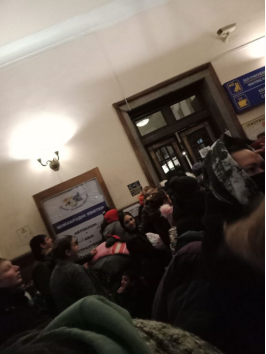
Our reason for leaving was the fear of losing our jobs and, of course, the fact that we had a small child with us played a key role. We all went to Lviv together, a big group, so to speak (me, my mother, my sister, her child, my brother, and his wife), but then we went our separate ways. My brother and his wife went to a village near Lviv to her parents’. We went to the Lviv-Peremyshl train. There were a lot of people, but because we were with a child, we were allowed to skip to the beginning of the line, where other families with children, elderly people, and people with disabilities were. The carriage was filled to capacity, everyone was sitting with children, animals, and their bags. Some people were carrying suitcases and others were standing in the aisle, and even in the vestibule of the train in front of the exit.
How was the trip? How long did it take?
We traveled for quite a while because at one point our train stopped and stood still for about twelve hours. But there were volunteers nearby who fed us. When we arrived in Poland, we were also well received there. They fed us, gave us water, helped us to find places to do; they gave toys to the children. We arrived in Przemysl late at night and an hour later were already on the train to Wroclaw. In the morning we arrived at the place where we waited for several hours for our relatives from Germany. On the evening of March 7, we arrived at a refugee camp in Leipzig. We registered, spent the night, and stayed there for the next day.
How did the adaptation process go? What helped you?
My cousin, who has been living in Germany since childhood, helped us a lot with paperwork and other issues that we could not solve without knowing German. She was the one to find a German family who agreed to help the refugees by giving them a place to stay in. It was a young couple with a little daughter. We stayed with them for a month while we were in the process of filling out various documents and looking for an apartment. Germany helped us a lot financially at that time and continues to do so.
What happened next?
After that, we moved, got a little accustomed to the German environment, and started taking German language courses.
Now about Germany itself. What were the first days of your relocation like?
The first days were very unusual. Another country, other people, another society, another language. If it weren’t for my cousin, it would have been much more difficult. But it still was not easy. For several days in a row, we could not manage to get the paperwork done because there was an incredibly long queue that could not be handled in one day, and many had to come for several days in a row to get to the reception. On the first two days, we did not manage to get on the list of those who were able to get an appointment. On the third day, my mother and I came to the building at three in the morning to get in line in advance. There were people who came before us, so we were the thirteenth in line. It was cold and we were sleepy, but this time we managed to get our first documents filled out. Later we finished the paperwork in other institutions, so we never encountered such long queues again.
What are some of the major differences between living in Germany and Ukraine?
One of the first differences you encounter when you arrive here is the sorting of garbage. Here, they pay more attention to this than in Ukraine. There are 4 different bins – for paper, plastic, and food waste. Everything else that does not fit into any of these categories goes into the fourth bin with other waste. Glass should be thrown away in special containers, which are also divided into several types depending on the color of the glass – white, brown, or colored. While the main garbage containers are located in every yard, glass containers are located mainly in the city. There are special collection points for old electric devices, things containing hazardous substances, old medicines, etc. At first, it was a bit unusual, but now we do it automatically, without thinking.
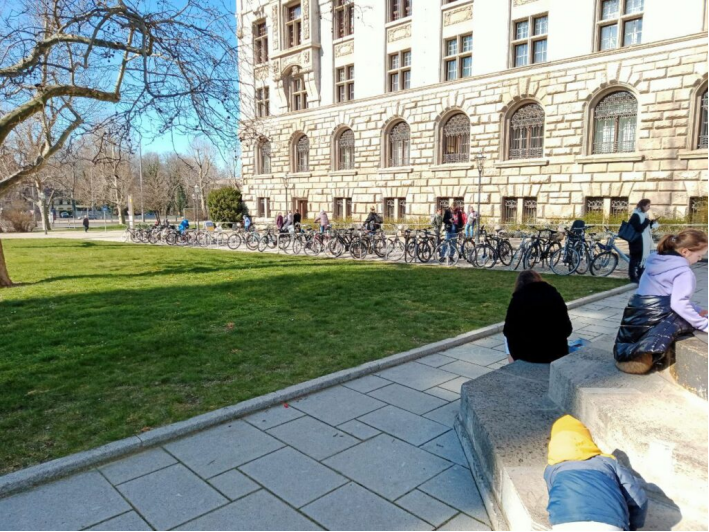
The second difference that I really like is the number of bicycles in the city. Everyone, young and old, rides bicycles. Whether it’s on the way to school or work, or a simple bike ride with family or friends, bicycles are an integral part of life here. I would have joined myself, but bicycles are very expensive here.
The next difference I still can’t get used to is the opening hours of stores. In Ukraine, you can easily find grocery stores and other stores that are open 24/7, but you won’t find that here. Most stores are open from Monday to Saturday, and on Sunday they are open only at the train station, and even then they work on a reduced schedule until six p.m.
Germans also like to plan everything in advance. You can’t do without the so-called “termin” here. Termin means “meeting” or “appointment” in German. If you want to do something or meet someone, it is better to plan everything in advance. That is why it is not so easy to get an appointment with a doctor here. I spent several months waiting for my appointment.
The last difference I’ll talk about, which I really like, is putting things in front of the house. Very often you can walk down the street and notice a box with some things – from jewelry, clothes, shoes, and decor to dishes, furniture, appliances, etc. Germans do this with things they no longer use, often they are in good condition, and those who want to take them can take them for free. This way, we have already gotten a printer and headphones, a floor lamp, and many other cool things in good condition.
What about your family, how did things go for them?
I’ll start with the youngest in our family, my nephew Yaroslav.
It was very difficult to find a kindergarten for him, as there were no places available anywhere. We had to apply in advance, at least a few months before he started school. It took us 5-6 months. Now he attends the group with German children, communicates, and plays with them. He still has difficulties communicating with them, but now it is much easier for him than at the beginning. He already understands a little German, and recently he started taking additional German lessons for children. In general, we can say that he has almost adapted to life here.
As for me, in Germany, there is a law that you have to study somewhere until you reach the age of majority. After turning 18, it’s up to you whether you want to continue your studies or not. At the time of my move, I was still 17 years old, but I had already completed 11 grades at a Ukrainian school, so I managed to attend an integration course instead of studying at a school or lyceum. There were other minors who wanted to attend that course, but they were denied because they were still in the process of studying. I studied there for 2 months, and then I had the opportunity to move to a Berufsschule (vocational school), which accepts students between the ages of 15-18. There, we had the opportunity to learn German at a higher level than was offered in the integration courses.
At the same time, we learn the basic knowledge of several professions, but the main emphasis is on learning German. After that, I plan to study at the Studienkolleg for a year. This is an educational institution where foreigners with a completed secondary education receive preparation for admission to German universities. After Studienkolleg, I plan to enter a university. As for my mother and sister, they had to take an integration course and then pass a language exam. After that, they have the opportunity to continue working in their field or learn another one. My sister has now passed the exam, received her language certificate, and is looking for a job. As for my mother, it is more difficult because she has certain health problems, so she will not be able to work for some time.
Have you met any other Ukrainians outside of your courses?
Yes, I have met other Ukrainians here many times, but I don’t know the details of their adaptation here. It was difficult for all of them to some extent, most of them faced pretty much the same problems, but everyone has their own experience of being here, which I did not learn about in detail.
Regarding Ukraine: in your opinion, how do Germans feel about Ukraine and Ukrainians? Have you seen anything that supports one of the parties in the conflict (Ukrainian or Russian flags, rallies, actions)?
The Germans are very open to us. In the beginning, we received a lot of help from them, and still do. However, I heard from some of my friends that when they were studying at a German school, they were bullied by German students who shouted slogans of the aggressor country. I don’t know how it really happened and what was going on there, I heard only superficially. Fortunately, I myself did not have such an experience and hopefully never will.
And finally, could you please tell me if you are going to stay in Germany in the future or if you are planning to return to Ukraine?
I’m going to live in Germany for the next few years because I plan to study here. But after I finish my studies, I would like to return to Ukraine because I miss it and my friends and family members who stayed there very much.
Translator: Zoriana Karpenko


