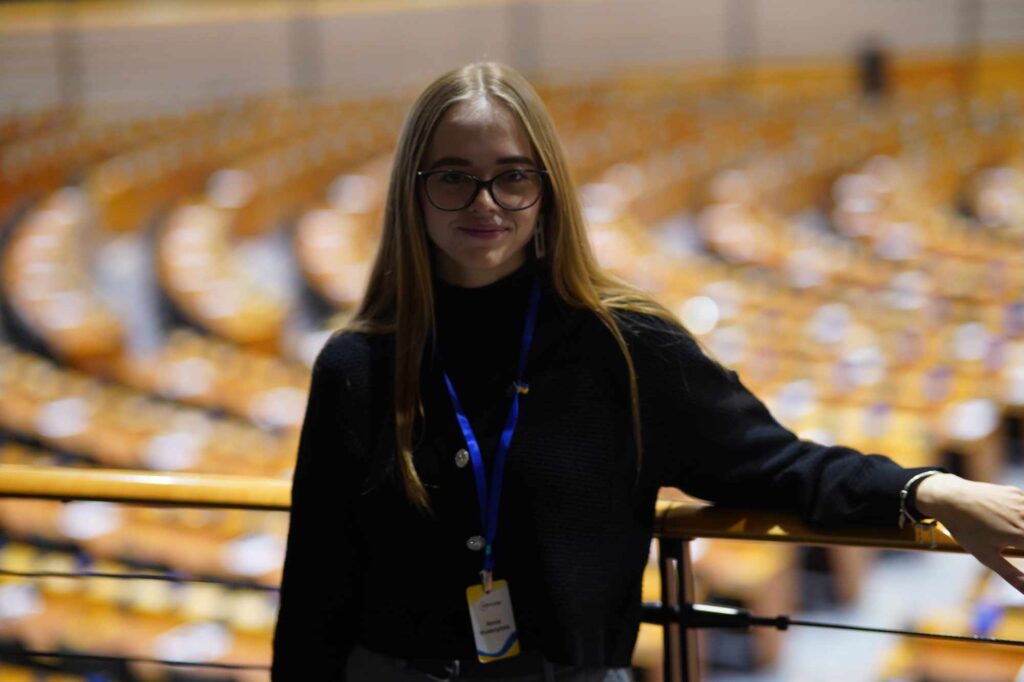
You are a recipient of various scholarships, from the Pinchuk Foundation’s Zavtra.ua to the German Konrad Adenauer Foundation. Could you tell us a little more about how you managed to get scholarships from various Ukrainian and German foundations? You also have your own project, which you mentioned above, where you organise all sorts of events. On top of that, you go on business trips abroad, for example to Brussels, where important political processes for our country take place.
How do you manage to work on all these things, and where do you get your motivation and energy from?
First, I would like to thank the Victor Pinchuk Foundation (especially the Zavtra.UA programme and the Konrad Adenauer Foundation). Such scholarship programmes really help students, both financially and in terms of opportunities. Even 4 years ago it would have been hard for me to believe that I would have received these scholarships, but our perseverance is very important here.
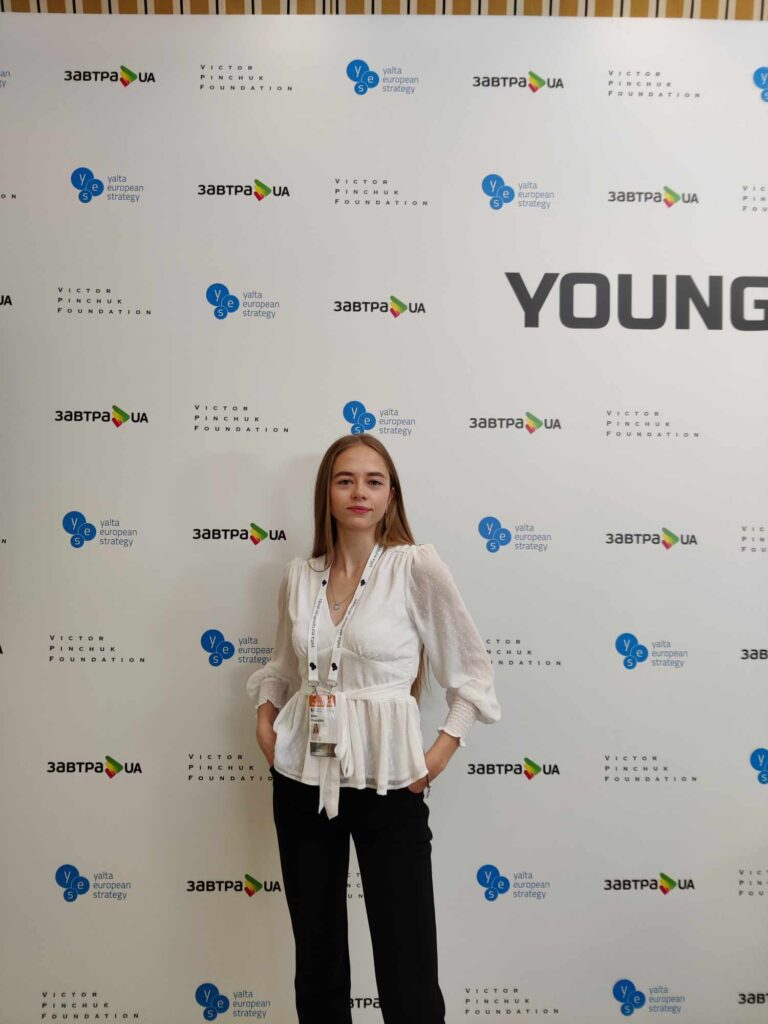
Speaking of Zavtra.UA, this programme is for students in their 3rd year and above. But already in my first year I was convinced that I would apply. So I wrote a research paper with great enthusiasm, prepared all the documents and passed the selection stages. I think I was successful because I knew exactly why I wanted to be a scholarship holder. I didn’t do it ‘just to apply’, I was very passionate about the idea and was very happy when I received the long-awaited letter of happiness. For example, if I were asked to give advice to those who are planning to apply, I would definitely say to understand the ultimate goal and to persevere.
When applying for opportunities for young people, I always follow the rule “do your best now, so that if you fail, you don’t blame yourself for not doing enough”. This helps me cope with setbacks and strengthens my application. This was the case with the Konrad Adenauer Foundation scholarship. I found it hard to believe that I could get it, and I probably underestimated myself. But I tried my best to get it. And I succeeded.
But in the context of all this, it is very important to note that for every positive response to your application, there are ten rejections. Literally. At the beginning of last year, I received about eight rejections in two months for different opportunities, and I didn’t get through to any of them. Looking back, I was upset, but I didn’t beat myself up because I followed the above rule. By the way, another vital motto that I always keep in mind is that “fate destroys our plans if those plans can destroy you”. And the most crucial thing is not to stop moving forward, not to stand still, because opportunity dances with those already on the dance floor.
As for motivation and combining your activities. At some point, most of my activities began to complement each other harmoniously. Now I focus on youth diplomacy, and my project, one of my jobs, scholarships, and travels only help me to delve deeper into this topic, to make important contacts and acquaintances. That’s why I see it all as one and inseparable. I am very happy that this has happened, because it has not always been the case. I used to take part in initiatives that were not related thematically, I did not understand the direction in which I wanted to develop, and so on. And that is absolutely normal when you are searching for yourself. And now I am happy to have found my purpose, at least for the near future.
That gives me motivation. I work with incredible people who inspire me to new achievements. I used to be very sceptical about the idea of “work on what you love, and you won’t have to go to work one day”. And it is an effective practice. I have a lot of responsibilities, but I can’t imagine what I would do if I didn’t have a job. I love what I do, and I want to keep doing it.
But it is also important to note that life balance is very important to me. After 6pm, I try not to open or complete any work tasks. This is the time I need to unload and recharge for the next working day.
What was your most memorable meeting with European politicians and diplomats?
In September, I took part in the Young Leaders Forum at Yalta European Strategy, which was organised for the ZavtraUA fellows. We had the opportunity to talk live with some incredible people, including Francis Fukuyama, Boris Johnson, Anne Applebaum, Timothy Snyder, Niall Ferguson and others. It felt like I could have listened to them all for hours, but I really remember one speaker, because this story did not end with the Forum. It was MEP (Member of the European Parliament – ed.) Radoslaw Sikorski, a representative from Poland. By the way, at the end of last year he became Foreign Minister of Poland. At the end of his speech, I decided to go up and ask for his e-mail. I was very afraid, it was terribly embarrassing, but I finally got it. Immediately after the forum, I wrote to him thanking him and sending him some photos, but he did not reply. I tried writing again, but still didn’t get a reply, so I decided to give up the idea.
A few months later, when I found out that I was going on a study visit to the EU institutions in Brussels, including the European Parliament, I wrote again, suggesting that we meet in person. To my great surprise, half an hour later, his assistant replied that Mr Sikorski would be happy to meet. Frankly, I felt it was a small personal victory. We actually managed to meet him in his office in the European Parliament and discuss certain issues related to Ukraine’s European integration, relations with Poland, lessons learned from the fight against corruption, etc.
In my communication, I acted on the principle: “It is not a given that I will get an answer, but if you are persistent, everything is possible.” And this is really an example for me of how active work and participation in various initiatives can help us build contacts and meet such prominent people.
How would you like to see your contribution to Ukraine? What else do you dream of achieving in your youth that would make you personally proud?
Compared to the contribution that our boys and girls on the front line are making to their country today, it’s hard to say. Because that is really the contribution that our country needs today. When I talk about my goals and dreams, I am convinced that my youth should be spent with dignity in relation to my country and the people who defend it.
When I entered the field of youth diplomacy, I was convinced that I wanted to achieve significant heights in this field. First, it is very important to adopt a specific document at the state level that will regulate activities in the field of youth diplomacy. I would really like to be part of this process. Perhaps I would like to be 30–35 years old and see that youth diplomacy is an independent field of traditional diplomacy, which is actively developing in Ukraine, and this happened thanks to my efforts, among others. The Ministry of Foreign Affairs has departments for public diplomacy and economic diplomacy. And I would like us to see the effective work of a new department in the future — youth diplomacy. Frankly, I believe in the possibility of this.
As for my personal achievements, I will do my best to make “United Youth” one of the leading platforms in Ukraine at the national level. I want to make it a place where those of our young people who want to develop in the field of international relations can turn to.
I read that at the end of last year, the Victor Pinchuk Foundation’s Zavtra. UA scholarship programme announced the winners of this year’s essay contest “What is Victory for Ukraine?”, in which the programme’s scholarship holders shared their thoughts on how they see Victory for Ukraine. Your name was among the winners, so as a final question I would like to ask you about what you wrote in your essay. What do you think victory is? And how would you like to spend that day, and what would you dream of doing then?
Probably the thread running through my essay was the idea that the victory of Ukraine is a very complex concept, and perhaps more than one generation will work to achieve it. The end of hostilities, which is often perceived as victory, is only one piece of a complex puzzle.
In my essay, I described that very day: “There is only one image that comes to mind now. Independence Square in Kyiv, millions of people gathered to mark this event as one of the greatest in the history of Ukraine. The world will see the longest moment of silence ever. Because every Ukrainian already knows the price of independence.
Speaking of which, my dream is to live to see this day and see all my relatives still alive. I’m not talking about social activities or anything like that. I want to finally feel calm and secure for myself, my family and every Ukrainian. Because I ended my essay with the following words: in all my attempts to write constructively about what victory would mean, the words that rang loudest in my head were: “If only all my relatives were alive”.
Translator: Ivan Chepaykin
The material was produced with the support of the NGO «Institute of Mass Information» as part of a project of the international organisation Internews Network.


