As part of the project “Ukrainian Youth Changes the World,” we collect and share stories of proactive actions by young Ukrainians with different backgrounds, beliefs, and lifestyles. Today, Andriy Tykhonyuk will share his story – the founder of the YouTube channel “Palata,” an activist in the NGO “Ukrainian Students for Freedom,” and a co-organizer of house concerts within the NGO “Tusovochka.if.”
Tell us about yourself.
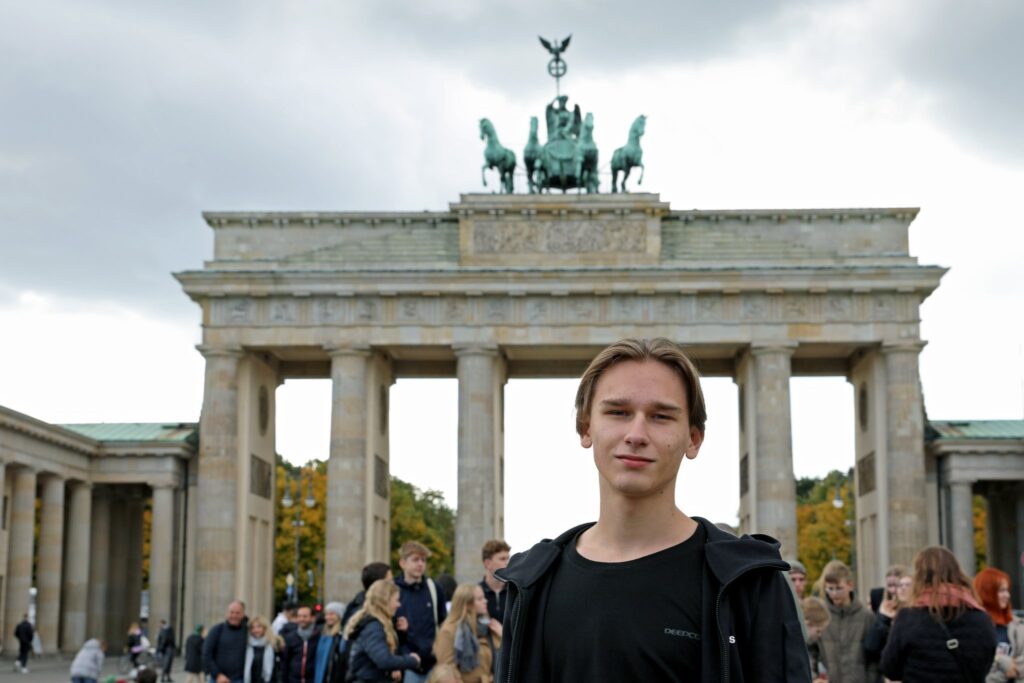
My name is Andriy. I’m 17 years old, and I’m from Ivano-Frankivsk. I started my YouTube project “Palata” when I was 15. I’ll tell you more about it today, but I’ve been involved in various things in my life. At 14, I founded a clothing brand for my high school. Then I actively participated in NGOs and became a co-founder of “Tusovochka.if,” organizing the largest cultural events and house concerts in Ivano-Frankivsk. Later, I became involved in many projects for proactive youth. It all had a significant impact on me. I’m also an activist in the NGO “Ukrainian Students for Freedom.” Currently, I’m studying management at King Danylo University in Ivano-Frankivsk.
“Palata” is a project where I interview various interesting people, trying to develop, convey, and spread important ideas. I’ve been working in this direction for two years. Initially, I interviewed my teachers at school, and now my greater guest is the Minister of Foreign Affairs of Ukraine in 2014-2015, Pavlo Klimkin, meaning I’ve reached the all-Ukrainian level.
How did the idea of creating the YouTube channel “Palata” come about?
I was in the 10th grade, and at that time, I already maintained relationships with teachers not only in the “student-teacher” format. I always saw them as full-fledged individuals who have their own lives, hobbies, feelings, rather than just someone who came to teach us. I wanted to convey my vision of a teacher as a person to most students and thought about taking interviews. I arranged with my history and biology teachers. The art teacher from my school helped me shoot it all. So, the initial idea was very local, aimed specifically at students in my school. But very quickly, literally, within one or two months, it started spreading to the Ivano-Frankivsk region and, starting with the interview with Irma Vitovska, became nationwide.
Why is the channel named “Palata”?
When I was just starting to come up with the concept of this project, I needed to invent a word that would, firstly, quickly attract attention, secondly, be easily memorable, and thirdly, stand out quite high in YouTube search. My dad helped me with this. We brainstormed ideas and came up with the word “palata,” which is easily memorable because it is associated with mental illnesses (palata – ward No. 6 – transl.). The images of a high school student and a teacher are entirely different. This has a good effect because it meets all the mentioned criteria. Accordingly, we decided to keep this name. I thought about rebranding because now the context of interviews, the project, and the vision differ, but I decided it would be a unique feature.
How would you characterize the current format of the channel and its content?
The format of the channel and its content align with the goals I set – conveying ideas that are important to me. These ideas can come from various fields: politics, perspectives on history, economic issues. I believe it’s crucial to reference authorities, especially those with qualifications and expertise in the field. This is much more effective than if I were to explain certain theses on my own in the video. The individuals I interview have an impact on public opinion.
It wasn’t always like this. When I was interviewing teachers, my vision was different. I could say it was somewhat undefined for a while. But, for the last eight months, it’s probably been clear.
How did you start developing the channel, and how are you currently developing it?
The art teacher helped me develop the channel in terms of shooting, post-production, and editing, and I am very grateful for that. The videos didn’t get many views, around 1500-2000. I shared them with high school students and received positive feedback. That’s how the development looked back then. Now it’s a bit more extensive. I connect with people I want to interview, arrange locations, and work with cameramen in various ways. If the interview is live, then there are three of them. Then comes preparation, recording, post-production, and finally, the PR campaign.
Is anyone else involved in developing the channel?
Essentially, it can be said that it’s just me, but it would be a bit unfair to my friend who has been with me for over a year. He is a videographer. He, his girlfriend, and I are co-founders of the public organization “Tusovochka.if.” For a long time, he filmed our online and offline interviews. I am very grateful to other guys who have helped me with the channel.
Overall, from the inception of the interview idea to its publication and dissemination, it is entirely my work. That includes design, editing, managerial issues, PR, and everything else.
How do you find interviewees? Your channel features interviews with quite authoritative figures.
I participated in some projects where I met interesting speakers, exchanged contacts, had some conversations, and offered interviews. Later, when there was a certain portfolio, I could afford to directly reach out, for example, on Facebook, through mutual acquaintances.
For example, how did you manage to interview Oleh Skrypka?
This is a fairly simple story. I am grateful to his manager. I found out that Oleh Skrypka would be coming to Ivano-Frankivsk. By the way, this is another problem with artists. Very few big concerts are held here. Consequently, there are certain difficulties compared to conducting interviews in Kyiv or Lviv.
So, I wrote to Oleh’s manager, she redirected me to another manager who was traveling with him on this tour. We agreed on a 40-50 minute interview, as well as with the drama theater where the shooting took place.
Why did you decide to address such serious topics on your channel, as, usually, young people are interested in entertaining formats?
I don’t target young people. If you look at the statistics of my audience on YouTube, there are 20% who are 25-35 years old, 20% are 65+, and 20% are 55-65 years old. So, I have an older audience. Young people are indeed more interested in entertaining content. I decided to develop these topics because they are interesting to me. Otherwise, I wouldn’t be doing it. Besides, self-realization and a positive impact on society, at least at the state level, are very important to me. I am currently more interested in journalism and management, so I combine it with the opportunity to influence society and convey important ideas.
What interview are you most proud of?
Probably, we’ll talk about my professionalism now. For a long time, there were many mistakes in my interviews in terms of language, behavior, and conversation management. Perhaps it’s not very noticeable for a person who just watches the interview, but for the person conducting it, these moments stand out.
I am most proud of the interview that I conducted professionally. Moreover, the person I interviewed said that it was very professional and mature. It was Vitaliy Portnykov. I felt that I understood how it should be. It wasn’t long ago, literally a month ago.
Tell me about the NGO “Ukrainian Students for Freedom.” How did you get involved with it?
I mentioned that I participated in projects in other cities and countries. One of them was the “Leadership Programme” organized by the NGO “Ukrainian Students for Freedom.” It took place in Medzhybizh, in the Medzhybizh Castle, Khmelnytskyi region. The idea of freedom united 300 students. These are people who consider freedom – individual, political, economic, and other manifestations as very important. At the end of this five-day program, there was an opportunity to join the NGO. I took advantage of this. Now, within this organization, I try to organize various lectures in Ivano-Frankivsk, inviting top-notch speakers. In this way, I also promote the idea of freedom.
What are your responsibilities as a project manager for the NGO?
I am a project manager within the Ivano-Frankivsk branch, not the entire organization. Here, my focus is on organizing lectures because I enjoy attending them. But the lectures I want to organize are a bit different. Accordingly, I also concentrate on other projects. For example, soon there will be the 10th anniversary of the first events of the Maidan. To commemorate this date, we might organize a screening of the film “Winter on Fire” about the Maidan.
As one of the co-organizers of “Tusovochka.if,” it’s interesting to hear about how you started this initiative.
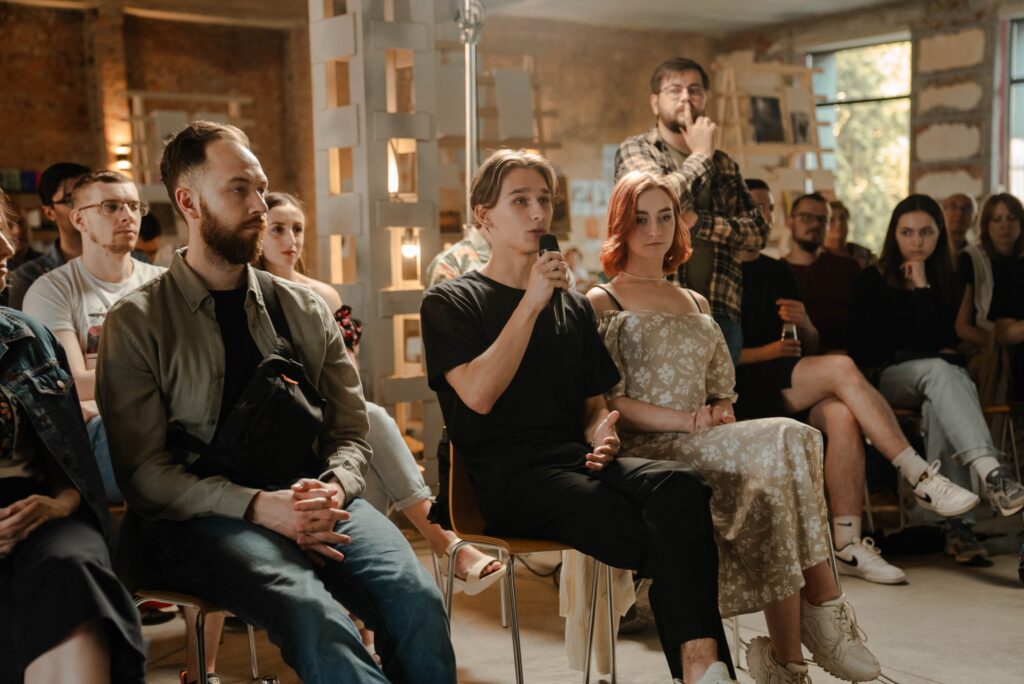
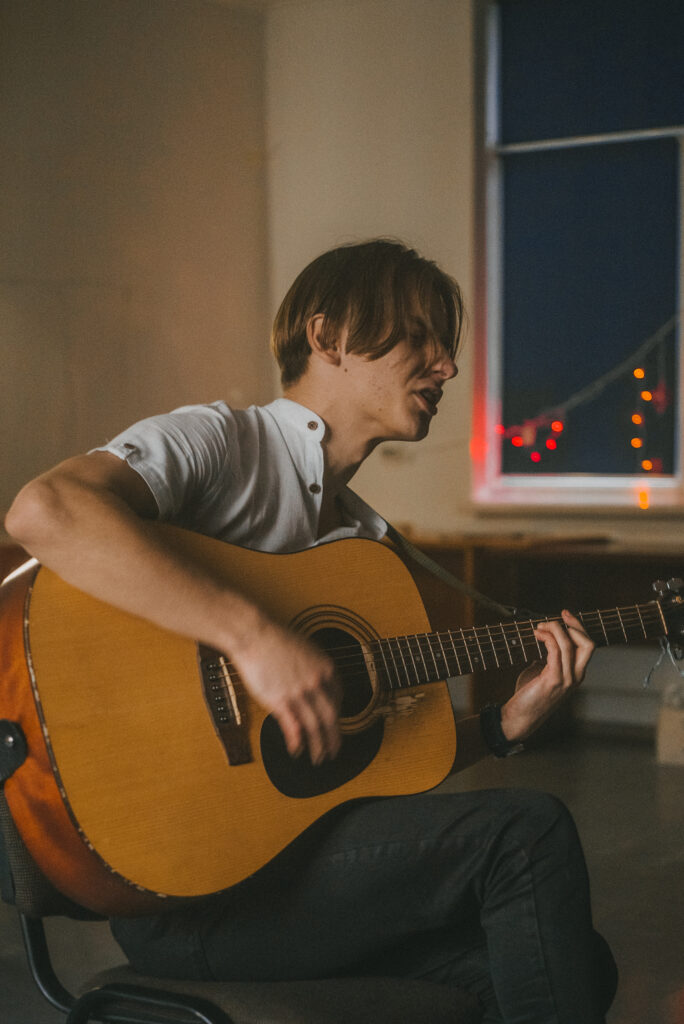
“Tusovochka.if” started from a small group of people who decided to spend time together in the evening: have fun, sing Ukrainian songs with a guitar, and so on. But then it grew into something bigger because we realized that it was really what we wanted to organize for other residents of Ivano-Frankivsk, who appreciate an atmosphere where you can read poetry and sing. It started as a very small initiative. The organizational team consisted of only four people and a few attendees. But eventually, it grew to the point where one of these gatherings attracted more than 70 attendees. For Ivano-Frankivsk, this is indeed a significant number for such an event. We’ve been doing this for a year and a half now.
Tell me about the other co-organizers.
I already mentioned one of them. He is my friend who helps me with the interviews. The third participant was the initiator along with another guy. He is currently in Chicago, so he is not a member of the organization now.
So, they started it, and later my friend and I joined. They are very initiative, have achieved a lot at their age, appreciate poetry, and the atmosphere of the gatherings. I enjoy playing the guitar and piano. We joined with a few more people who have good organizational skills and started organizing these events.
What age group attends your gatherings?
We have a fairly wide age range in our audience, but mostly it’s young people. There are people as young as 12 and as old as 50 and above. The gatherings are about communication between generations. The age difference fades away because everyone is on the same vibe.
Where are the gatherings usually held?
We are very lucky that in Ivano-Frankivsk, there is a space called “Mizh Inshym”. It has two large halls, two smaller rooms, and even a kitchen. This space seems to exist entirely thanks to European grants. One condition of these grants is to support youth initiatives in the city. We are very grateful to the “Mizh Inshym” team; they support us, provide advice, and help us.
Admission to your gatherings is a donation. Where do these funds go, and do you report on them?
Initially, there was a fixed donation of 50 UAH, later increased to 100 UAH. Afterward, we won a grant from the Department of Youth Policy and Sports, and at that point, we switched to a free donation model. Currently, we don’t have a grant, so we might set some fixed amount again.
The funds were directed to foundations. Once, before St. Nicholas Day, we raised money for gifts for orphaned children. We often announce collections for drones and humanitarian aid. We regularly broadcast this in our stories. Usually, we report within a day or two after the event because it takes time to convert the collected cash into digital money and send it.
Translator: Bohdana-Nikolietta Terekhina


