As part of the project “Ukrainian youth is changing the world,” we collect and share stories of proactive actions by young Ukrainians with different backgrounds, beliefs, and lifestyles. Today, Alina Avramenko, a member of the legal department of the charitable foundation “UAID,” will share the story of the foundation’s creation and activities and also talk about why she decided to join the volunteer movement.
First part of the interview (out of two parts):
Tell us a bit about yourself.
I am a student at Lviv National University, studying at the Law Faculty. Before this, I studied at the Faculty of International Relations, specializing in international law. Currently, I head the legal department of the charitable foundation “UAID,” which was registered in April 2022.
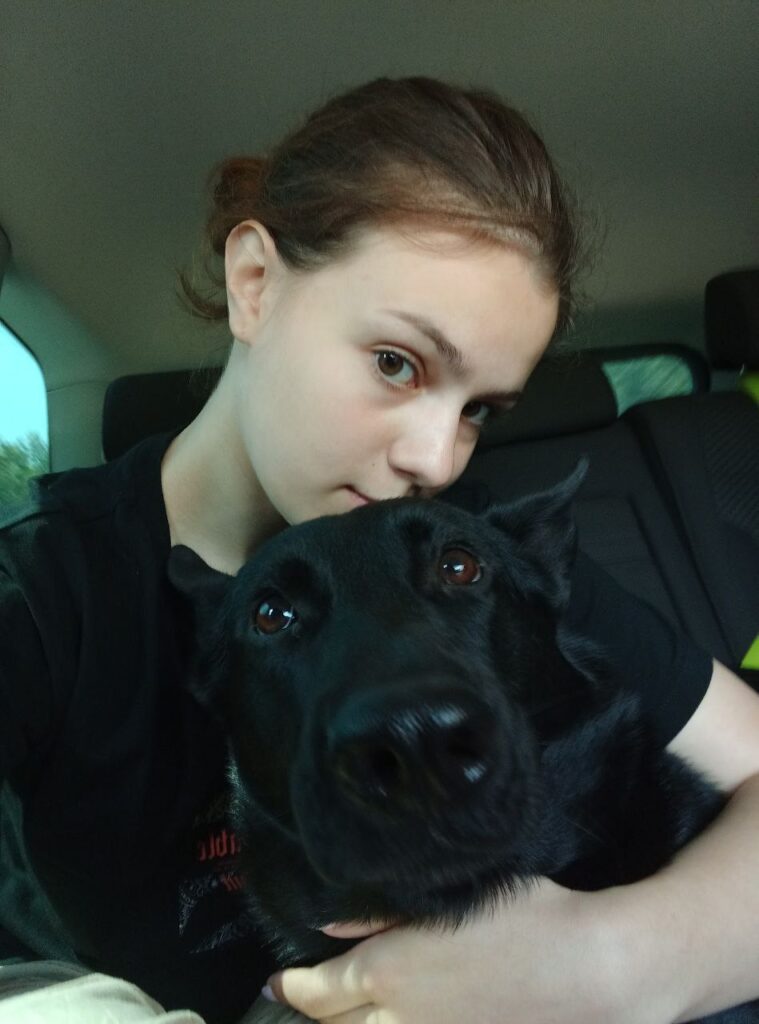
I love my dog, who is currently distracting me from answering your questions. I’m 20.
Why did you decide to choose the profession of a lawyer?
Because I have a humanitarian mindset and a vision of this world. All the interconnected processes of economics, history, and communication management with people interest me the most in this life.
I don’t believe that we can solve global problems until we understand the basics of interaction. And since jurisprudence, I mean, in a way, law, helps us understand this, I decided to study exactly that.
Can you share how you experienced February 24th?
I didn’t sleep. I saw the address by the President of the Russian Federation, I call it “russeia.” I woke up my acquaintances. My parents were in Sumy at the time. Sumy was already out of Ukraine’s control. Not occupied, but not under its jurisdiction either. Since I am from Sumy myself, I tried to persuade as many acquaintances as possible to leave. I understood then that this city very close to the border and might not remain free for long. And that’s what happened.
On the morning of February 24th, I had to decide what to do next because at that time, my boyfriend, with whom I lived, and my closest friend, were already planning to go from Lviv to Kyiv to register and, to support the resistance somehow. I was left alone the next day. I had no one. My closest friends went to Europe, and all my relatives stayed in the occupied territory.
Acting on strong impulse, I went to the train station, as it’s the logistical center of any city. Lviv, where I was at the time, started accepting refugees.
I decided to join volunteer centers near me. So, from February 24th until the end of March or the beginning of April, every day, and sometimes several days in a row, were spent at the train station. I still see February 24th as a terrible nightmare, related to the railway.
What happened next? Did you stay in Lviv?
Yes, I stayed in Lviv.
Despite the fact that I am currently exclusively involved in military matters, my volunteer activities initially started purely as humanitarian. I remember the horrifying moments when Lviv was accepting refugees. Trains were overcrowded, and they were traveling on non-standard routes. If a standard railcarriage is designed for 60–70 people, there could be up to 200 people in there. I remember the queues at the borders. We asked our customs officers to let mothers with children pass through with some sort of green corridor. We delivered medicine and accepted newborns from Kyiv.
However, since all my surroundings consist of military personnel, at a certain point in my life, I had to shift from humanitarian work to military work. I started looking for minimal equipment like thermal imagers, rangefinders, and so on.
Everyone was united. Everything was discussed through Telegram and phone calls. You could trust a stranger with a cargo worth 1,000 euros because that was the time. You didn’t think that someone could deceive you in such circumstances.
That’s how we got acquainted with the team of my foundation. Some helped with relocation, some asked for something for someone, some found money but didn’t know how to purchase something. We formed spontaneously, but since we still live by certain rules, we had to align with the laws of the state.
Spouses Romankevich are the “mother” and “father” of our organization. They initiated the creation of the charitable foundation. Gradually, people from the group that met and worked from the very beginning of the war began to join it.
So, have you been volunteering since the beginning of the full-scale invasion?
Yes, you could say from the first day after the “non-declaration of war” and the declaration of a “special military operation,” which was the next day.
What actually prompted you to get involved in volunteering? Was it an internal impulse?
Well, since I live in a “social bubble” where people are divided into at least two categories: collectivists and passionate individualists, it was a natural impetus. Something needed to be done, and it was a matter of my individual existence and the existence of society as a nation.
So, nothing prompted me; it was more of an instinctual, living impulse. I realized that either I do something, or I face an uncertain future.
What is your personal role in the foundation’s work?
Since I am studying to become a lawyer, about two months after the foundation was registered, I took on the role of a legal consultant. However, from the very beginning, my task was to find goods, order them, and oversee their delivery.
But it turned out that many goods require a specific procedure for purchase and transfer. I had to study the legislation explaining the functioning of non-profit organizations, humanitarian aid, as well as the purchase of goods of dual or military use. Since October 2022 and up to the present, my responsibilities include the contractual documentation of purchases, document preparation for the proper customs clearance of these goods (as most of them are purchased abroad), proper accounting within the organization, and the preparation of transfer documents from our organization to military units or other recipients of aid.
All these procedures are too bureaucratic, in my opinion. The majority of my free, and not-so-free, time is still spent on studying certain nuances that will allow us in the future to avoid being heavily penalized. After the end of the war, there will be serious audits. Currently, there are many audits from the Ministry of Defense. And mistakes we made in the past regarding transfers, purchases, etc., could come back to haunt us in the future. I need to close all past debts so that none of us faces unwarranted legal liability later on.
How much time per week does volunteering take up for you?
I used to work before. I had to quit because starting in September, I am resuming my in-person education. Previously, volunteering took up all my free time, especially a lot of time at night.
Now, since I don’t have a job, volunteering takes up my entire day. Sometimes I allow myself to do nothing on weekends, but there are emergencies when I need to work even on weekends.
I still have a very flexible schedule. When I feel like it, I can draft a document, and since I’ve already worked on most cases, I can use my previous experience. But logistics and military managers who communicate with the military work 24/7. I don’t envy them because it’s tough not only physically but also emotionally.
End of the first part of the interview with Ms. Alina.
Continue reading in our next post, where Alina will share more about the foundation’s achievements, extensive fundraising efforts for our soldiers, and the challenges faced at the beginning of the large-scale war, as well as what is the most challenging aspect of being a volunteer. Go here to read the second part of the interview with Alina.
Translator: Bohdana-Nikolietta Terekhina


