
(Photo: Hanna Ryasna, from personal archive)
Hanna Ryasna – holder of the Order of Princess Olga III degree, director of the regional communal institution “Luhansk Regional Center for Support of Youth Initiatives and Social Research”. Since the beginning of the full-scale war, Anna moved from Lysychansk to Dnipro. Her husband went to the front, she began to help the residents of her hometown, who remained there, and the displaced.
Thanks to the “Life and War: 10 Ukrainians – 10 Stories” project, we had the opportunity to talk with Hanna:
– Hanna, how did you meet February 24, did you immediately understand what you needed to do?
-Since February 24, our family has been preparing, we were already ready for the coming war, because we have been a family of military personnel since 2014. It was at this moment (February 24) that my husband had to start his service in the city of Dnipro, so we all went there together, and in this way we were prepared both by the Luhansk Regional Youth Center and the Youth Council for the fact that it would be necessary to evacuate, because we already had experience. We have known what war is like since the 14th year, and this time we did not want to make the same mistakes we made last time: not to export equipment, not to export documents; so this time we were already preparing for a full-scale invasion.
– Since you already have experience working with adults, please tell me if you have already had experience working with children, especially those who have lost a father or mother, what psychological aspect applies to them?
-Today, we have opened a shelter for displaced people from Luhansk Oblast in the city of Dnipro. This is a site where almost 300 people can stay at the same time. Today, 80% of people are permanent residents and 20% are in transit. With regard to the children’s audience, we start working with the fact that already on the second day of stay, a psychologist works with this family; works with an adult audience and works with children. These are two different people: a person who specializes in adults, and who specializes in children. 90% of people who come to us are people from single-parent families, people from difficult family circumstances, and after they get to us, we, together with psychologists, select difficult families, especially with children, and continue to work with each individually family individually. For example, we currently have a woman who uses drugs, she has two children who constantly suffer from domestic violence, and this is one of the examples of particularly difficult family circumstances with which we are currently working.
– Your evacuation and creation of a group of volunteers in Dnipro. How difficult was it for you to adapt to a new city and get into the rhythm of work? What challenges did you face in the beginning?
-It was difficult… So difficult. I had never been to the city of Dnipro before, and I had never dreamed of moving anywhere at all. It was difficult especially with the team, because in order to say to your team: “We are all moving to Dnipro”, it was necessary to create some conditions. We understand that youth policy is good, but it does not give good wages, and when a person’s salary is 6,500 hryvnias, it is unlikely that he will be able to rent an apartment in the city of Dnipro for 12,000 hryvnias. Before calling our team to work fully, already as a regional youth center, we and a team of new like-minded people in Dnipro, who became members of the “Light of Culture” public organization, created a shelter in order to have something to offer people. This was the first stage. In general, why did I start working, and why didn’t I shut down, like most people, sitting in my personal problems, because right now my parents are in the occupation and I can’t do anything, they are there, and if I don’t help, I think that no one will. Therefore, this was the impetus to start working on the humanitarian component. We carried drinking water, we carried bread, food. We carried clothes, hygiene products, many things, and it is certainly personal injuries that stimulate the need to act.
– Regarding the moral condition of children who left the territories where the war is going on, what help is provided to them if the situation is very serious? What is being done to improve the morale of children?
-First of all, it is a safe environment into which children and their families fall. Next, a medical examination is also carried out, thanks to the Luhansk regional administration, we have 24-hour medical support on the territory of the shelter, teams change alternately, so that we can always receive people and provide them with the first medical aid they need. After that, there are psychologists who work with families on an ongoing basis. This is a prerequisite, even for those people who do not see that they have problems.
– About support from foreign countries. On the one hand, foreign countries declare their support for Ukraine, on the other hand, they have relations with Russia. Do you think that the support of foreign countries is sufficient for Ukraine?
-I will say this, that’s it, if we talk about the creation of a shelter, thanks to the support of the Czech organization, we started. Before the winter period, we made a roof thanks to the American government. We are now opening a network of youth hubs in three large cities of Ukraine for youth from the IDPs of Luhansk Oblast, also thanks to the USA project “Democratic Governance in Eastern Ukraine”. In my opinion, non-governmental public organizations are well-supported by international partners and donors. It would be better if we supported our Armed Forces of Ukraine more strongly, then maybe we would come closer to victory faster.
– Your work, helping people over all these years could not go unnoticed by itself. On February 24, Volodymyr Zelenskiy awarded you with the Order of Princess Olga of the III degree – does this additionally motivate you to create new feats for the Ukrainian people?
-Certainly motivating. I probably told close people that after Mr. Zelenskyi gave me his hand and thanked me for my work, I grew wings, and now I want to do much more to bring our victory closer.
– What will happen to volunteering after the end of the war? Can we create a culture of volunteerism and is it necessary?
-It is 100% necessary, and already in the future, and we must be ready for what will happen tomorrow. The war will not end so quickly and the next stage is the stage of reconstruction, and that is why volunteers will have to unite in groups and rebuild their Ukraine, because thanks to our people we are holding on.
– How do you feel, will the war end soon?
-This is a philosophical question, as a wife of a serviceman, I experience it very painfully, every day when he is not with me, and if we did not say that the victorious spring is approaching and the war will end soon, I hardly believe it. Having lived in Lysychansk for 8 years, I no longer have fantastic stories in my head that it will all work out and end. I can’t say I feel like victory is coming soon…
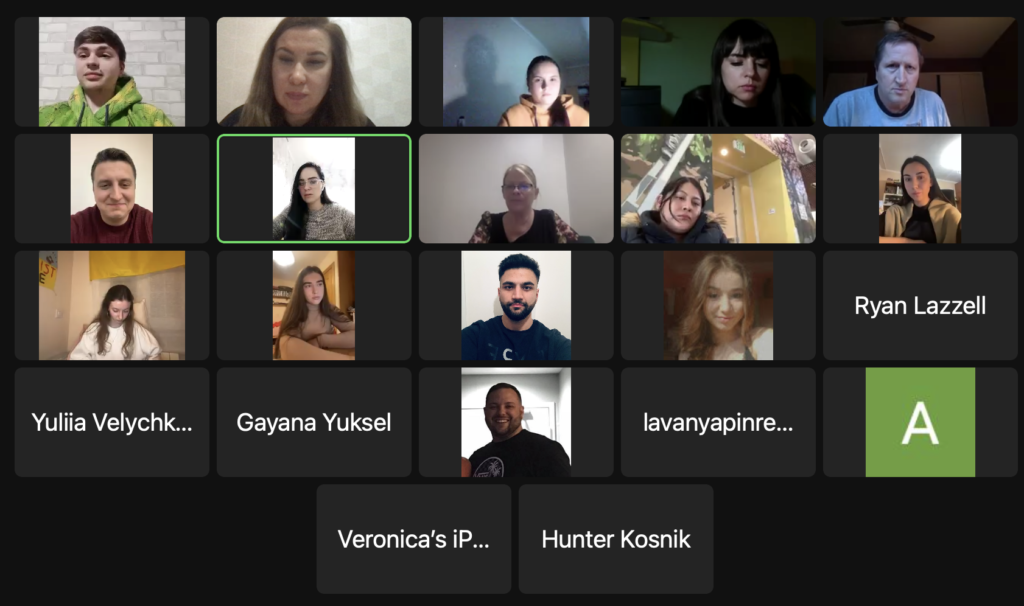
(Screenshot: from a meeting in Google Meet)


