Sumy is a city that was one of the first to face a full-scale invasion and survived despite everything. As part of the international project “10 Ukrainians – 10 stories”, we were lucky enough to talk with Dmytro Tishchenko from Sumy, who until February 24, 2022 was engaged in media management and public activities.
On the day of the full-scale invasion, Dmytro and his team remained in the city and continued to inform the residents of Sumy about the events of the region and Ukraine. In particular, they disseminated evacuation routes, official notices of administrations, and also helped volunteers, territorial defense fighters, publishing their needs on the Cukr website.
In addition, the boys resumed the activities of the “Sumy” Public Fund, conduct educational activities related to leisure, quality music, stand-ups and lectures for the development of their own city.
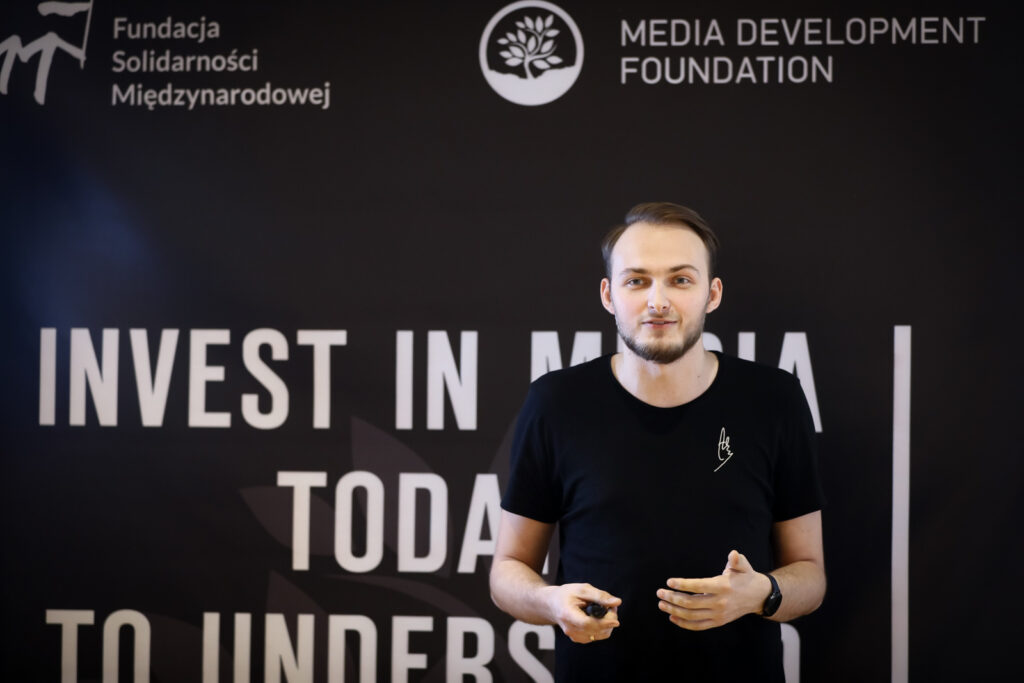
(Photo: Dmytro Tishchenko, from personal archive)
–Were you prepared for a full scale invasion and how did you meet it? Did you have any plans? Were there thoughts about what will happen next with your activity, how to continue to develop it?
-I’m back from an unplanned vacation, actually scheduled a week before the full-scale invasion. Accordingly, our team was prepared purely for any crisis situations, but we did not carry out any specific actions of preparation for war conditions.
You could say I was lucky to some extent because I didn’t lose my job. As a media person, in principle, I had a key goal – to inform people, including in wartime conditions.
There were no plans for us.But already at six or seven in the morning, we made a decision to work from home or from safe places, because the city was being shelled and it was necessary to stay in shelters, which we actually took care of on the very first day. Therefore, we continued to work in combat conditions. This month under occupation, according to feelings, was one day.
–Since the beginning of the full-scale invasion, how have you been able to maintain psychological health? What did they do for this? How do you stay so calm? How did the war change your life?
-Actually the question is very important and thanks for the compliment. I was fortunate that by the time the full-scale war began, I already knew what psychotherapy was and was working with a mental health professional. Therefore, it was somewhat easier for me in this regard. The only problem was that my request in March to see a therapist was rather strange because my therapist needed the same help as I did. But somewhere 50/50 we were useful to each other. Therefore, starting from March, I continued to talk and solve my problems, including with the doctor.
In addition, as soon as the opportunity arose, I found time to return to routine affairs. It helped a little psychologically, mentally, somewhere to remember the normal state of the body, health. Well, in the end, it brought a little back to life. It actually happened. Everything came back to normal, probably in the eighth or ninth month of the full-scale war. And now I already have such an acceptance. But everything was much worse before. War is the key change you come to.On the surface, it seems that some work processes are changing, some, say, operational issues are changing.
But in fact, the key thing that you addressed is changing – simply the attitude towards people and everything that surrounds you. I hope that every Ukrainian will realize in the shortest possible time, if someone hasn’t realized it yet, that we need to change our attitude towards each other. And this is probably the most important change.
–What steps can be taken to prevent Russia from influencing smaller countries that are territorially around it? What steps should NATO take in order to provide Ukraine with adequate military and financial protection for fighting not only physical, but also mental?
-I recently had an interesting conversation with a representative of a Central Asian country. And we come to the conclusion that in addition to exerting military influence on Russia, as an organism that constantly threatens its military potential, the whole world should make efforts to reduce their military potential, especially nuclear. And we also have to support national minorities who have been abused for hundreds of years. It would be better for the Russian army to win its independence, to continue its existence in the format in which they will want it, and not as part of the empire, which, in most cases, only mocks them and limits their rights.
-How can other countries help and support Ukraine? What is important to do so that others in the world know about the war in Ukraine?
-We have to say again that Ukraine is actually fighting against an organism that actually fights against development, fights against progress. That is why we are fighting for the freedom of Europe. We are fighting for the freedom of all modern countries that practice democracy. This is the first thing that is important to know and understand when it comes to supporting other countries. The second important issue that I want to say is that we have enough specialists, we have enough experts and potential to restore our country, reinvent it, do some new things. But we will definitely need the competence of specialists from European, American or other countries who will be ready to help rebuild the country, develop it, because everyone should be interested in this, because Ukraine has a really powerful human potential, and, accordingly, it should be interesting other countries.
–The social structure of the population of Ukraine and what efforts are being made to help people recover from the psychological effects of the war?
-Let me try to answer. There are simply too many questions, but it is necessary to clearly understand that about fifteen, maybe twenty percent of the population of Ukraine is now abroad. Accordingly, Ukraine rather trusts Ukrainians as partners and is able to not worry too much for a while in the absence of the necessary resources. What concerns people who are on the territory of Russia – they, even civilians, are also, let’s say, a segment of the audience that is difficult to “cover”. This is not a very large percentage of Ukrainians, but it is a category that we should remember.In order not to get into the word more and more, just running to the end of the question, what to do with it?
There is not a single person in Ukraine who has not experienced problems in connection with the war: social, economic, psychological. Even a person who lives in a city where there have never been explosions is actually a victim of war. It is necessary to implement full-fledged powerful programs with adequate funding and adequate specialists. We will not do this without partner countries. We are already doing a lot with their participation, including partner organizations. But we need to work on it all together. Including specialists in sociology, specialists in psychology can and should make their expert contribution to recovery, for which the Ukrainians themselves will be sincerely grateful.
-What do you miss from your routine life?
-This is a small everyday example: many people in our city appreciate such an opportunity as a vacation in a park or forest area. And in fact, I never thought that such an opportunity would become unavailable.
It seemed that this was generally some kind of low level of opportunities, when you can always go to the forest, recover, take a tent, barbecue, take anything and go to rest. Now, due to the fact that our vast territory of the region is mined, shelled and, in principle, it is forbidden to be in the forest park part of the region, it is very worrying that it will be difficult to return to such routine things and it will take tens of years to recover.
Such small examples actually hide the trouble that lives next to us.
–Many of us have had such cases when, after the twenty-fourth of February, we were disappointed in some of our friends, acquaintances, even relatives because of different political views. Have you had this experience?
-I can say that life experience allows you to separate friendships and relatives, as well as anything else, from political views. But, most likely, I was lucky that I did not have very pro-Russian views from certain people.
I have friends and relatives around me, with whom I may disagree on certain issues, but there were no such critical moments, because of which, in fact, our relationship could suffer. Some I took a break from communicating with, some I still don’t communicate with, but that doesn’t mean we stopped being friends. It’s just that there is time and there is tension in society that does not allow us to have a constructive and unemotional dialogue. Therefore, we are waiting for better times.
–How did the idea of creating an online magazine of the city of Sumy – Cukr – come about?
-Actually, the idea of creating a magazine is the quintessence of our social activities, because I actually grew up with some community in Sumy and engaged in social activities. A year before the pandemic, we felt it and made an online edition that helped us continue our activities in a modified online format. Then the media could continue to maintain contact with the concerned consciences. That is, in fact, our idea of media is to connect people who are already active residents of the city with people who want to be active residents of the city, in order to change Sumy for the better.
–What are Сukr awards and how does it help city residents?
-Сukr awards is a project that took place only once. It was an initiative to reward volunteers and changemakers of the city of Sumy. It is about the fact that we awarded attention to people who do something useful for the city. It was a rather symbolic meeting in an informal setting, where we actually wanted to get to know each other as changemakers.
–How much money has your volunteer organization managed to raise so far for the needs of our military?
-In January, it was calculated that we transferred 16 million hryvnias of fundraising to the Sumy public fund. This is actually a partner organization, on whose account we collected funds during the year.
–It is known that you organize stand-ups, lectures, bring cool speakers from all over Ukraine. Do you do this only within Ukraine? Have you ever thought of expanding, holding such events, for example, in European countries? There are many of our Ukrainians there, for whom it would also be relevant.
-My motivation to do educational activities related to leisure time, quality music, stand-ups and lectures is tied solely to the desire to develop my own city. Not even so much the country, because I understand the finiteness of my resources, I perfectly understand my capabilities, the capabilities of my team. And my team, in fact, is united around the idea of competence, its “resourcefulness” – this is something that we can definitely influence. Therefore, we are not even talking about going outside the city or region.
Of course, we are ready to share our experience, if it will be useful to someone in how to organize it. But directly ninety percent of our efforts will and have been focused on Sumy. The only thing we do is an online component, including for Sumyans who went abroad, to other cities of Ukraine, so that they could feel at least some involvement in the work we do. We have such a community, called the Cukr Club, where there are almost four hundred people with whom we are in financial contact. We are in constant contact with them in e-mail newsletters. That is, we stay in touch with people. But I return to the fact that the key motivation is to develop the city of Sumy. Therefore, I do not see much profit in going somewhere and talking about the context of Sumy outside the borders.
–You organize stand-ups. What stand-up artists do you invite? How does society treat stand-ups during the war?
-Those that we like in terms of value and material. Society behaves well, laughs. It helps them to adapt a little, to laugh off anxieties, to laugh at injuries, to experience everything a little bit not through tears, but through some other emotion.
–You work with stand-ups. I have a question regarding the recent conflict with Andriy Shchegel. What do you think about this?
-In general, by the way, I look at this as an existential problem in the country. Because despite all the offensiveness and such hate speech of Mr. Shchegel, I know him well enough and therefore I cannot draw an unequivocal conclusion, but this indicates a psychological problem in general among us, among Ukrainians. That is why it is such a painful topic.
–What was the most difficult during the full-scale invasion?
-The most difficult for me was the first month of the great war, active hostilities in my region. Our city was blocked by the Russian army, some cities in my region were occupied. There were many cases of rape, abuse, people were kidnapped and sometimes killed. It was the most difficult to survive the first month, when these events were very massive.
–How do you manage not to lose heart, find strength in yourself and keep going? How did you manage to stay out of the way of help and continue working on your projects?
-Psychotherapy, self-discovery, meditation, resting in time and knowing what restores you, finding yourself in the principle of the real you, not who you are during the war.
–What advice can you give Ukrainians to continue developing despite a full-scale invasion?
-In fact, those who do not have the motivation to continue developing. It is necessary to dig very hard into why they did something in the first place and why it has become irrelevant now.
Perhaps people should reconsider their sincere motives for what they would like to do. Perhaps someone is simply not aware of their psychological state. For this purpose, there are specialists and medications that help solve these problems, there is supervision, psychologists and psychotherapists, and eventually psychiatrists. Many people do not really realize that, including, they may need the help of specialists, which for some reason we are accustomed to consider as an extreme measure of some condition. But I will be happy to think about what motivated a person to work before.
If there is nothing now that motivates you to continue your work from your past life, then as soon as possible start looking for it through books, some meditations, studies, education – this is a very cool method. That’s why I want it.
–What would you like to do after the victory of Ukraine?
-I am lucky that, in principle, I do what I want. In addition to the fact that there is a very large military component here, in general, even without it, you want to continue developing the city to the point where you can raise your family, relax, share inspiration with others and be inspired by other people.
(Screenshot: from Google Mееt)


