Why did you decide to become a volunteer?
Volunteering came to me out of the blue. I saw a post on a social network from a volunteer, a girl who asked if anyone had anything to give away, she needed to launch a new collection. We exchanged private messages and I offered her my still life of pomegranates, which was already finished. After that we had a fruitful collaboration and became friends. One day I decided to help her with the collection and take over some of the work. That’s how I opened my first little collection. Then, as fate would have it, I was driving from Kharkiv and met a soldier and we started talking. Later he wrote to me asking if I could help them with the collection, or if I knew someone who could. That’s how I got my first collection for a car. And I am still working with my ‘first’ team.
Do you work with NGOs? If so, could you tell us how you got involved?
I am officially a volunteer with the NGO ‘Free Fate’. I met the head of the organisation through comments on social media. It turned out that we were both from Donbass. We talked for quite a while, and then he offered me to officially join their NGO and help more teams. It took me a while to decide, I hesitated because it was even more responsibility than I had before. But a month later I made my first trip to Donbass.

We know that you are involved in a project to collect pill-packs for the military. Could you tell us how you started? (*a pill-pack is a set of pills that a soldier takes once after being injured, containing an antibiotic, painkiller and anti-inflammatory drugs -ed.)
The ‘Pill Pack Project’ should not really be called that. It is more likely to be a permanent collection of medicines. One day a soldier wrote to me and asked if I could provide him with pill packs.
I thought about it for a while, talked to civilian and military doctors, hospital doctors. It was a set of pills to be taken after an injury to prevent blood poisoning. At the time there was a request for 50 of them. I then sent them to my friends for testing and criticism. My friends and I improved the technology, and now we regularly pack and send pill packs to medics and soldiers. The happiest days are when your volunteers call you and tell you that they are delivering humanitarian medicine. This reduces the final amount of money needed to buy the medicine.
The most rewarding moments for me are when the soldiers send me a text message, not a delivery report: “Boys of the 300th, we drank your pill packs. Everyone is alive and already being treated in hospital. Thank you very much.”
Then I realised it was all for a reason.
But not just the pill packs. My friends and volunteers from an NGO and I are constantly raising money for drones and electronic warfare (EW) equipment for cars and medicines, for turnstiles and first-aid kits.

In April this year, at the entrance to the Donetsk region, four unknown people who called themselves volunteers ‘updated’ the stele bearing the name of the region by painting over all the messages left by the military.
You are the founder of the Donetsk Stele Restoration Project — tell us how it all began. What stage has the project reached?
As far as the Donetsk Stele Restoration Project is concerned, everything happened by chance. I didn’t expect to get such a great response from people who cared. I was on the phone with my friends when I came across a post on social media saying that some ‘vandals’ had decided to update the Donetsk Stele. They had ripped off all the stickers and painted over all the inscriptions.

It was a blow to me. My friends and I sat there and didn’t know how to react. After the first wave of surprise, I suggested that we should somehow restore it. So, after some discussion, we decided that it would be more sensible to make stickers on transparent film with the inscriptions from the stele. I wrote a post that was seen by a lot of people and everyone started sharing it, and I got a lot of messages in my personal messages with photos of the stele. It seemed that everyone was looking for a video of the stele and taking screenshots. That’s how the community was formed, we scanned most of the inscriptions and found the organisations that had left stickers there.
My team and I went to the stela to measure all the dimensions of the structure and the letters. But when we got there, there was no room left for the inscription. Then one of my friends made a joke: ‘Knowing you, you’ll make a copy of the stele and take it to the city centre. It was a joke, of course, but it got to the point where we are working on a project to install a Donetsk stele that is twice as small. With all the stickers and inscriptions that soldiers and visitors have left on it. When you drive past it, you can’t help but stop and visit it.
Why a mobile installation? I was at the stele two weeks before it was ‘restored’. And how many people didn’t have time to visit it, or didn’t have the opportunity to go to the Donetsk region just to look at it. That’s why the column is coming to you.
At the moment, my friends and I are working on the layout and design, so that it is collapsible and vandal-proof. We are making the design and digitising the letters and so on.

How do you manage to combine art and volunteering?
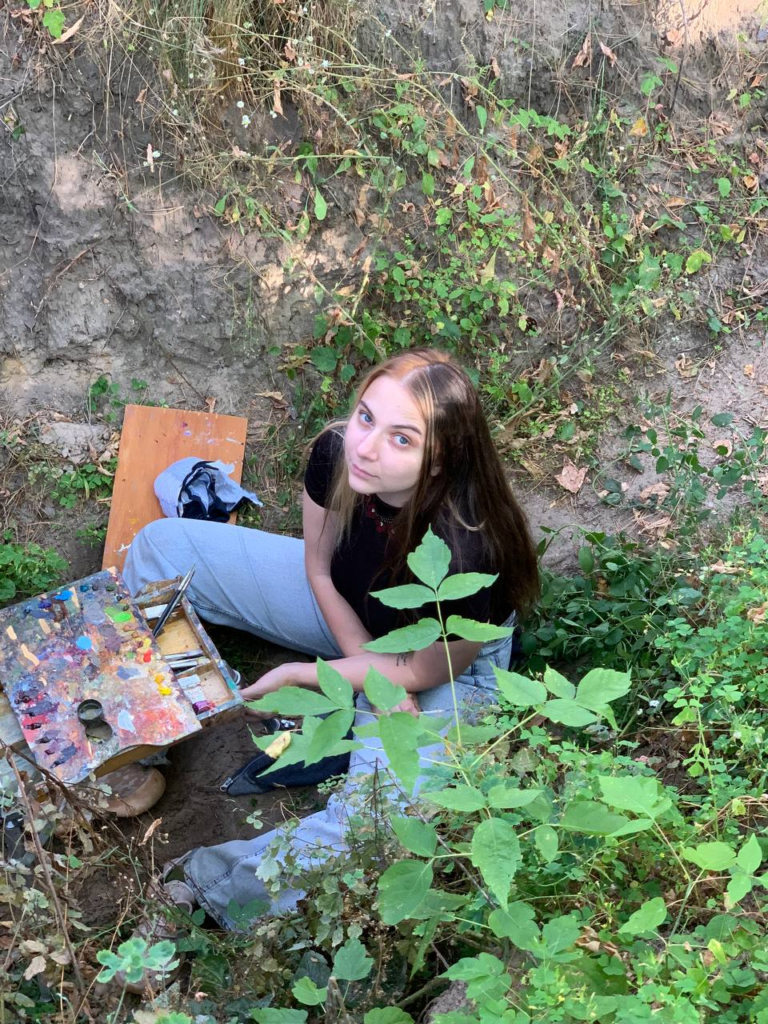
Actually, they flow from each other. I started my artistic career with paintings about war, still lifes with grenades, landscapes with phosphorus. Well, forgive me, that’s contemporary Ukrainian art. Where do you get your inspiration? I get inspiration from everywhere. For example, the subject of my next painting will be a moment from a flight to Donbass. I had to take things to the boys and get them to sign my posters for the next training camp. And here we are in the courtyard, I take out a cigarette and light it. There was a cherry tree in blossom and a chair under it. A soldier was sitting on the chair, his elbows on his knees. He was also smoking. I sat on the edge of the cast-iron bath and just watched. I think this moment is worth a whole picture.

Tell us the most memorable story of your flights. How did you feel when you arrived in Donetsk Oblast after a long time?
When I was travelling from Kharkiv, I looked out of the window and the driver asked me what I was looking for, and I told him ‘spoil heaps’. He smiled at me and said: “They are not here. They are in Donbass. But we have to go somewhere else.
A few months went by, and I kept looking out the window until I saw them! The spoil heaps of my homeland. Remember the moment in the Shrek cartoon when the donkey kept asking, “Are we there yet?” I did the same until I saw the first spoil heap. Look, a spoil heap,’ I said to everyone we passed. The boys laughed because they had brought me home.

Then we arrived at our destination, handed electronic warfare (EW) equipment to the boys, then met another soldier and I handed him the pill packs. We joked at the time — ‘delivering the head of the front line’.
On the way back, we stopped near a dump and had 5–10 minutes to stretch our legs. I ran away from the boys and came back in 5 minutes, happy as a child. They asked me where I had been. I pulled the edges of my fleece aside and told them to put their hands in their pockets. They were full of coal. When I met with my friends in Kyiv, I gave each of them a piece of my native land. It was a particularly sensitive moment for my friend from Donetsk.
What are your plans after the war and our victory?
First we have to win, and then we’ll see. We will find out on the spot. But one thing I know for sure is that as soon as our Donetsk is free, I will get together with my friends and go to the waterfront to paint Nessie and the yellow submarine again. After all, in 10 years they have completely disappeared. I will go to my father and take flowers to him. I’ll take the flowers to the Donetsk airport terminal. I’m going to visit my grandmother and other relatives. Also with flowers. I will finally see them all, it’s a pity it’s only this way. But I will.
I will come home and hang this still life on the wall.

End of Part 2 of the interview.
Translator: Ivan Chepaykin


