Was it difficult to integrate into the foundation’s work? Perhaps there were some difficulties in the first few weeks?
I can’t say that it was difficult for me. I am a fairly sociable person, and, moreover, we were already communicating with the foundation’s team at that time. I have already met some members of the organization in person, and some, we still haven’t met, but we communicate very closely.
At the beginning, it was very challenging to understand how to spend money effectively and rationally. We currently have issues with donations; and fundraising, in general, is slow. However, at the beginning of the war, any fundraising efforts were highly successful. They were announced, and within an hour or two, the entire amount was collected. After that, the question arose of how to spend the money correctly, what to buy and where. Because the civilian perception at that time and the actual needs of the military were significantly different. We had to learn not only in practice but also from the mistakes of our own practice. And this was probably the most challenging part, but as soon as I started focusing solely on my area, which is jurisprudence, it became much more exhausting because the human factor is always present. People make a lot of mistakes, and someone has to take responsibility for those mistakes.
Currently, our organization’s director is responsible for them, and she is a very good person. Since she will be held responsible for someone’s incorrectly prepared document, all our efforts are directed towards correcting these mistakes. People often make mistakes or do something incompetent in their enthusiasm to help, so there are many such cases, and we have to deal with them individually and constantly.
When more people join the foundation, delegation of duties becomes necessary. It becomes easier for each individual, but the number of mistakes increases. As soon as we started expanding, I began to focus on legal support. The needs started growing. The funds we have today (which is a stable million hryvnias each month) started being accounted for. Since then, everything has become much more exhausting. It wasn’t exhausting at the beginning.
Can you tell us about some of the major fundraisers or needs that the foundation has successfully addressed?
Last year, the foundation processed 32 million hryvnias through its accounts.
We had a very close collaboration, or at least we used to, with Mr. Sternenko. We helped him make drone purchases, and he assisted us in fundraising.
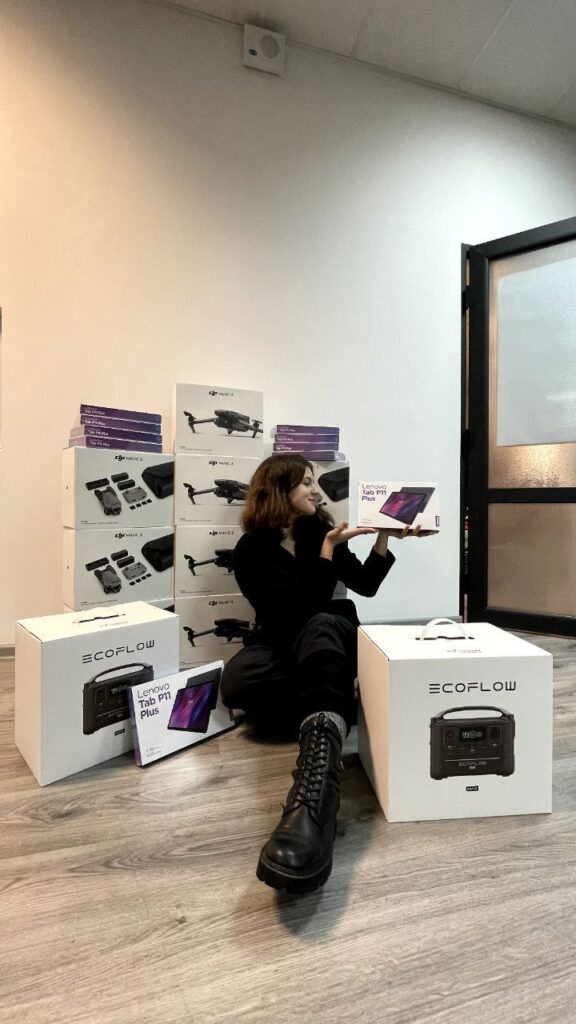
Perhaps the most significant project of the past year was the acquisition of 130 Mavic drones (in a single purchase). It seems that we delivered these drones to 22 military units.
We had a five-million hryvnia fundraiser for optics. This included night vision devices, thermal imagers, binoculars, and rangefinders. Recently, we held a substantial fundraiser for five vehicles.
We collaborate with various companies and fulfill the needs of thermal vision drones. We work regularly with the 80th brigade. We have already allocated more than 4 million hryvnias to them. Recently, we finally received 35 contracted drones.
Overall, the work that our foundation does each month is enormous in my opinion. We provide equipment worth approximately a million and contract for about a million. So, the actual turnover of the foundation per month is 2 million. It’s all very large-scale to me.
We also collaborate with the military school “Boryviter,” specifically financing the training of personnel. As far as I remember, we allocate funds to them quarterly, up to 400 thousand hryvnias each time.
You mentioned that donations have decreased recently. Do you know how the foundation is trying to attract more people to contribute?
In my department, we have only four people, so we have a very heavy workload. Because of this, I know very little about what is happening in other departments, except for logistics, which is closely related to our activities. To be honest, my desk is piled high with stacks of paperwork from all sides.
But I do know that our fundraising department is trying to cooperate with YouTube bloggers, restaurant chains, and also I personally try to do something with media activity on social networks.
Our fundraising is done through cooperation with legal entities, typically large companies. Most often, these are IT companies.
Recently, there was a “Homin” event in the inner courtyard of the Lesya Ukrainka Theater in Lviv, organized by our foundation and the “Zahin Kinomaniv“. We often practice charitable auctions. We take items like shells and casings, and artists decorate them, trying to turn them into art objects. Then, we try to sell them nicely, but society is currently oversaturated with such initiatives. Therefore, auctions are not very profitable, if we can use the word “profit” for a non-profit organization.
In my opinion, donations have decreased not because people have gotten tired of the war, but simply because unemployment rates are gradually increasing here. All the savings that people had before the war started have slowly been depleted, if not entirely depleted.
And donating is a matter of giving something of your own to someone. It’s a choice between covering your minimum physical needs or making a donation. Society is being exhausted not that emotionally (although that also happens, unfortunately) but financially. Those who can donate will continue doing it. From my observations, it’s primarily the IT sector. They work in the Western market and receive Western salaries accordingly.
What, in your opinion, is the most challenging aspect of being a volunteer?
The most challenging aspect of being a volunteer is when you can’t help in time. There are many cases where people ask for help, and when you’ve already found all the resources to assist, the help becomes irrelevant.
The biggest disappointment is when people write to you saying there’s no one left to help. In general, volunteering is an exhausting endeavor. You find yourself somewhere in the middle. You don’t belong to the civilian world, and you’re definitely not a soldier. You can’t relate to the military world because it’s entirely different. They perceive the world differently and are in dreadful conditions. To say that I am part of the military movement is to display great pride and ego. So, you’re somewhere in between, torn between the two, and it’s psychologically exhausting.
Any failure is exhausting because you understand that it’s not just a personal failure that can be corrected; it’s a person’s life that others are waiting for and loving. And sometimes you can’t keep up or you do something wrong.
The most challenging aspect of being a volunteer is that volunteering greatly impacts all other areas of your life. Your work suffers, your education suffers, your minimal communication with people, which is essential for your well-being, suffers. And the more exhausted you become, the worse your productivity at work becomes. Many volunteers have started taking antidepressants because they physically can’t handle it anymore.
But the hardest thing is probably not being able to keep up.
How do you manage to cope with stress and exhaustion?
I can’t say that I get very stressed. I am emotionally a very cold person, and I have enough inner resources to control stress and despair.
Perhaps what helps me the most here is coffee. As soon as I have a cup, it becomes much easier for me to work and think. But that’s just me, and I’m probably an exception, however, it might sound pretentious.
Others have a harder time dealing with stress because, besides stress, you also lose most of your friends. Almost all of my friends, with whom I communicated before and during the war, are now deceased. On Monday, I will be attending the funeral of that young man whom I saw off to the war in Lviv on February 24, the same friend who went with my boyfriend to defend us against the Russian invasion.
Gradually, some people’s psyches adapt, while others do not. Those who haven’t adapted have to contact psychotherapists and take some form of “doping”.
Honestly saying, since there’s no time for relaxation, most of the volunteers I know, take medication. Dealing with stress in conditions of constant stress is not feasible.
What do you find satisfying about being a volunteer?
What I find satisfying is the sense of a certain kind of vengeance. Because any work you do turns into something. For example, a drone itself or a thermal imager on its own doesn’t provide any benefit; they are just devices. But when you hand them over to competent people who know how to use them, and even under the circumstances of material losses, they can achieve more than these devices cost, you feel a certain satisfaction.
The enemy took away years of my youth, my friends. To some extent, as a lawyer, I also care about the internal and external sovereignty and the territorial integrity of my country. I want to take back from him the same.
I, like any healthy person, will be pleased that our activities bring about a sense of “an eye for an eye, tit for tat”.
It also brings satisfaction when those you communicate with come back and express their gratitude. And you are very happy when you see them alive, healthy, and some even happy.
My motivation, in general, has a bit of revenge at its core.
Do you engage in anything else besides volunteering? Perhaps you have hobbies that inspire you and give you the strength to move forward?
Before the war, I had many interests that were somehow related to law. I’m a bit crazy about jurisprudence. So, I used to attend debates in English on legal topics.
I was involved in music, but now I don’t have time for it at all. Currently, all my hobbies are limited to literature, but of course, not professionally, just fiction.
Sometimes I can play the synthesizer, but I don’t dedicate much time to myself as an individual. Because I adhere to the belief that as long as the war continues, individuality doesn’t matter. What matters is a united society that opposes something. So my hobbies, interests, plans, and leisure have not just taken a backseat but have been pushed into the future beyond the horizon.
This is the second part of the interview. Follow this link to read the first part.
Translator: Bohdana-Nikolietta Terekhina


