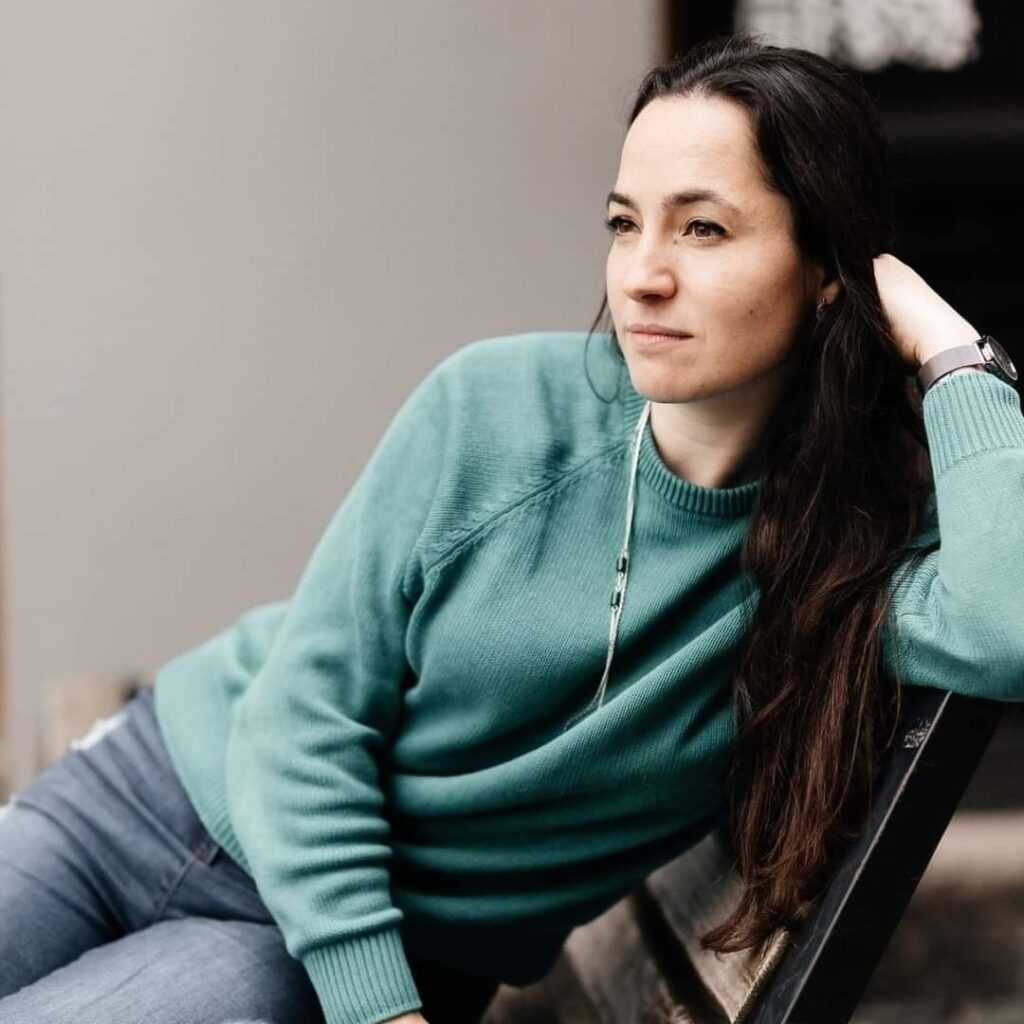
Natalia, I would like you to introduce yourself and tell readers of the Truthful Reporting platform about yourself in the form of a one-minute elevator pitch.
My name is Natalia Vasylieva. I am a book person: I publish books, edit them, design them and write them myself. I know how to see and feel a text, how to turn it into a book. I live by what I do and I enjoy it.
I was born in Kharkiv and have lived there all my life. Because of Russia’s full-scale invasion of Ukraine, I lived in Ivano-Frankivsk for a year, then in Kharkiv for a year, and in the new year of 2024 I moved to Kyiv, and now we are here with my son Andrii.
Do you have a publishing house?
Yes, I have my own publishing company, «Vidkryttia». It started under the name «Litera V». But after the full-scale Russian invasion of Ukraine, the name was changed because it was impossible to continue working with the letter that the occupiers had taken as their symbol. Besides, the name «Vidkryttia» is closer to the publishing house’s mission, which is to publish the works of young, promising Ukrainian authors. In addition, youth is a conditional concept; the actual age of a person is not important to us. The main thing is that they are debutants in literature and that their work is interesting.
We are the only publishing house in Ukraine that deals exclusively with young authors and has a full cycle of book publishing: literary editing — layout — printing — promotion — sales. You can find out all about our books and the world around us in the Open Publisher podcast.
Were you aware in 2014 that the Russian-Ukrainian war had begun?
Definitely, yes. This realisation frightened me and froze me. In order to come out of this state, I fully immersed myself in my work, I had to somehow come to terms with this realisation and survive it. The outbreak of full-scale war was also a personal trauma for me, because I have relatives in Russia — the whole family of my father, who is long dead. Although we never had close relations, we gradually communicated. They were decent people, as far as that is possible in their country, and they told me things about my father that I could not know because I was young when he died. After 24 February this communication stopped. At the same time, I didn’t feel that I was losing anyone, and I understood that this gap was for life, at least for me. I also immediately understood which side was right, at a time when such understanding was rare. That’s why I froze, because I didn’t know where to go with my active position, because my environment was passive.
The proximity of the Kharkiv region to the border has made many of its inhabitants understand that Russia is indeed an older brother. For me, Russia was never an older brother. Not even for a moment. Even though I had many Russian classics and books by foreign writers translated into Russian at home, and my surroundings were Russian-speaking like me.
I was educated in a Jewish school, with an in-depth study of Jewish history, culture, religion and literature. So I didn’t grow up with Pushkin, although of course I read his works and learnt them by heart. By the way, I was the only one in my class who read War and Peace, not because I admired the work, but because I was looking for Lieutenant Rzhevsky from the jokes (laughs). Because of my education, I was absolutely religious for a while. I knew the Torah very well, having studied it on several levels. My religion teacher brought me a Torah from Israel with commentaries in Russian so that I could understand the meanings myself. (Thanks to the Torah, as a teenager I learned to look at texts more deeply, and later, in my literary studio classes, I developed the ability to see the text deeply from the inside, which is the basis of literary editing). I studied history well, which had fascinated me since childhood thanks to my grandfather, so I knew some non-obvious things about the Romanov dynasty and the Second World War. And at school we studied the Holocaust in particular. Therefore, in my adolescence, at school, I had completely different hobbies from most of my peers who studied at other schools in Kharkiv. My emphasis in the perception of history was shifted. I never admired Moscow, I never wanted to live there.
I am Jewish on my mother’s side, so I always have the option of moving to Israel or America. But I reject this idea because I know that I will be a stranger in any country. I made a conscious decision to live in Ukraine. I don’t know if it will remain Kyiv in the future, but I will definitely stay in my home country.
So when I realised in 2014 that the war had started, I had a survivor’s guilt complex for several years. I was not affected, my city was not affected, but people who lived in the east of the country were, and I could not help them.
Over time, this guilt complex disappeared because I realised that the most important thing is to be yourself where you are and to be useful in the circumstances.

How did you feel on 24 February 2022?
I didn’t want to believe the news about a possible enemy invasion until the last moment. I did not prepare an emergency suitcase. My husband’s parents live in a village in the Kharkiv region, and we used to visit them once or twice a month, so I am in the habit of packing for a short trip. I thought that whatever happened, I wouldn’t need much time to grab what’s most important in my life, which for me were my child, my cat and maybe some documents, money, a hard drive and a laptop. I knew I would have 15 minutes to get ready, even though we lived in Kharkiv in Saltovka, a residential area in the east of the city, relatively close to the Russian border.
And now it’s 5:00 in the morning. We wake up to explosions. And I can see everything from the 8th floor. And I realise that this is a full-scale war. And a war in the most bloodthirsty sense of the word. Of course, I wanted it to be over as soon as possible, I had some hopes, so I wouldn’t lose my mind. But I had no illusions.
We decided to leave: me, my brother and sister with our families. The plan was as follows. A pregnant sister would leave with her family – her son, husband and mother-in-law. My brother would take my mother. We would take my 88-year-old grandmother. My grandmother said to me: «Why do I have to do this? I’ve already survived one war: I hid under a cart, I was evacuated from Khmelnytsky to Uzbekistan. That’s enough for my age. And I put my cat in her arms and said: «Grandma, a full-scale war had to start for you to come to me and finally pet my cat». That’s how I turned the panic into a joke, and my grandmother gradually calmed down.
And then I got a call from my cousin in Russia. She was crying: “I’m sorry.” I said: “I can’t forgive you”. And then the shelling started and I hung up because I had to take my son and my grandmother to the toilet. We never spoke again.
The village we left on 25 February is equidistant from Sumy, Kharkiv and Poltava. At the time of our departure, Sumy was surrounded, Kharkiv was almost surrounded, and the only possible road was through Poltava. I was very afraid of the occupation, which could quickly reach this village. I realised that I was a Ukrainian writer, publishing Ukrainian writers. A young woman with a child. It’s not hard to imagine what they could do to me. My relatives tried to calm me down, but I had one panic attack after another, and my son fell ill from the stress. Finally, we went to Ivano-Frankivsk.
As a Ukrainian publisher, you mentally played out a possible scenario of being under occupation. Did you find confirmation of this scenario when the story of Volodymyr Vakulenko, the writer who was extradited and shot in the Kharkiv region, came to light?
I am not just a publisher, I am a writer. That is important to me. My first book was published 10 years ago. I gave it to my mother-in-law, to my husband’s relatives and to the village library in the village where we left Kharkiv. And, as I was told, the book was read. That is to say, I was known in the village as a writer. And even though I was writing in Russian in 2014, it was still clear that I was a Ukrainian writer, especially since I now publish Ukrainian writers. But I had no doubt that this would happen during the occupation – I had studied the history of the Second World War very well, I had no illusions about what war is – war is always violence, blood, death, torture and rape. Volodymyr Vakulenko, teachers, doctors, heads of village councils, proactive people died because of their conscious position. And I know for a fact that I have a conscious position. I became convinced of the realism of my predictions after the liberation of the Kyiv region, when the world saw the photos of those shot in Bucha.

What happened next?
I had two jobs in Ivano-Frankivsk. The first was in a charitable foundation, which allowed me to earn a living, and the second was in a publishing house, which I never left. I got up at 5 a.m., worked until 7 a.m., took my son to kindergarten, worked from 8 a.m. to 4 p.m., picked up my son, and worked or read until late at night. Of course, I alternated between emergency mode and rest, but in general it was like this because I had to earn a living and run a publishing house that employed three other professionals in addition to myself.
I returned to Kharkiv at the beginning of January 2023. It was a conscious decision: The Kharkiv region was liberated and the number of shelling incidents decreased. I also felt that I was losing contact with my husband, who had returned home after taking me and my son to the West. There were also rumours that schools in Kharkiv would go offline. But classes continued online — and it was terrible. My son loves live communication, and here he was left alone, without friends. From time to time, I received offers from my publishing partner to move to Kyiv and work together.
So my husband and I got divorced. At the end of December 2023 I accepted the offer to move, I was helped with renting an apartment in Kyiv, my son went to school offline, and then he also started acting in a children’s theatre. It is extremely important for my work to be visible, and in Kyiv I now have the opportunity to hold meetings and presentations. There is a publishing house, a printing house, a podcast team, many authors, and book events. So a new phase of my life has begun during the full-scale invasion.
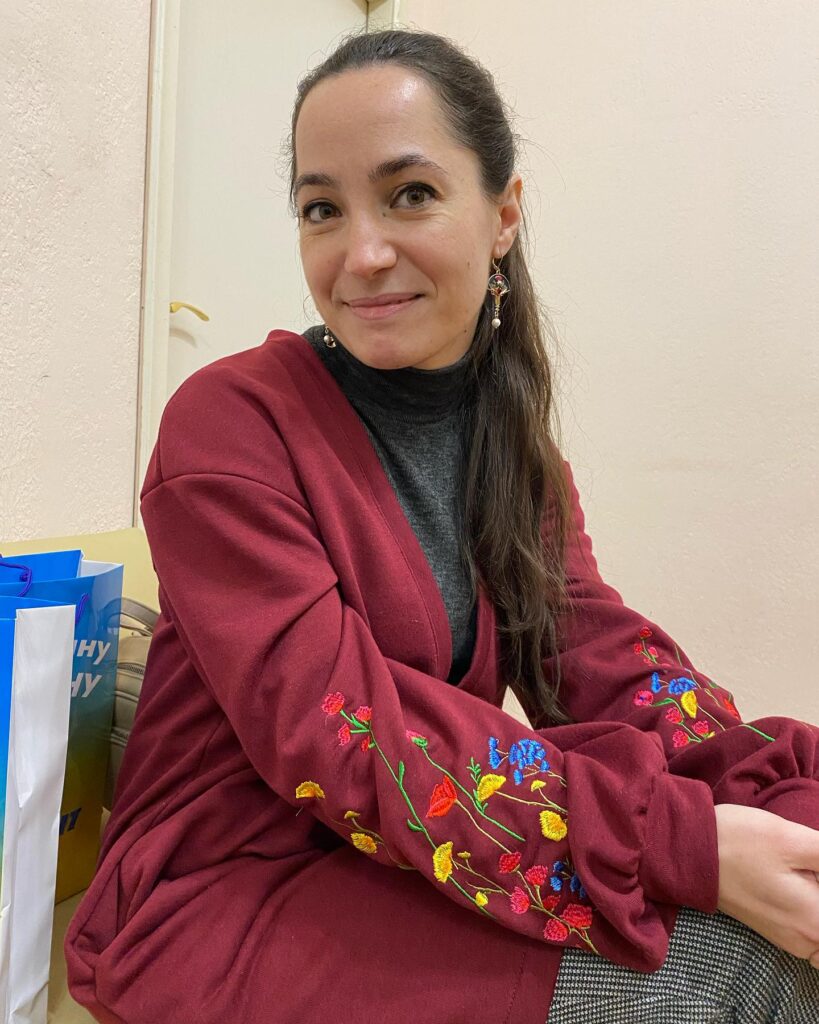
How do you balance safety with a conscious decision to stay in Ukraine?
When 24 February happened, I was very scared. For the first week, every loud noise made me shake and I cried almost all the time. My body was numb: my muscles were tense, I couldn’t bring myself to change my clothes or wash my hair.
And then I realised: Kharkiv was not taken! And this invincibility of my city gave me an incredible boost.
I know Kharkiv very well. I was born here, I lived here, and for the past six years, together with my publishing partner Olga Chistyakova, I had been preparing a historical calendar, Kharkiv: People, Events, Dates, which contains all the information available in open sources since the city was founded in 1654.
When I lived in Ivano-Frankivsk, I thought about Kharkiv every day. It was very important for me to return home. And when I did ( I was able to do it because I was living in my mother’s apartment), I went back there 15 years later. And when I had the opportunity to look at the photos of my family again, I felt that I had got what I wanted. I moved to Kyiv not because it was dangerous in Kharkiv, but because I cannot be fulfilled in Kharkiv today because of the war.
Speaking of abroad, I cannot be a publisher who takes care of young Ukrainian writers outside Ukraine, I need constant contact with them.
The main argument for me is the psychological state of my son. The main factor in my peace of mind is that he has never been afraid of the explosions.
If my city is, metaphorically speaking, like reinforced concrete (meaning it won’t allow any invader to take it), it is a sin for me not to be at least as strong in character. This city has given me a core. But if that core is not there, if panic attacks happen every day, then it is better to leave. It’s more honest than staying in Ukraine and not letting yourself or your loved ones live.
Translator: Ivan Chepaykin
The material was produced with the support of the NGO «Institute of Mass Information» as part of a project of the international organisation Internews Network.


