Since the beginning of the full-scale invasion of Russia, we have been collecting stories of Ukrainian men and women who suffered from the actions of the Russian occupiers. Every day, the Russian military launches rocket attacks and kills our citizens. We document the stories of Ukrainians who are forced to evacuate to different parts of Ukraine and the world, but at the same time continue to support the Motherland.
Today we spoke with Oleksandra Romankiv, who was in Kharkiv in the first hours of the invasion and after some time was able to evacuate and start a new life in Scotland.

Oleksandra Romankiv. Photo: personal archive
How do you remember February 24, 2022?
Before the invasion I lived and worked in Kharkiv. I studied at the Yaroslav Mudryi National Law University and worked as a tutor. The first month of winter was the best in my life.
I remember the evening of February 23. In the last month, many people talked about the war, and we are tired of “waiting” for it. I remember the last two days before the invasion.We talked with my classmates at classes: “God, I wish I could get to the university tomorrow. Maybe the war will start tomorrow.”
We went to bed quite late that day.
Did you have a sense of something imminent?
Yes. There was something like that. That day we went to bed at 2 am and woke up at four in the morning.. My neighbors woke me up and told me that the war had started. At first I thought they were joking, well… We were just talking and joking about this topic and God, how I longed to sleep then. Explosions were already heard in the Saltiv district of Kharkiv. We all ran to the basement of the house, where we were without food and water for some time. We didn’t go out anywhere and there was a problem with money: only cash was accepted in stores, and most people had money on cards.
How did you experience the beginning of the war?
The first two weeks after the beginning of the invasion, I was in Kharkiv. We hid in the basement of an apartment building, because it wasn’t clear where it would hit next time. A destroyed house was already visible on the nearby street, and we were very afraid to realize it. We kept hearing explosions. I lived on the seventh floor and it was very scary to go up there.
Did you communicate with family and friends in the first days of the invasion?
My parents, who lived in the Poltava region at the time, were terribly worried about me. All my friends were in Kharkiv, so we immediately tried to establish contact. They stayed in basements without food or water. Everyone had prepared their emergency go bags in advance, but a week before war started we unpacked them. We weren’t ready for this.
Was your university affected by the first Russian missiles? How did the university management react to these events?
Dormitories located near a small airfield (which had no military significance) were mainly affected by shelling. Up until now, our university has mainly online education. A week before the war, our rector Anatoly Pavlovich Hetman, who was in Turkey, signed an order about offline studying and many students returned to Kharkiv. And so it began.
Did you have people affected by the Russian invasion?
In the first months, yes, since many lived in the Kharkiv region. Due to the large-scale shelling of Kharkiv, my best friend returned to Balaklia, thinking that it would be calmer in a small town. But then she found herself under occupation. For a long time she didn’t have the opportunity to safely evacuate and get in touch. Their house was destroyed. Fortunately, at that time some people at the end of the city had working internet and after some time she was able to contact me.
How did you feel when you realized that life had completely changed after the invasion began?
I thought it was some kind of joke and it should end quickly. On the first day, I couldn’t understand anything because of the horror. I didn’t want to believe that it was true, but after that… I decided to go to my parents. The next month was hectic: everyone just checked the news every day and constantly discussed it. It was impossible to plan anything at all then.
How do you now assess your own decision to evacuate and what exactly influenced it?
First, the danger to my own life. At first, it was very scary in Kharkiv: constant air raids and shelling of the city. You live in emotional stress. I have never felt so stressed in my life. And then, a few weeks later, Russian troops were already standing near the city, Okhtyrka was next to us, which was heavily bombed. Then we decided to evacuate.
What were your first feelings when you found yourself in a country where there is no war?
At first I lived in Poland, where I was waiting for a Scottish visa. I remember the day when the memory of the dead president of Poland was commemorated and sirens sounded, from which I woke up with a feeling of horror. It was a different world in which people continued to live and I even felt insulted by the fact that Ukraine does not have this, and in another world life continues. Although Polish people sympathized with us a lot.
What difficulties did you face after evacuating to Scotland?
I returned to Poland after a few months to meet relatives and loved ones. I haven’t seen them since the beginning of the invasion, normal life was interrupted. You live without knowing what to do tomorrow. I studied and worked in law in Ukraine, but now in another country my education is worth nothing. It is necessary to start from the beginning. Sometimes it is difficult to find new acquaintances. I have Ukrainian friends and a nice sponsor, with whom we live as a family, visit others, talk with her friends.
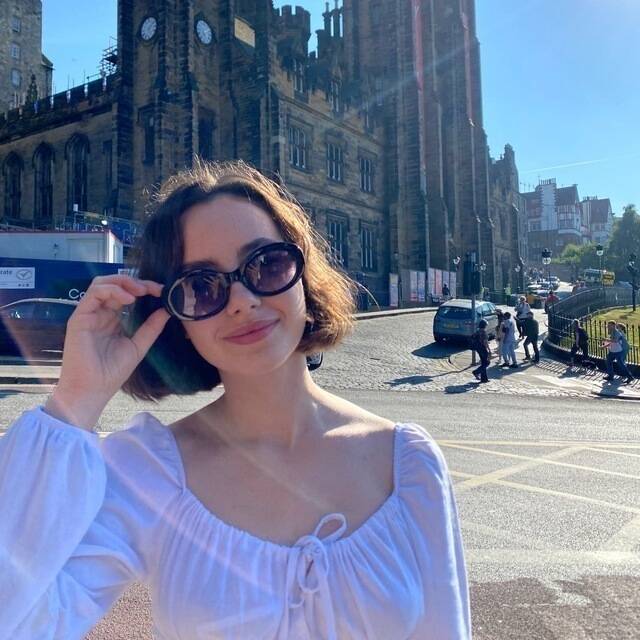
Alexandra in Edinburgh, Scotland. Photo: personal archive
How do you now assess the decision to evacuate to Scotland?
Positively. Unfortunately, there are problems with work in Ukraine now, but here I can work and help my parents. I’m safe now, I don’t have to worry about it.
Have you participated in protests in support of Ukraine?
Yes. In May of this year, I was at a protest in Krakow. It is important for me to participate in protests in support of Ukraine, mainly, to support those people who remained in their homeland. I think it is important for them, but for us… We should talk about Ukraine, call on the world community not to forget about the war that is still going on. By the way, every evening I hear the war in Ukraine being discussed on the radio.
What do the changes that happened in your life after February 24 mean to you?
I understand that until this moment I didn’t have the opportunity that I have now: to study and live in Great Britain. But I also realize how nice life was before the war: I could see my family and communicate live with friends. And now I don’t feel at home.
What are your plans for the future?
Next year I plan to enter the University of Edinburgh. I don’t have time to do it this year. I study English with a tutor every week. I like this country despite the terrible climate. Everything is very organized here.
I want to tell the Ukrainians who remained in their homeland that they are incredibly courageous and strong.
Support Ukraine now!
The large-scale Russian invasion of Ukraine has been going on for 6 months. During this time, the Russian occupiers destroyed and damaged thousands of residential buildings. About 5 million Ukrainian men and women became refugees. Many Ukrainians found themselves under occupation. People do not have access to clean drinking water, quality communication, food and a safe place to live. To support Ukrainians follow this link.
Translator: Bohdana-Nikolietta Terekhina


