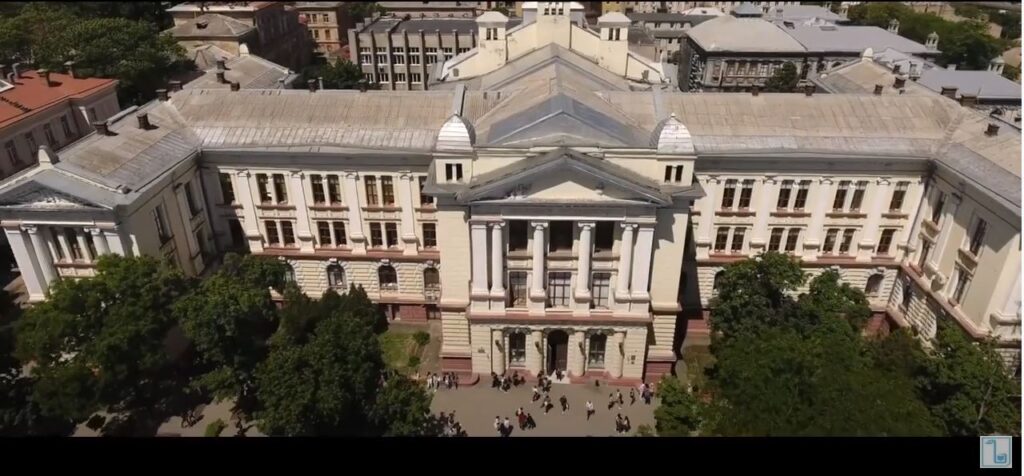
Medicine is an important area of life at all times. Odesa National Medical University (ONMedU), founded in 1900, is one of the higher education institutions that provides training in this field. The university currently has more than 5000 students.
Despite the importance of acquiring practical skills in the medical field, the university still introduced online learning during the Covid-19 pandemic. However, later, as the world adapted to the coronavirus, Russia launched a full-scale invasion of Ukraine. Then ONMedU, like most universities in the country, switched to online learning. However, today the university has resumed teaching within the walls of its institution.
Students of this university, Olena, Krystyna and Victoria, shared with us their experience and opinion about offline learning during a full-scale war.
All names have been changed for privacy reasons.
In what format did you study before the full-scale invasion? How do you think this has affected or will affect your qualifications? In your opinion, how good was the offline training?
Olena: Before the full-scale invasion, we studied online in the first year due to covid, and in the second year we had a mixed schedule, meaning that we studied offline and went online for 2 weeks when someone was sick with covid. In 2022, when the full-scale invasion began, we studied online for a year and a half. Now we are in the 4th year and we have the opportunity to attend classes offline, which I was very happy about. We missed out on some practical skills, but I think we will be able to catch up.
Krystyna: Before the full-scale invasion, we had mixed learning: both online and offline. It all depended on the level of Covid-19 incidence in the group. In fact, I think what we missed most during online learning was live communication with teachers and peers and working on some practical skills. How has online learning has affected/will affect our studies? I think that everything depends on the student and his or her desire to be a doctor. Everyone’s result depends on this. Offline learning is actually very interesting. Teachers are different: some are stricter, some are kinder, but the knowledge is presented in a good format. Most likely, in this case, we can only worry about some lack of sleep and a lot of information for one day/night, but here we can do nothing but learn.
Victoria: The main form of study at my university was online. First of all, this format was established because of the COVID-19 pandemic, which made offline learning dangerous for the health of the students of my institution. In my opinion, the quality of student training has dropped significantly. Unlike the theoretical format of student training, which was established at the proper level, the lack of practical training had a negative impact on the quality of knowledge of students at my institution. The lack of practical training directly affects the learning and memorisation of information provided by teachers.
How have the realities of your studies changed since the full-scale invasion? Did your university help you? Do the teachers help you?
О: It was hard at first, getting up for classes in the morning after the night attacks. Did our university help us? Yes, they didn’t mark absence or presence in class, we didn’t have to work out a missed class or a failed grade, some departments cancelled tests after the topics we had covered. Were the teachers accommodating? Many were very understanding, but it all depends on the person.
К: After 24 February, life changed dramatically, but we still had to study. Some teachers themselves were confused and did not know what to do, but later everything went back to normal – no one cancelled classes. Still, the university met us halfway: they introduced some privileges, such as the cancellation of absences that could not be made up, and cancelled classes during the air alarms, but we had to study missed topics ourselves. Milestone tests were cancelled, but exams and differentiated tests remained, there we were treated loyally. And, of course, it’s clear that we were on an online programme.
V: In the first days of the full-scale invasion, the university provided assistance to its students in every possible way. There was a comprehensive, active support, ranging from general psychological assistance to individual work of teachers with students. Of course, understanding the complexity of the situation in the country, teachers understood our needs.
During the active hostilities, Odesa was subjected to heavy shelling. Tell us, how did you experience it as a resident of Odesa?
О: Of course, at first we were scared and had no idea what to do next. I was with my family and it made the situation much easier. We often slept in the hallway at night, went to every alarm, the alarms could last for 5 hours. So often we studied/worked sitting in there under the explosions.
К: At the beginning of the full-scale invasion, I had to leave Odesa, but I returned in August. The winter was the hardest for all of us because of the blackouts. Everyone’s situation here is different, but for me, for example, it was like this: during a blackout, the water went out, but the gas remained. There was no internet or any mobile connection (I live outside the city), so I had to go to the nearest coffee shop to attend classes and not miss anything. Later, we installed fibre optics, which allowed us to stay in touch during electricity outages, and we connected power banks to it to make the charge last longer.
During some of the explosions, everyone has already developed their own reaction: I’m very calm about it, but I think it’s because of chronic stress, when the body has already adapted, cortisol and adrenaline are released. This has really hampered my instinct for self-preservation, but to be honest, we are all very tired of it. Still, it’s unbearable to live in the unknown, not knowing where the rocket is going to land, and when you hear the sound of a missile whizzing by, you selfishly exhale and thank God it’s not in your house.
V: The first days of the full-scale war were accompanied by intense fear and personal concern for the lives and health of relatives and friends. Almost 2 years after the start of the full-scale war, the internal experience has significantly decreased and emotions do not take the form they used to.
You are currently studying offline, attending classes directly in the university building. Tell us, have there been any situations when an air alarm sounded during classes and what did the administration do to protect students?
O: Yes, it happened more than once. What did the administration do to protect the students? They told us to go to a safe place, if offline we could go to a hallway where there were no windows or to the shelter. When it was online, some departments cancelled classes, some took a break for an alarm, sometimes continued classes from a safe place.
К: Yes, there were several times when there was an air raid. The departments are quite responsible, so we sit either in the basement or in the shelters themselves. But it so happens that the alarms usually occur at night, so we often come in not having slept. The administration has prepared shelters for us and an order that we have to follow during an alarm. The same applies to the departments.
V: Currently, our training format is offline. For our safety, the administration of the educational institution has allocated a shelter where students are placed during an air raid.
Tell us about your feelings about your studies. Do you have any misunderstandings about certain decisions made by the administration, or do you support the idea of offline learning?
O: After so much time studying online, I really missed the live communication with patients and teachers and I like the idea of an offline format. Now there is a possibility of blended learning and everyone chooses what is more convenient for them. If a person is abroad, he or she can inform the administration and easily study online.
К: This is actually a very interesting question for me. I think the administration has made a pretty good choice: the first two years of students stay at home for their own safety, and starting from the third year, everyone goes to offline learning.
On the contrary, I like offline learning. I like to gain knowledge. I like this connection between teachers and students. I like to be in society, to communicate with patients, to support them in such a difficult time for all of us. We gain practical knowledge so that in case of emergency and danger we know how to act and react (and in our situation this is very important). In addition, our university conducts first aid training for both students and civilians (using new American standards). So I’m more in favour of face-to-face training than not, because it benefits us.
V: Yes, I actively support the idea of offline learning. The transition to an online format due to the pandemic and then the escalation of the war had negative consequences, consequences that I can still observe today – the lack of practical skills that are essential for an experienced specialist. And although active hostilities are still taking place, this is not a reason for the loss of experienced specialists in various fields in the country.
During the full-scale war in Ukraine, missile strikes have hit not only civilian infrastructure but also residential buildings and educational institutions. The occupiers are killing all social groups of the Ukrainian people, including children and teenagers.
That is why learning offline is dangerous. Nevertheless, a large number of educational institutions have decided to continue education in the classrooms of their premises under their own responsibility.
If you are a pupil or student, make sure that your institution has a clear plan of action in case of an air alert.
Translator: Alina Maler


