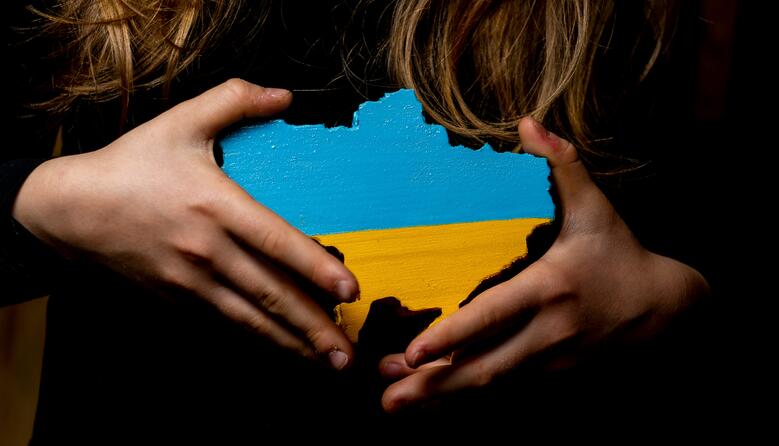
Ultimately we want to tell stories of young Ukrainians who are trying very hard and actually contributing something of their own to making the world a better place, adding value to their communities, other people’s lives (so it doesn’t have to be purely about the war, although that’s of course the most relevant topic today).
We will pay a lot of attention to those young people who, despite great challenges and difficulties, continue to make their contribution to the future victory of Ukraine. We’re going to tell the stories of our volunteers who are helping refugees, distributing food, setting up funds to help the needy, and organizing various events (including abroad) aimed at helping Ukraine.
We will tell the stories of young journalists who go to destroyed towns and villages and talk to local people, we will write about young people who have joined various NGOs and are working to make this world a better place, including by helping their own country and people during a great war. We will collect stories from those who lived under the Russian occupation and ask them what it was like, what they experienced and so forth. Furthermore, we will focus on the experiences and a proactive attitude of our youth during the war with the Russian aggressor. But we will also think about the long-term perspective. We will ask them about their hopes and wishes for the future and, of course, what steps they are taking today to make this future a reality.
Project objectives
Target audience
The project is designed for a wide target audience. At the same time, our priority is to reach young people aged 15 to 35, who will shape the future of Europe and the world for the next 20 years.
Who will implement the project
The project will be implemented by the NGO “Student Journalism Platform”. The founders of this organization are students and teachers of V.I. Vernadsky Taurida National University, which was founded more than 100 years ago and worked in the Crimea for about 100 years. As a result of the Russian occupation in 2014, TNU was displaced to Kyiv, and now it has more than 2,000 students. Many students and teachers of the university have the status of temporarily displaced persons, i.e. came from the occupied territories – the Crimean Autonomous Republic, Donetsk and Luhansk regions. So, they know well from their own experience what war is like, have their own stories of independence, freedom, and resilience.
In 2021, the NGO Student Journalism Platform launched the #TruthfulReporting website, which aims to publish articles (in Ukrainian and English) by students of TNU and other Ukrainian universities on a wide variety of issues: ethics, human rights, international relations, youth policy, student life, history, and culture. Following the large-scale Russian invasion of Ukraine in February 2022, members of the NGO “Student Journalism Platform” called on students from across Ukraine to join the War Diary project to capture the events, actions, and feelings of people during the war. Students of the National University of Kyiv-Mohyla Academy, Taras Shevchenko National University of Kyiv, Ostroh Academy National University, and Lviv Polytechnic National University, Volodymyr Dal Eastern National University and other universities responded. In total, a team of about 40 participants gathered – future journalists, editors, translators. Many of them are currently living abroad, for example in Canada, Austria, and other countries, but they continue to raise the topic of Ukraine and the war and encourage others to support our country and people.
We’ve been able to successfully complete this project “War Diary”, and now we aim to develop a new grant project “Ukrainian youth is changing the world” that will focus primarily on the actions of our young people dedicated to our victory.
Start date / date of completion
The project will last for 3 months: 01.07.2023–31.12.2023. By the end of the grant project, we will have published 26 stories. Also within two months after its completion, we’ll prepare and send a final report to the Fritt Ord Foundation showing how the grant money has been spent and what we’ve been able to achieve during this period.


