I’m Tetiana Komisarchuk, the wife of Artem. He’s a former serviceman and a person with a first-group disability and an amputation. I’m his strong support.
Tetiana, tell us how it was for you to go through all of this, because I can’t even imagine what Artem went through, but I understand it was just as difficult for you, since you had to be support both for yourself and for him. And if you have a kid, then of course raising the child as well.
Well, actually, yes, there are completely different lives during one injury in a family. When Artem went to the military recruitment office on February 24th, I was 95% sure they wouldn’t take him. He had a second-group disability. I thought: “God, there are such long lines, where would they take him?” I thought: “Okay, go ahead,” because I understood that he wanted to, he’d warned me about it. If war started, he’d go. We’d been prepared for this for several months before it all happened.
They didn’t take him once, then a second time, a third, and he calls me on February 26th and says, “Well, congratulate me.” “On what?” I thought maybe they had given him a final refusal, and he says, “I’m in the Armed Forces of Ukraine.” He said it so proudly and honestly, from that moment on, I didn’t fully know how is he after captivity. We met about a year and a half after he was released, or almost two years. He kept that part of his life very private. He told me about it, but let’s say I didn’t fully understand it, because the war in 2014 was something I only knew about because a few of my friends had died. That’s it.
Then Artem joined the Armed Forces of Ukraine, put on his uniform, and I saw that his eyes were lit up, that he was happy to be there. His mother, of course, cried and asked me to convenience him, since she couldn’t. But I didn’t see why I should persuade him out of it. We had talked it through. Of course, I wouldn’t have wanted it to end the way it did. It could have ended worse, but I probably couldn’t have changed his decision. It was his man’s decision, and that was that.
But really, there was a certain period of time when he was still in Ternopil for training and preparation, and then there was the City Day of Ternopil… I remember it so clearly: everyone was celebrating, and I was standing there crying, because I had this feeling that I was saying goodbye to him forever. I don’t know why, but when he was leaving home, he gave me his keys for the first time in his life and just said, “I think I won’t need them anymore.”
We talked about all sorts of things: his death, where he would be buried. As adults, we talked about all these things before he left. A very short time passed after he left, probably a month and a half. I talked to him then. It was Pokrova (Intercession of the Theotokos), Defender of Ukraine Day at that time. I congratulated him. He seemed a little sad, I thought.
Then this absolutely shocking news for me, when I talked to him in the morning—everything was fine. Since I’m a volunteer, I had just bought him a car. He had asked for one, and I had brought a great car. The godfather of our child painted and fixed it up. I bought everything for that car, packed it up, and I said:
“Okay, Artem, the car is here, it’s so great. How should I send it to you?”
He was like:
“Just give me time until Sunday.”
I was so happy, running around buying him fleece gear, so excited to send it all. Then there was this knock on the door, which is still scary for me. Because no one had called me, no one had said anything. His commander had been wounded two weeks before him, and I only knew him and the numbers of a few of his guys. I realized that more than half a day had passed. It was 5 p.m., and I had talked to him at 10 a.m. I thought he just wasn’t online.
Then I opened the door and I saw a bunch of people standing there, my neighbor. I thought, “Oh, some kind of meeting, I guess, for the residents.” But everyone just had this blank expression. Just this wildly blank expression, without a single emotion. I went outside, leaving my child with my sister. And then… that phrase: “Your husband has been wounded.”
I just stood there, thinking:
“How? He spoke to me this morning!”
This woman who’s telling me this starts to cry. I say:
“Is he alive?”
And she says:
“Well, we don’t know. He’s badly wounded. He said you’d sort something out for him…”
And I just stare at her, my eyes wide:
“He said to contact my wife, she’ll handle everything.”
And I’m like:
“Okay…”
Of course, I was in shock. I couldn’t fully process that this had actually happened. I thought:
“The main thing is that he’d be safe and sound. Just safe and sound, that his head is okay…”
I thought, he could have called if everything was okay, and then I get in touch with the medic from his brigade. The medic says:
“Everything’s fine, don’t worry. Like, everything’s normal there. Something just tore up his butt a little, a bit here and there. But everything’s good, you’ll have to find a new place to hide your money.”
That phrase of his, he was trying to cheer me up, but it wasn’t encouraging for me at that point. I understood that something unusual was going on there. Then one of his brothers-in-arms calls me and says:
“Five wounded. Artem is the worst.”
I’m thinking:
“Okay. But why isn’t he answering?”
He says:
“Well, you know, he’s in surgery, they took his phone…”
So, they couldn’t tell me exactly what happened. Just:
“Something happened to his leg…”
That night, through contacts, friends, Ukrainian support channels, we finally got hold of his medical report around 10 p.m. I started reading… and I just couldn’t believe it. I start to really read the list of injuries. I see: every part of his body—head, arms, stomach, abdominal cavity, pelvis, right leg, left leg, fingers… just everything. I’m thinking, “God, there’s nothing left in one piece, I guess.” That’s why he isn’t answering. I don’t remember driving those 100 kilometers to his parents’ house. I don’t remember the road, anything. It was just a mode: I had to “handle things,” as he asked me to. I was constantly handling something. I immediately sent the van with that car to the guys that very same day, or the next day. And I always tried to keep myself busy with something. Just so I wouldn’t sit around and cry. That’s probably my personality trait: when I’m under a lot of stress or a big emotional shock, I can’t cry. I just have this focus on the one thing that needs to be done. It was on getting him moved closer to here, because our child was a year and a half old at the time, and I couldn’t go to him. My mom was crying, “Don’t go, you have a child, they’ll kill you there too.” Basically, everything was a mess. His mom said, “I’ll go.” Then, “They won’t let you in, don’t go anywhere.” They weren’t letting people into Kharkiv.
Then, from Kharkiv, he was just acting terribly. It was like he’d wake up, have some sort of hallucination, then fall back asleep. But he was calling us every two minutes once they gave him back his phone and every two minutes, he didn’t remember the previous call. It was constantly, “Get me out of here, they’re shelling us! Get me out of here, the hospital is on fire! It hit right in my room!” But we could hear that it was quiet there, the doctors were speaking calmly. There was a lot of that.
Then, in Sumy, we found out a fragment had gone all the way through his head and was stuck on the other side. A 7×7 mm splinter. The doctor calls us and says, “We were in shock! The whole hospital was watching how that fragment went through everything and didn’t even touch any vital vessels.” Just his nose a little bit, because he remembers that his nose was bleeding after he was wounded.
Artem: “So you handled it.”
Tetiana: “Yeah, I handled it with St. Peter. We sorted it out.”
After that, it was emotionally difficult, but I guess at that moment, the stress kept me going. I knew that at some point, that energy would just run out and there would be a backlash. And that backlash came when he finally got home.
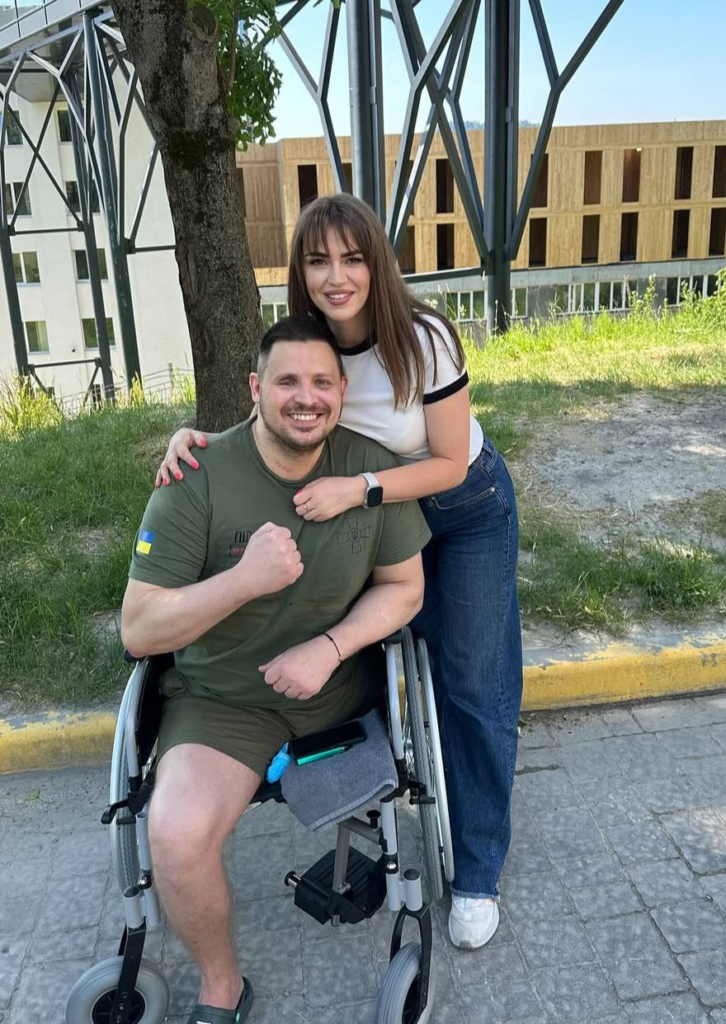
Probably it’s a standard procedure like that. It all hits when you can finally relax and breathe out. It’s impossible to breathe out. He’s still going through 10 more surgeries here after coming home, experiencing it each time.
“Went to see St. Peter two more times.”
Right. We always tried to live positively, to take all news positively. Although he really got on my nerves in those hospitals, because he really took all his anger out on me: he divorced me 10 times a day, then remarried me 10 times a day. Then blocked me, unblocked me. He didn’t know that I had his backup phone that he left at home. I unblocked myself right away and wrote again.
Artem: “You were transferring 2 hryvnias on Privat24 and writing in the comments, Unblock me, dammit, because when I get to that Gdansk, I’m going to kill you'”
Yes, in Gdansk, he really had over 100 surgeries, probably. They were very difficult, and we didn’t understand the scale of it because it was just one of many. When the nurses started writing to me, “Tania, we’re all praying,” I was like, “Oh no…”
I didn’t make it to one operation there. It happened to be such a complex operation, already almost at the end. After six months of staying in Gdansk, a doctor came out to me, our doctor from Ukraine, he’s been working there for a long time. He was incredibly supportive. For me, it was such relief that he spoke Ukrainian, and I at least understood what was happening to him. After six months he says: “It seems there’s no more threat to his life.”
I go: “What, there was one?”
He goes: “Well, yes…”
I didn’t even know his life was in danger. I thought everything was okay. Tthen we made that decision. It was really hard for me to travel every month. You just go to Poland, it’s a long trip, you go for a week, then you come back, you send humanitarian aid to the East, you spend a week on that, then the little child, kindergartens… It all just piled up like that.
He was also pressuring me. Like: either he doesn’t see snow, or the rain isn’t falling right for him because he wants to look at it up close. We always dreamed that we’d walk around Gdansk. I say: “I’ve already studied all the spots here except the shops, of course. I already know where I’ll take you in the wheelchair. We’ll walk around here, we’ll go by the sea…” We always tried to find some positives in this.
I’d come, he’d say: “Yeah, the sea is close here. We’ll go there in the wheelchair.” Good, good, we’re waiting for the sea.
Well, we didn’t get to it, of course. But someday we’ll go there on your two legs.
We breathed a little easier already, but then the amputation happened. We breathed a little easier in Gdansk because there was already such a routine. They came out and told me, “Well, let’s just say the surgery didn’t go exactly as planned.” He had a very deep infection in his hip.
They told me that he probably wouldn’t survive the surgery. He’s alive. I heard it was time to say goodbye to the leg first when they brought it out. I looked at his last name and I thought, “God, that’s it. This is it. There’s no turning back…” The anesthesiologist simply told me that his condition was critically serious. And, well, like, “You’re young, prepare for the worst.”
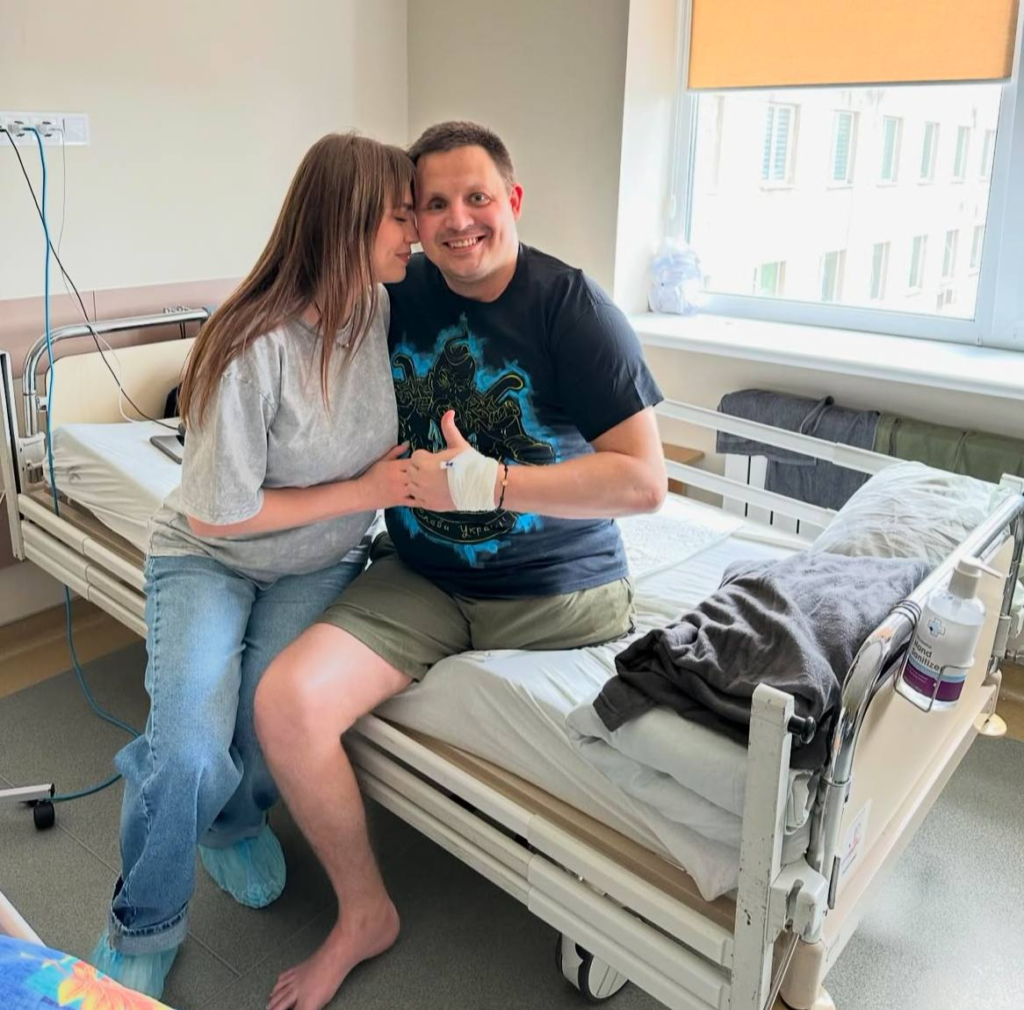
And I’m like: “We’re screwed!” How is that? I actually supported him in this. It turns out I myself wheeled him to that surgery. Then this stress just hits me. How? No! This isn’t real. This is impossible! Like, who? He can’t. He’s not a mortal to me! They beat him there, shot him, tried to finish him off. Then he went to war again and got blown up. We actually found out later that his organs were falling out through his leg. His heart stopped twice during the evacuation. I’m saying, “And what? And just like that after all that he’s going to go and die?”
I stood up and said, “No, God, don’t say that. We’ll sort everything out right now. He has to come back!” Well, and the next day, they let me in to see him in intensive care, of course to say goodbye. Just to look at him. I knew they weren’t just taking me in to look at him, because his condition wasn’t improving. I talked to him for a bit.
I said, “They cut the leg off just fine, don’t worry. Better than we planned!” I looked and he was moving his fingers. I said, “Everything’s great!” He was showing me something with his fingers. I asked the doctor, “What is he showing me? Is he doing okay?” The doctor says, “No. I think he’s showing you a heart.” And I was like, “Oh, okay,” and I did a heart sign back.
Well, the next day, the anesthesiologist comes in and says, “Oh, your Artem is so talkative!” I said, “I was up all night, crying. He’s back?” Just so suddenly. He says, “Yeah! He was talking to us already.” I go in, and he’s entertaining everyone in the intensive care unit.
Of course, everyone had already arrived. Because it was very difficult to break that news to his parents. I had told them myself, “Go home. I’ll stay with him. Go, I’m staying in Lviv.”
Well, and here they tell me at night that he’ll probably die. I think: “God, they survived captivity. They’ve already buried him a bunch of times somewhere in their heads, and he’s their only son!” I think: “How am I supposed to tell them this?” I call mom and I understand that I can’t say the words to her. I say: “Everything’s bad.” His mom just starts screaming into the phone. I say: “He’s alive, but not so well. Come to Lviv.”
I realized that maybe I told mom about this wrong. Dad immediately took the phone. But I heard mom’s scream, how she was crying. I say: “I’ll keep you updated.” Mom says: “For the first time, I wished you wouldn’t call me… And all my friends, we all wished you wouldn’t call us at night.
In the morning, our anesthesiologist friend says, “I was praying not to see your call.” My godmother, too, “Nobody wanted to see a call from you because we knew what that call would be…” But I probably wouldn’t have called anyone anyway.
That’s why in many interviews, when they ask us how we live now, how our life is going. I always say that the support of wives, mothers (if there are no wives), and close loved ones is really important.
Because Artem was right, he said, “For me, it’s just they gave me a shot, I fell asleep, and then I woke up. But those 9–10 hours, or that full day you just don’t exist.” I once said that for the first time, I felt my body not processing things. Like, you don’t hear your body: I couldn’t feel my legs, my sense of taste; they gave me food, but it tasted like cotton. That’s when I realized that I probably went through a bigger stress than his injury. That was probably the biggest stress. But it’s okay, everything is slowly coming along. We somehow pulled the whole situation together, as they say, we gathered our emotions.
There was just this one funny situation. I go into the intensive care unit the next morning, when he’s already conscious. Of course, I hadn’t slept. I’d been crying all night, I was swollen (and I’m one of those people who doesn’t go to the store without makeup). And I walk in, and he says:
“So?”
I’m like:
“Everything’s great, the surgery went great?”
He says:
“Uh-huh. And I’m in the ICU.”
And I say:
“Well, you’re always in the ICU, don’t worry. This is your standard procedure, didn’t you know?”
And he says:
“No, you’re not wearing makeup, you’re swollen, everything is not great.”
And I say:
“No, you were dying.”
He says:
“Oh, here we go again.”
I say:
“This time it was really bad.”
But he says:
“Well, I came back.”
I say:
“Well, good. But you have to fight a little more because they told me you were still dying.”
He says:
“Okay, I’ll keep fighting then.”
So we kind of turned it all into a positive thing, really, but it leaves a huge emotional residue.
Can you tell us about the specific steps you took to actually get back to your life? I’ve heard you mentioned psychotherapy, but maybe there was something else, because there are a lot of people who need your experience.
Look, honestly, I personally haven’t gone through psychotherapy, although I probably should have. I did use the services of my husband’s psychologist in Gdansk, but these were, let’s say, informal meetings. It wasn’t about breaking down a problem or specific therapy.
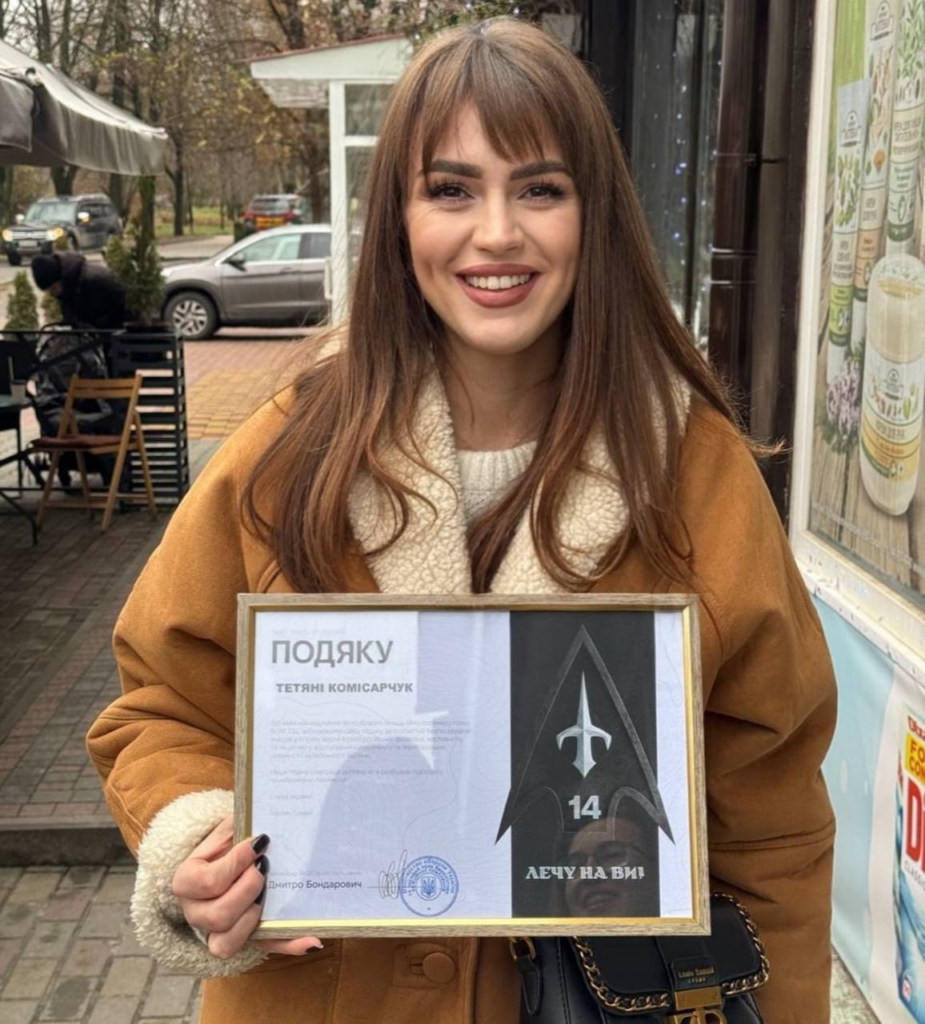
What really pulled me through was my volunteering. I talked with his comrades as much as possible. I have a lot of guys I work with, who would encourage me by saying, “You’re strong, you’re doing great, there’s no one better than you.” And I’d be like, “There’s no one better than me. That’s it, I’m great.” But then I’d think, “Nah, I could do more.”
Artem supported me at the same time, because he always praised me. The guys would call him, and thank me for helping them. That gave me a huge emotional boost.
Translator Yuliia Melnyk


